.webp)

Browse all resources
Thank you! Your submission has been received!
Oops! Something went wrong while submitting the form.
Storytelling

Scatterbrain Synesthesia
From The Watchmen to creative problem-solving, here’s how embracing “scatterbrain synesthesia” can unlock your next big idea.

It’s 4:23 in the morning and I’m sweating up a frenzy on the stairstepper. It’s all about the serotonin. I’ve got a thing for it.
Overloaded from sensory input from the eight different plasma televisions in my field of vision here at Planet Fitness, I’m feeling a bit like Ozymandias.
Ozymandias, you say? As in the character depicted in the 290-year old poem of the same name from Percy Bysshe Shelley (he of “look upon my works, ye mighty, and despair”)?
While that would be apt and applicable, I’m not in the mood to piss and moan about all that’s wrong in the world. Not today anyway. We’ll get back to solving all the world’s woes tomorrow.
The Ozymandias I’m referring to today is the retired superhero from The Watchmen graphic novel (and eventual motion picture), the brainiac who must retreat to his Mission Control-like lair stocked with a wall of TVs he uses to process the rhythm of the world intuitively in order to attempt to save it.
It’s not that I have a superhero complex, although I do have The Watchmen on the brain. And in re-reading it this weekend for the umpteenth time, I was struck by the powerful metaphor the character has to offer anyone in business, the creative arts, or anyone looking for a neat parlor trick.
Side note: my alternate title for this post was “Something To Think About When You Watch The Watchmen)”.
In The Watchmen, the Ozymandias character feels the pulse of the universe and then lets intuition take over to parse out the answer to the day’s most difficult problems. It’s a powerful technique that one can use to “riff” on difficult problems, and it may just make you better at “The Six Degrees Of Kevin Bacon.”
See, if you want to think outside the box, really, the easiest way is to just relax and allow your right brain to tap into a well-spring of idea flow. Six televisions tuned to different channels will nurture this mindset. I’m a big fan of coupling this with sustaining a heart rate of 150+ bpm. Some people use drugs and alcohol for a similar effect, which may explain why so many writers are alcoholics.
The goal here is to abandon linear thought and just let your right brain take over. If you resist the urge to regress to the logical left brain and tendencies of linear thought, your brain can achieve this Zen-like stasis. At some point you’ll have that “Aha!” moment…what some would call a moment of clarity…and it’s all the result of the right brain’s penchant for pattern recognition.
The really neat thing is that it will feel entirely accidental, but there’s nothing accidental about this technique. We have those lightbulb moments when we tap into the power of metaphor, what neuroscientists would call symbolic thought, which is the most powerful type of thought.
What I call “scatterbrain synesthesia” is a powerful tool to use in the quest for creativity. You’re more likely to gravitate toward this technique if you lean more toward the intuitive spectrum of thinking. But even the more logical and methodical among us can use this. In fact, I believe they are especially good candidates to grow through this technique, because they are less inclined to go there inside of their natural preferences.
Wikipedia defines synesthesia as “a neurologically based phenomenon in which stimulation of one sensory or cognitive pathway leads to automatic, involuntary experiences in a second sensory or cognitive pathway.”
The guardians of the world rarely engage in this style of “riffing.” However, employing this strategy can yield powerful results in myriad ways. In the world of entrepreneurship, it works very well if you are looking to forge an innovation model in your industry, or what we call “business topology” in the Wizard Of Ads vernacular.
And speaking of Wizard Of Ads, this is exactly what my business partner Roy H. Williams uses for such dramatic effect in the rabbit hole of his weekly Monday Morning Memo.
Bouncing from one idea to the next like a renegade pinball… letting the right brain go on a fishing expedition… eventually, you’ll come to the intersection of the hoodoo and the mojo. That’s the plan anyway.
Sometimes it feels like a convoluted mess. A fool’s errand, seemingly. Diarrhea of the mind. Not unlike this chapter, perhaps, which I am hopefully using to demonstrate the idea of which I speak.
And that’s the whole point. If you don’t make and take the time to give your right brain a serious, sweaty workout, then you’re really only using half of your brain. Or more accurately, you’re only using one of your two brains.
Customer Journey

You Can Quantify Trust
People trust numbers—even when they don’t tell the full story. Learn how to use strategic numbers to influence choices, drive sales, and shape perception in your favor.
People trust numbers. They trust them even when those numbers might not tell them the whole story. If something looks better numerically — higher ratings, bigger discounts, or more followers — people assume it’s the better choice, even if that’s not always true.
You can influence choices by showing numbers to make your products and services seem better. Here are three ways:
1. People Pick What Looks Better in Numbers
- Restaurants – A burger joint with a 4.8-star rating attracts more customers than one with 4.5 stars, even if the lower-rated place has better food.
- Colleges – A university ranked #15 in the country seems better than one ranked #20, even if the lower-ranked school has better programs for specific majors.
- Fitness Apps – A workout app with “10,000 downloads” looks more trustworthy than one that says “loved by thousands,” even if both are equally good.
2. People Pick What “Feels” Cheap or Expensive
- Subscription Service – “Only $1.99 per day” sounds cheaper than “$59 per month,” even though they cost the same.
- Car Lease – “$99 per week” feels more affordable than “$5,148 per year,” even though it’s the same price.
- Furniture Sales: “Save $400 today!” sounds like a better deal than “Get 10% off,” even though both discounts are identical.
3. People Use Numbers To Compare Themselves to Others
- Job Hunting – A LinkedIn post that says “500 people applied for this job” might discourage people from applying.
- Social Media – A TikTok with 2 million likes feels more important than one with 100,000 likes, even if the smaller one has better content.
- Gaming – A leaderboard showing “Top 1% of players” makes people more competitive than if it just said “Elite Player.”
You should show numbers highlighting its strengths whenever you want to sell something. If something is causing harm (like social media comparison), removing numbers might help.
Numbers change how we make decisions, and we help people make decisions.
Branding

Why Branding Is the Cheat Code for Long-Term Growth
Short-term ads bring quick wins, but real growth comes from branding. Discover why long-term campaigns create preference, profit, and sustainable success.

Let’s get this out of the way upfront:
Short-term advertising absolutely produces better short-term results.
If you’re only measuring results based on how many leads you create today, next week, or even next month, short-term sales activation is the way to go.
But you will reach a point where you can no longer grow based on short-term advertising alone.
The factors that short-term ads require for success work against healthy profit margins and sustainable campaigns.
What factors?
- An attention-grabbing deal, and
- Urgency
Now, if you’re selling a must-have service — like, say, heating & cooling or plumbing, etc.
Then the urgency is baked in.
But you still have to offer people a deal.
Because it’s almost impossible to win a last-minute sale based on preference.
If the customer had a preference, they’d have already picked you, rather than googling a generic keyword or receiving a direct mail offering from you.
So the key to long-term growth and healthy profit margins lies in creating that preference BEFORE the sale.
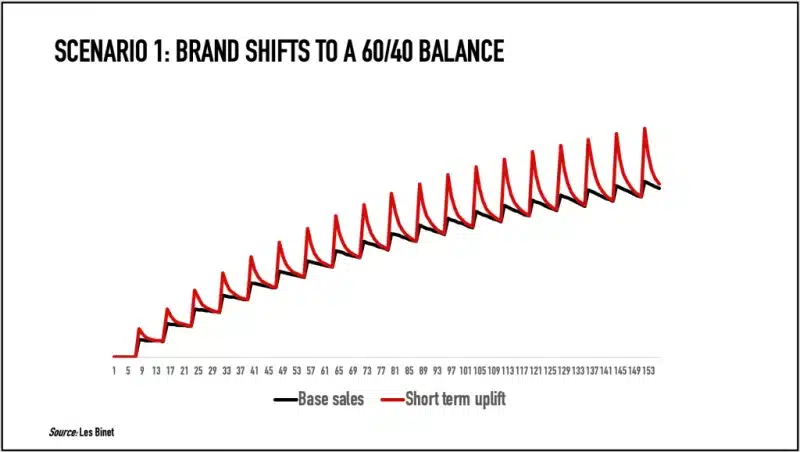
And that requires long-term branding, which is exactly what decades of the best data on the planet show, as you can see in the chart below:

This chart was created based off of over 30 years of data and thousands of case studies.
Now here’s the kicker — if you want to talk to an audience about a product or service that they don’t need yet, you have to gain their attention first.
And if your product or service is not inherently interesting — i.e., if it’s an unsexy or ugly-duckling business — then you’ll probably need to “push” your advertising in front of them.
That basically means using mass media combined with entertaining or interesting ads.
It also requires staying on the air long enough, and with enough frequency, for your branding to gain traction and bring in increased high-quality leads.
Can you bootstrap a business using guerrilla advertising and short-term offers?
Absolutely.
Can you grow that business big and profitable without, at some point, switching to proper branding?
Maybe, but maybe not.
If no one in your market is branding themselves over the air, and if you are branding your company but not yet running a branding campaign, then you can get pretty big.
‘Cause in the land of the blind, the one-eyed man becomes king.
But it’ll be a lot harder and growth will be a lot slower and a lot less ensured than if you were running a proper branding campaign.
So if your company is currently suffering from “feed-the-beast-itus” — if you’re struggling to get enough leads to sustain growth or even stay busy — then the answer is certain:
You need to invest in a proper, long-term branding campaign featuring high-impact messaging.
And here’s the kicker to that — the better your long-term branding works, the more that will lift your short-term sales activation efforts as well.
So the previous chart should actually look a bit more like this:
Storytelling

Creative Storytelling In Traditional Marketing. Your Brand Story is Your Unique Selling Proposition
Discover the timeless power of storytelling in traditional marketing and learn how a unique selling proposition (USP) can transform your brand.
The Story That Sells
In 2025, the advertising world is enamored with all the shiny digital bits—AI content, chatbots, and the blockchain of everything. But while the future glows with tech, the truth whispers something ageless: people still buy from stories, not education.
This isn’t a tale of the "next big thing" but a return to first principles. Enter BetterNest Solutions, a humble residential handyman business whose resurrection wasn’t from the nuts and bolts but from the feelings of storytelling.
The Struggle
BetterNest Solutions started as a small family business in 2010. They cleaned homes, repaired fences, and painted walls, but the story of why they did what do had never been told.
Competitors with slick apps and clever promotions drowned them out. By 2023, the business was on life support, and Maya Torres, the founder, had to make a choice: fade away quietly or flip the script.
Maya’s moment of clarity came not from technology but from a book on storytelling and a speech about "unique selling propositions." It wasn’t her services that needed reimagining; it was the story she told.
A Eureka Moment
At a 2023 marketing seminar, Maya learned the magic of building her Unique Selling Proposition (USP). She crafted a statement that resonated: "BetterNest: Because Your Home Tells Your Story." Her new brand wasn’t just cleaning homes; it was helping people create sanctuaries that reflected their personal identity. And it worked for Maya because she had always seen it this way.
The breakthrough wasn’t in an app or sales offer; it was the realization that Maya’s best customers didn’t care about what she did—they cared about why she did it. BetterNest wasn’t just a service; it was a partner in reflecting a person’s internal beauty in the pride of their home.
Traditional Wisdom
While competitors fought for digital ad clicks, Maya couldn’t compete with the cost of clicks. She decided to leverage the less fashionable traditional marketing channels to spread her message:
- Radio: Maya worked with Ryan Chute and his team at Wizard of Ads® for Essential Services to craft an evocative message for radio. Instead of listing services, the ads told stories of transformation—families hosting holiday dinners in fresh home designs, children playing safely in backyards of form and function. These tales turned listeners into loyal fans.
- Direct Mail: Maya sent handwritten notes to past customers, inviting them to "rediscover the joy of coming home." She included before-and-after photos of homes they’d serviced, anchoring her message in social proof and transformation inspiration.
- Community Events: BetterNest sponsored local Home and Garden Shows, where families went looking for inspiration on ways to make their house a home. These events showcased Maya’s expertise while embedding her unique brand into her community’s pride.
What Made It Work: The Brand Story as the Unique Selling Proposition
BetterNest's transformation was fueled by three principles:
1. Emotional Connection
Instead of selling "services," they sold the idea of a beautiful home that showcased the homeowner's identity. Customers didn’t just book a handyman; they bought a feeling—a sense of pride, status, and belonging.
2. Relentless Consistency
Every radio ad, direct mail piece, and event expressed their USP. "Your Home Tells Your Story" wasn’t just a tagline; it was their guiding principle.
3. Unexpected Value
BetterNest offered intentional "extras" like art pieces that helped “finish” the space perfectly. These touches surprised customers and reinforced the brand’s commitment to service.
The Results
Within 19 months, BetterNest grew its revenue by 170%. Their client base expanded not because they spent more but because they connected deeper with a much larger audience from radio. One family hired them for a single repair, and ended up booking a full-scale renovation. Why? Because they believed BetterNest understood their vision to reflect their unique identity.
Brand Lessons
In an age of AI and automation, the timeless truths of advertising’s first principles shine brighter than ever:
- People crave authentic stories: Data may inform decisions, but stories inspire them.
- A great USP is your compass: Your brand guides every decision, ensuring your message remains clear and resonant, making it your most powerful USP.
- Traditional media is alive and well: Radio, print, and events deliver unmatched emotional power when paired with the right narrative and repetition.
Moving Forward
As BetterNest looks ahead, their plans aren’t just about growth—they’re about legacy. The team is creating a podcast to share homeowner stories of transformation, expanding their direct mail campaigns, and exploring partnerships with local artisans.
For Maya, the mission is clear: keep storytelling at the heart of everything they do. After all, homes may be built with bricks and beams, but they live in the memories and emotions of those who dwell within them.
And that’s a story worth telling.
Customer Journey

Time Is The Great Validator
Marketing isn’t about quick wins—it’s about consistency over time. Discover why brand-building is like the Grand Canyon: slow, steady, and impossible to ignore.
“A river cuts through a rock not because of its power, but its persistence.” – Jim Watkins
Consider the Grand Canyon.
Without the help of Doc Brown, his trusty flux capacitor and a spare DeLorean to do some major time traveling over the course of 70 million years we can’t be exactly certain how one of the Earth’s most astounding natural features came to be. But we have some ideas, and the main culprits are water, wind, ice and more than a little bit of continental drift.
Really think about that: a hole in the Earth that’s 277 miles long, 76 feet wide and 85 feet deep in some spots got there because of what became the Colorado River… plus a whole lot of time.
Standing back and taking in the scale and scope of the Grand Canyon reminds us that consistency of effort over time can accomplish anything, whether you’re talking about a raging river or a calm creek.
Since none of us are here for a crash course in geology, let’s port that example over to the world of business marketing and how the hands of time are the best judge of where we’ve been and where we’re headed.
When it comes to building business and finding customers, there has to be some reliance on return on investment, analytics, and measuring results to ensure you’re not throwing hard-earned revenue down the drain. But a “measure everything!” mentality gradually turns every marketing message into a Pavlov’s dog scenario where nothing matters beyond making the phone and cash register ring within 30 seconds of transmission.
It’s transactional instead of relational.
Messages that are nothing more than calls to action dressed up with bells and whistles act to push customers your way, rather than helping them to choose your business by seeing you as the clear choice when their need arises for what you have to offer. Take away the treat, and Pavlov’s dog stops salivating pretty quickly.
For the foundational basics of building a brand, there is still nothing better than the use of consistent echo-and-intrusion advertising through broadcast to get your message on the minds of potential customers. Those messages keep your business at the forefront (or at least in the mix) of those who are bound to need what you’re selling at some point in their lives. And when they do, it won’t matter if you’ve got a sale or a new grand opening happening because they’ll simply know without thinking twice that you’re the place they can turn to.
That kind of marketing works because of consistency and repetition over time, but is easy to take for granted in favor of something flashy that gives you fast results you can point to. But to trust in the long-term results is to build a customer base that will be with you through just about anything.
When mankind was a long way off from walking the planet there was no one to realize that a gigantic canyon was forming in what would become Arizona merely as the result of a river doing its work. But with the benefit of time we can see how much is possible.
Branding

The Alchemy of Brand Awareness: Crafting Campaigns That Captivate and Endure
Discover the key elements of a successful brand awareness campaign, including storytelling, consistency, value proposition, data strategy, and engagement, to make your brand unforgettable.
Building brand awareness isn’t magic, but done well, it’ll feel like it. Brand awareness is a blend of strategy, creativity, and consistency. To make your brand unforgettable, you need a campaign that connects with your audience’s emotions, holds their interest, and anchors retention and recall.
So, what are the key elements that form a truly successful brand awareness campaign? Let’s dive in.
1. A Campaignable Story
At the heart of successful brand awareness lies a campaignable story. Your brand isn’t just about selling a product or service; it’s about offering a durable narrative that resonates with your audience’s conscious and subconscious needs. A great brand story not only demonstrates what your company does and how it makes a difference in the buyers' lives but also why you do what you do.
A powerful story will create a deep connection with your audience, making your brand more desirable. It should reflect how the owner intended to serve their buyers, helping your customers see the values you will die defending for the benefit of the consumer and self-inflicted consequences of the brand. The narrative should be authentic and aligned with your mission to resonate with your audience at the human level.
For example, Call Dad is an HVAC brand that instills the values of a dad caring for their children. Whenever something bad happens, we lean into the trigger of calling dad to come fix it. From goofy dad jokes, to how dad handles the situations of life, we impart the notion of when you’re dealing with something bad, call dad.
The takeaway: Craft a story that connects emotionally with your audience. It should be authentic, relatable, and aligned with what your brand stands for.
2. Consistency Across Brand Impressions
Brand awareness relies on recognition, retention, and recall, and this comes from consistent repetition. If your audience encounters your brand in different places—whether on mass media, your website, or in ads—it should feel like they are meeting the same brand everywhere. Your visual style, messaging, tone, and voice should be congruent to avoid confusion and build a memorable connection.
When your brand feels consistent, whether through your design elements or the language you use, people begin to remember and trust your brand more easily. Consistency builds familiarity, and familiarity reinforces trust—an essential element in successful brand awareness.
For example, we have a client that speaks about the “YouTube expert” in every ad. Each one leading to hyping, and general chaos, if it weren’t for the level-headed advice of the business owner. With the campaign well under way, we have now created the YouTube channel of the proverbial “YouTube expert” offering said advice.
These videos will serve as an additional entertaining layer to the established campaign that we will refer to in social media and email content. This not only deepens the brand narrative, it also adds context to an otherwise vague reference with highly shareable content.
The takeaway: Consistency is king when building brand awareness. Ensure your messaging and visuals are coherent across all platforms to reinforce your identity and get in front of your audience as frequently as possible each week.
3. Clear Value Proposition
Brand awareness is never about just getting people to recognize your logo—it’s about convincing them your brand matters more than your competitors. A strong brand clearly communicates the distinct advantage of aligning my personal brand alongside your brand. When your brand is a badge of honor, I will proudly patronize your shop.
A clear value proposition compels your audience to care. It is way more than a catchy slogan; it answers the question why. If you want to be remarkable, you have to do something markable first.
For example, Home Service company, Maverick, celebrates a maverick in each of their ads. By identifying and then aligning with what a Maverick is, they both identify as a maverick and become a beacon for those who identify as mavericks, too.
The takeaway: Make sure your value proposition speaks directly to the needs and desires of your target audience. It should clearly answer the question,
“Why should I choose you?”
4. Engagement, Not Just Exposure
Brand awareness doesn’t stop at getting your message in front of people. Engagement is where the magic happens. When people feel connected to your brand, they become your advocates.
Social media, reviews, and user-generated content (UGC) are all opportunities to engage prospects and previous clients, but the real money is getting an appointment and running the call. Until a prospect sees you in action, all you’re doing is dancing.
Certainly encourage interaction with your audience through likes, shares, comments, and 5-star reviews. Just don’t forget that the real magic happens when you do something they would give you money for.
People don’t want to be sold, but they do want to buy when the value you offer is worth more than the cost of their money, effort, and time. The most engaged a customer can be is when you’re in their home making a lasting impression. When you knock their socks off, you’re most likely to earn a brand ambassador.
For example, a plumbing company on the outskirts of Dallas has risen to $5 million in revenue in 2.5 years by not sweating the small repairs. When they go out for a service call, minor repairs requiring very little time and no real parts are done for free.
During meaningful repairs, they always look to find and do a minor repair for free as well. This has earned them a sound word-of-mouth reputation for under-promising and over-delivering, quickly making them the local brand of choice.
The takeaway: Don’t just focus on impressions—focus on creating revenue-generating opportunities that turn into remarkable interactions. Engagement builds trust and loyalty, and that's what drives lasting brand awareness.
Brand awareness is essential for disproportionate new client growth and long-term retention of previous buyers. Therefore, brand awareness is more than just a clever idea—it’s an ongoing process that requires strategy, consistency, and emotional connection.
To be successful, your campaign should tell a campaignable story, be consistent across all impressions, communicate a clear value proposition, and foster genuine engagement. When you get these elements right, you don’t just raise awareness—you build a lasting relationship with your audience.
No results found!
Frequently asked questions
Questions? We’ve got answers.
Why Wizard of Ads for Services?
Are you ready to transform your business into a distinctive, emotionally resonant brand? Here's why hiring Ryan Chute, Wizard of Ads for Essential Services is the game-changer your business needs:
Distinctiveness Beyond Difference: Your brand must be distinctive, not just different, to stand out. We specialize in creating an emotional bond with your prospects to make your brand unforgettable.
Building Real Estate in the Mind: Branding with us helps your customers remember your brand when they need your service again, creating a lasting impression.
Value Proposition Integration: We ensure that your brand communicates a compelling value proposition that resonates with your audience, creating a powerful brand-forward strategy.
Who Should Work with The Wizard of Ads for Services?
Wizard of Ads for Essential Services start by understanding your marketing challenges.
We specialize in crafting authentic and disruptive brand stories and help build trust and familiarity with your audience. By partnering with Ryan Chute, Wizard of Ads for Essential Services, you can transform your brand into one people remember and prefer. We understand the power of authentic storytelling and the importance of trust.
Let us elevate your marketing strategy with our authentic storytelling and brand-building experts. We can take your brand to the next level.
What Do The Wizard of Ads for Services Actually Do?
Maximize Your Marketing Impact with Strategic Alignment.
Our strategy drives everything we do, dictating the creative direction and channels we use to elevate your brand. Leveraging our national buying power, we ensure you get the best media rates for maximum market leverage. Once your plan is in motion, we refine our strategy to align all channels—from customer service representatives to digital marketing, lead generation, and sales.
Our goal is consistency: we ensure everyone in your organization is on the same page, delivering a unified message that resonates with your audience. Experience the power of strategic alignment and watch your brand thrive.
What can I expect working with The Wizard of Ads?
Transform Your Brand with Our Proven Process.
Once we sign the agreement, we visit on-site to uncover your authentic story, strengths, and limitations. Our goal is to highlight what sets you 600 feet above the competition. We'll help you determine your budgets and plan your mass media strategy, negotiating the best rates on your behalf.
Meanwhile, our creative team crafts a durable, long-lasting campaign designed to move your brand beyond mere name recognition and into the realm of household names. With an approved plan, we dive into implementation, producing high-quality content and aligning your channels to ensure your media is delivered effectively. Watch your brand soar with our comprehensive, strategic approach.
What Does A Brand-Foward Strategy Do?
The Power of Strategic Marketing Investments
Are you hungry for growth? We explain why a robust marketing budget is essential for exponential success. Many clients start with an 8-12% marketing budget, eventually reducing it to 3-5% as we optimize their marketing investments.
While it takes time to build momentum, you'll be celebrating significant milestones within two years. By the three to five-year mark, you'll see dramatic returns on investment, with substantial gains in net profit and revenue. Discover how strategic branding leads to compound growth and lasting value. Join us on this journey to transform your business.
Ready to transform your world?
(do it - you
deserve this)
deserve this)