Browse all resources
Thank you! Your submission has been received!
Oops! Something went wrong while submitting the form.
Marketing

Target Audience Analysis for Contractors
Map homeowner decision-making with demographic, psychographic, and behavioral research. Replace guesswork with strategic audience analysis for contractors.
Target audience analysis gives service contractors a real map of how homeowners decide, built from demographic, psychographic, and behavioral research instead of a guess dressed up as a pay-per-click strategy. Business owners and contractors who learn how prospects actually think, instead of chasing keywords, earn the kind of brand recall that outlasts a single ad click. That's what turns a spot in Google's 3-Pack into real Main Street recognition, and turns undecided shoppers into customers who keep coming back.
What Will You Gain From This Analysis?
The first thing you get is a clear picture of the right homeowner, built by combining demographic, psychographic, and behavioral data into one usable profile. Skip this step, and a contractor ends up aiming advertising at everyone, which means connecting with no one. Target audience analysis exist to close that gap before a single ad ever airs.
The stakes here are higher than most contractors realize. The average person absorbs roughly 10,000 advertising messages a day, enough noise to drown out a generic pitch before it even registers. A furnace repair ad thrown into that noise can't just exist; it has to be built to be remembered, not merely placed. Analysis is what tells you which words, tones, and channels actually cut through that clutter for a specific homeowner segment.
What does the analysis actually produce?
The output is a strategic blueprint: it names the specific group a contractor's business is trying to reach, and pairs that with the psychological mechanics that make advertising persuasive to that group. Instead of guessing at messaging, owners walk away with a documented understanding of how their ideal customer thinks, decides, and responds.
That blueprint typically delivers:
- A defined audience profile combining location, life stage, and behavior patterns
- Insight into the psychological triggers that make an offer feel trustworthy
- A messaging direction built for recall, not just a one-time click
- A foundation for creative that stays consistent across every channel
Why does this matter more than another PPC campaign?
Paid clicks vanish the moment the budget runs dry. A brand message built on real audience analysis keeps working in memory long after the ad has stopped running. Contractors who understand what actually drives their audience's decisions build advertising homeowners remember at the exact moment a pipe bursts or an AC fails, instead of advertising that gets scrolled past and forgotten.
Why Do Demographics Alone Mislead Home Service Business Owners?
Age, income, and zip code can't predict who picks up the phone first when a furnace dies at 2 a.m. A broken heating system on a cold morning creates the same emotional emergency no matter the bracket or the neighborhood. The retired couple on a fixed income and the young family with two incomes both panic the same way when the house goes cold. No spreadsheet of demographic averages captures that shared moment of dread.
What happens in the homeowner's mind during an emergency?
Panic overrides price comparison. In that moment, a homeowner grabs the phone and calls whatever name feels familiar, not whichever ad bid the highest. Demographic targeting assumes a rational shopper weighing options; real homeowners default to recognition under stress. That one behavioral fact exposes the limits of age-and-income targeting better than any dataset ever could.
Advertising itself splits into two camps, and demographic lists only serve one of them. Informative advertising, built on facts and features, is one of the two most popular advertising types, but it only speaks to the rational buyer. Persuasive advertising, built on emotional recall and brand familiarity, wins in the moment demographics can't reach: the panic call.
Genuine Target Audience Analysis Services close that gap by layering in what demographics omit:
- Interests and values that shape which brand feels trustworthy
- Beliefs and attitudes toward hiring outside help
- Buying habits during both routine maintenance and emergencies
- Preferred media channels where recognition gets built before the crisis hits
Contractors who lean on age and income brackets alone are chasing a shopper who barely exists. The homeowner who actually matters is the one in crisis, searching on instinct, not spreadsheet logic.
What Tools Do You Need To Start?
A documented process for examining advertising has to come first, before a single new campaign gets written. Contractors and marketing leaders need a real method for determining what effect an ad has on homeowners, not a guess about what sounds clever in a meeting. Skip that diagnostic step, and new creative just repeats old mistakes instead of correcting them.
Target Audience Analysis Services supply exactly that method. The work starts by reviewing the ads already running, to see how they're shaping what prospects think and want. That review is a diagnostic skill, not a creative flourish, and it has to happen before a single new script gets drafted. Skip it, and you're writing blind and hoping the market responds.
Why does analysis have to come before creative writing?
Successful marketing research demands a documented, clear understanding of the target audience before any ad gets built. Contractors who skip this step end up with content that feels good in the office but never lands with the homeowners who actually call for service.
What does the analysis actually produce?
Applied correctly, this diagnostic work generates more leads, more sales, and more profit. The output isn't a report that sits in a folder gathering dust. It's the foundation every future ad, call script, and landing page gets built on.
The toolkit itself is simple to describe, even if the execution takes discipline:
- Collect every existing ad the business has run, across every channel.
- Examine each one for the effect it had on consumer behavior, not just its look or tone.
- Document the gaps between what the business said and what the audience actually heard.
- Translate those findings into a written audience profile before writing begins.
That sequence protects the budget, and it protects the brand's voice from drifting every time a new campaign launches.
How Do You Map Emotional Buying Triggers?
Emotional buying triggers surface the instant a furnace quits on the coldest night of the year. A homeowner shivering under blankets asks one instinctive question: who can I trust right now? That single moment of panic, not a feature list or a price point, is the real trigger contractors need to map before writing a single ad.
Mapping starts with a sequence, not a guess. Each step builds on the one before it, and skipping any of them weakens the whole map.
- Identify the moment of crisis. Pinpoint the exact circumstance, a broken AC in August or a flooded basement at midnight, that pushes a homeowner to search for help.
- Separate facts from feelings. Informative advertising leans on facts-and-figures messaging to convince an audience a product solves their problem, but facts rarely move someone mid-emergency.
- Connect as a consumer, not a prospect. Precise identification of the audience comes first; only then can messaging land on a human level instead of a sales pitch.
- Catalog wants, needs, and expected value. Document how homeowners make purchase decisions and what added value they expect from a service call, from speed to reassurance.
- Match copy to the trigger. Write ad language that speaks to trust and urgency rather than specifications.
What makes emotional triggers different from standard marketing data?
Standard data measures clicks and demographics; emotional triggers measure fear, relief, and trust at the point of decision. Target Audience Analysis Services exist to translate that difference into usable creative direction, mapping the feeling behind the search instead of just the search term.
Why do facts-based ads fail during home emergencies?
Facts-based ads assume a calm, comparison-shopping buyer, but an emergency strips away all patience for specifications. A homeowner facing a broken system wants reassurance first and details second.
How Do You Capture Auditory Memory Cues?
Capturing auditory memory cues starts with building a sonic signature: a repeatable sound, phrase, or jingle that lodges in memory long before a homeowner ever searches for a plumber or an HVAC crew. Contractors who skip this step lose the call the moment a prospect opens a map app and scrolls through a crowded list of look-alike listings. Google Maps now functions as the modern storefront, and ranking high there only delivers real visibility once a brand already lives in memory. That digital Main Street stays packed with undecided shoppers, and only the name already anchored in recall earns the tap and the call.
Before building an auditory identity, marketing leaders should run a round of Target Audience Analysis to confirm which sounds, phrases, and cadences actually resonate with the homeowners the business serves. Skip that groundwork, and you risk a jingle that sounds generic instead of one the brand can own.
Follow these steps, in order:
- Define the one or two emotions the brand wants homeowners to feel during an emergency call.
- Draft a short phrase or sound mark built to repeat across every call center greeting, radio spot, and video script.
- Test the phrase aloud with staff and real customers before locking it into paid campaigns.
- Repeat the cue across every touchpoint for a full media cycle before judging whether recall took hold.
Why did print directories disappear so fast?
Print directories vanished from households almost overnight once search engines took over, proof that attention always migrates toward the easiest channel to recall. For decades, households reached for directories organized by service category rather than brand name, a habit any distinctive audio identity now has to override.
Does a jingle still matter in a digital-first market?
Yes, because the same recall mechanics that made category directories obsolete now reward brands that own a sound. Homeowners search for a name they already remember, not a category they have to scroll through.
How Do You Build A Homeowner Persona?
Building a homeowner persona starts with research, not assumption. Contractors and marketing leaders define the exact household calling for repairs, replacements, or new installs, then build messaging around how that household actually behaves. Guessing at an audience just wastes media spend. Any business that wants to win at marketing has to understand, recognize, and actively target its specific audience instead of guessing at it.
Persona development follows a sequence, not a brainstorm session. Every step builds toward one outcome: turning an undecided homeowner into a paying customer.
- Define the core target group first. Persona work should always tie back to converting a visitor into a buyer, which means identifying that core group with precision before writing a single ad.
- Map the homeowner's triggering moment. Pinpoint what happens right before someone searches for a plumber, an HVAC tech, or an electrician.
- Document decision patterns. Note how the household compares providers, what stalls the decision, and what pushes it forward.
- Align the persona to brand voice and media channels. The persona should dictate where dollars go and what the ads say, not the reverse.
Target Audience Analysis Services from Wizard of Ads for Essential Services, headquartered in Halifax, NS, build these personas directly for contractor clients, turning raw homeowner behavior into usable creative direction. A ten-person team keeps that research tightly coordinated across every phase, from discovery through media buying, so nothing gets lost between strategy and execution.
What makes a homeowner persona different from a typical buyer profile?
A homeowner persona centers on urgency and trust, not just demographics. Most essential service calls happen under pressure: a broken furnace, a leaking pipe. The persona has to reflect decision-making under stress, not leisurely browsing behavior.
How Do You Apply Insights To Media Buys?
Media buys succeed when persona research dictates channel, message, and timing, not the other way around. Homeowners don't dig through directories for help anymore, so media dollars need to follow them into the digital and broadcast channels built for recall, not into outdated listings nobody opens. Target Audience Analysis Services translate raw persona data into a buying blueprint that media planners can execute with precision.
The process follows a defined sequence:
- Map the persona to channel habits. Identify where the target homeowner actually spends attention, broadcast, streaming, search, or social.
- Match creative tone to the moment. Decide whether the message needs to inform or persuade; that choice depends entirely on the business goal and the situation being targeted.
- Align the Google Business Profile with persona language. A cleaned-up profile becomes a first impression, a source of social proof, and a conversion engine once persona insights shape its content.
- Lock in buying power before launch. Secure placements that reinforce the message across every touchpoint simultaneously.
Should informative or persuasive creative run first?
Neither format wins universally. An informative approach suits a market that doesn't yet recognize it has the problem. A persuasive approach suits a market that's ready to choose between providers. The persona research is what tells you which stage the target homeowner is in.
Does Google Business Profile optimization belong in a media plan?
Yes. A profile shaped by persona insight becomes a digital storefront. Skip that alignment, and you waste the recall built everywhere else by paid and broadcast media.
Wizard of Ads for Essential Services builds this sequencing into every buy, so strategy, not guesswork, decides where dollars land.
What Mistakes Undermine Audience Analysis Results?
Three mistakes sabotage most audience research: chasing SEO jargon instead of strategy, treating every homeowner as identical, and stopping at surface demographics. Home service businesses that fall into these traps burn ad budget on tactics that generate clicks but never build lasting brand recall. Correcting course takes a disciplined, repeatable process, not another shortcut.
Why does chasing SEO tricks waste marketing budget?
Confusing SEO jargon promises fast rankings but delivers results that don't last. A strategic, sustainable approach built on real audience insight outperforms magic-trick tactics every time, because it targets the homeowners most likely to call instead of gaming an algorithm.
How does treating all homeowners the same hurt results?
Lumping every prospect into one bucket erases the real differences between an online-savvy single professional, a budget-conscious working family, and a high-earning homeowner researching from a mobile device. Target Audience Analysis fix this by separating those groups before a single message gets written. Contractors avoid this mistake by following a clear sequence:
- Segment prospects by income level, household type, and age range.
- Identify how each segment shops: mobile-first, desktop research, or word-of-mouth.
- Match messaging and media channel to each segment's behavior.
Skipping the deeper layers, attitudes, interests, values, lifestyle, only compounds the problem. A contractor who knows nothing beyond a prospect's zip code is still guessing at what actually triggers a service call. Engagement patterns, not just demographics, show which homeowners respond to urgency, which respond to trust-building, and which need both.
The fix stays the same in every market: build a strategic, sustainable, service-driven presence instead of reaching for whatever ranking trick is trending this quarter. Audience analysis done right protects the budget and builds the kind of recall that outlasts any algorithm update.
FAQ
What is target audience analysis for home service contractors?
It combines demographic, psychographic, and behavioral research to map how homeowners actually decide, replacing the guesswork common in pay-per-click targeting. The result is a detailed customer profile that drives measurable marketing results.
Why do demographics alone fail to predict customer behavior?
Age, income, and zip code can't predict who calls first during an emergency, like a furnace dying at 2 a.m. Homeowners across every bracket and neighborhood panic the same way when they're facing an urgent crisis, and that panic overrides price comparison.
How does audience analysis improve a contractor's advertising?
It identifies which words, tones, and channels actually cut through the daily clutter of advertising messages homeowners see, building brand recall that outlasts any single ad click.
Conclusion
Target audience analysis transforms contractor marketing from reactive guesswork into strategic precision. By mapping homeowner personas across demographics, psychographics, and behavior, service businesses align every message, channel, and dollar to the moment of greatest need. The result is a brand homeowners remember first when crisis strikes, not because of clever tactics, but because strategy drives every decision. This disciplined approach builds lasting market leverage and the kind of trust that outlasts trends.
Marketing

Direct Mail Marketing for HVAC Contractors
Weekly direct mail campaigns for HVAC, plumbing, and electrical contractors. Proven carrier-route prospecting and retention strategies that drive consistent.
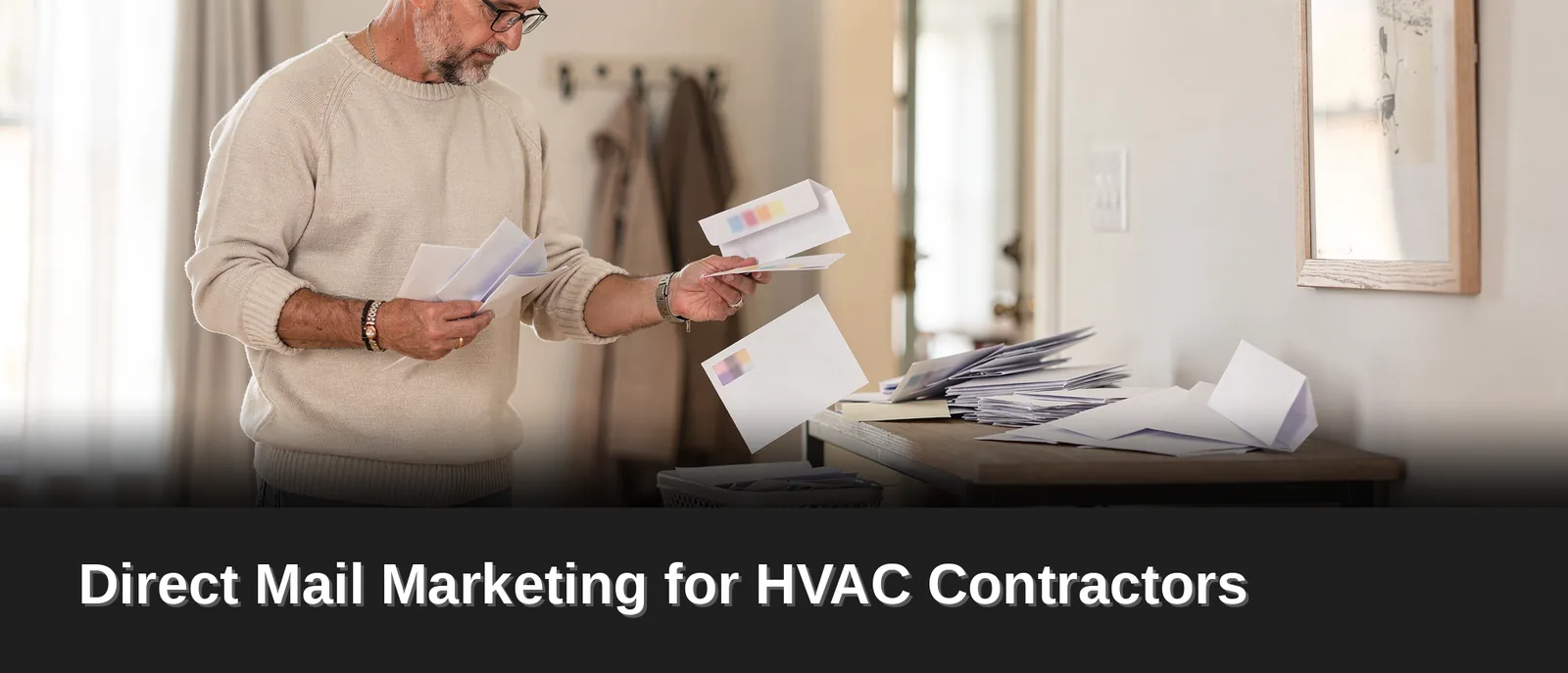
Effective direct mail strategy for HVAC, plumbing, and electrical contractors requires repeated weekly mailings, not one-and-done postcards, paired with consistent brand messaging across every touchpoint. Service businesses see stronger results combining carrier-route prospecting with radius. Retention campaigns targeting new homeowners, building the recognition that turns a single mailer into reliable, repeatable call volume over time.
Key Takeaways
- Weekly direct mail campaigns acquire and retain more customers through data-driven prospect carrier route mailings.
- Radius, Retention, and New Homeowners programs target specific customer segments for HVAC, plumbing, and electrical services.
- Direct mail products include both paper and plastic options to maximize response rates and brand visibility.
- Fast Track Postcard service delivers quick-turnaround campaigns for essential services contractors seeking immediate market penetration.
Why Does Generic Direct Mail Get Ignored?
Generic postcards get ignored because homeowners have trained themselves to stop seeing them. Most contractor marketing, including the standard coupon mailer, looks. Interchangeable that recipients file it as junk before reading a single word. A discount offer with a furnace graphic and a phone number blends into every other flyer sitting on the kitchen counter. Invisible coupons mailed to homes routinely fail to capture any real attention.
The math makes this worse, not better. The average American encounters roughly 10,000 advertising messages a day. A bland postcard has almost no chance of breaking through that noise. HVAC postcard marketing that looks like every competitor's mailer simply adds to the pile recipients have already learned to tune out.
Brands that get remembered take a different path:
- They surprise recipients instead of pitching them.
- They delight before they sell.
- They make the mail piece feel like an event, not an ad.
That distinction separates a home services direct mail campaign that builds brand equity from one that funds the recycling bin.
Does Mailing Once Ever Work?
Rarely. Sending a single piece of direct mail and stopping is almost always a wasted investment for service companies. One mailer, however clever, struggles to compete with the 10,000 daily impressions that vie for attention.
What Makes Direct Mail Memorable Instead of Disposable?
Memorable mail breaks the pattern recipients expect from contractor advertising. Direct mail marketing for HVAC companies, direct mail for plumbers, and electrical contractor direct mail all succeed on the same principle: surprise earns a second look, and a second look earns a call.

What Makes a Home Services Direct Mail Campaign Work?
A winning home services direct mail campaign combines consistent weekly mailing, sharp audience targeting, and bold creative that refuses to blend into the stack. Three elements separate results-driving campaigns from forgettable postcards: frequency, targeting, and distinctiveness.
Weekly prospect carrier route mailings form the backbone of effective direct mail marketing for HVAC companies, plumbing contractors, and electrical businesses. Consistent weekly drops build the repetition brand memory requires, rather than a single blast hoping for a lucky response.
Targeting determines who receives that mail in the first place. Radius, retention, and new-homeowner targeting strategies help direct mail for plumbers and electrical direct mail campaigns reach households statistically primed to need service soon: recent movers, past customers overdue for maintenance, and neighbors near a completed job.
Does frequency matter more than targeting?
Neither element works alone. A home services direct mail campaign built only on frequency wastes spend mailing people unlikely to respond. Targeting without repetition, meanwhile, fails to build the recall that drives calls when something breaks.
Why do generic postcards underperform?
Templated, me-too postcards get tossed with the rest of the day's mail before a homeowner reads a single word. Guerrilla-style marketing proves bold ideas outperform big budgets. Pieces built on timeless persuasion principles beat generic layouts almost every time.
This is the strategic lens Wizard of Ads for Essential Services brings to HVAC postcard marketing: distinctiveness engineered on purpose, never left to a printer's default template. The payoff shows up in direct mail ROI contractors can actually measure, booked calls, not vanity impressions.

Should HVAC, Plumbing, or Electrical Companies Try Direct Mail?
Direct mail earns a place in the marketing budget only when owners treat the decision as strategic, not experimental. Service companies evaluating direct mail marketing for HVAC, plumbing, or electrical operations face a real investment question: does the channel deserve real dollars and real time, or does it get tested once and abandoned?
That single-test instinct sinks most campaigns before they start. Owners often ask to run one mailing, see what happens, and decide later whether more makes sense. A mail program built on that logic rarely produces the data needed to judge performance fairly. direct mail ROI contractors chase gets buried under a sample size too small to mean anything.
What should a contractor decide before committing to direct mail?
The choice starts with a harder question: what does the business actually want to build? Owners weigh three outcomes: revenue, reputation, or genuine community impact. Most companies want all three, but one has to lead the strategy.
That priority shapes which advertising approach fits. Marketing splits into two dominant camps:
- Informative advertising: built to educate prospects and drive action through facts and clarity
- Persuasive advertising: built to move emotion and build long-term brand preference
Does the right approach differ for electrical contractors versus plumbers?
Goals, not trade labels, determine the right path. Whether the business runs electrical contractor direct mail, direct mail for plumbers, or a broader home services direct mail campaign, the same rule applies: strategy comes before creative, and creative comes before stamps.
How Do You Measure Direct Mail ROI for Contractors?
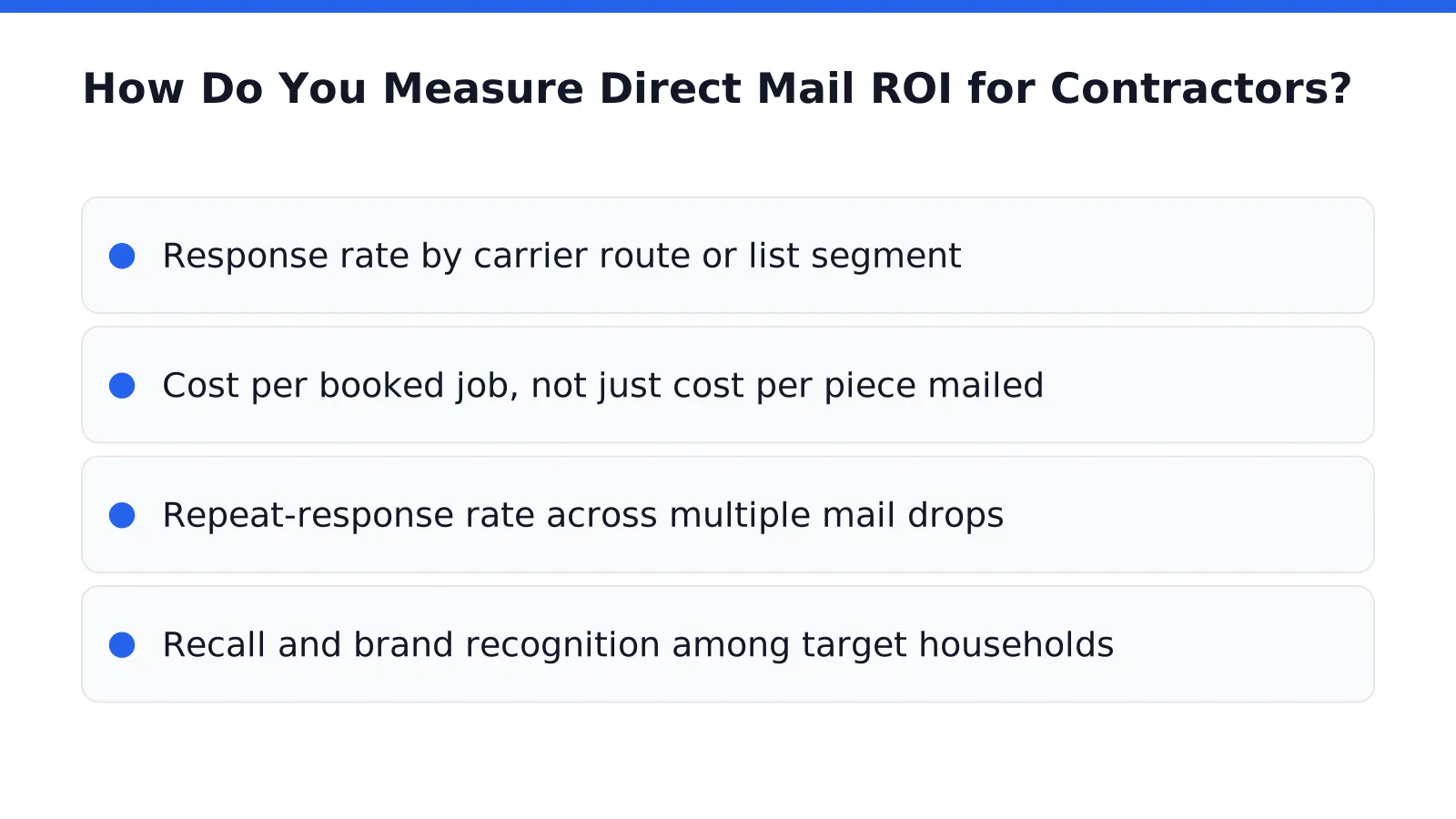
Direct mail ROI for contractors comes down to tracking which pieces generate calls, then comparing that cost against revenue from booked jobs. Many contractor mail programs collapse at this exact step. Owners spend on printing and postage, then have no reliable way to connect a specific postcard to a specific phone call, leaving the entire home services direct mail campaign running on guesswork instead of data.
Tracking failure usually starts upstream, with the list itself. Batch-and-blast mailing lists spray a wide radius with no segmentation. HVAC postcard marketing dollars get spent on households unlikely to ever need a repair or install. Contractors running direct mail marketing for HVAC companies see stronger ROI when targeting replaces mass distribution.
Why do most contractor mail campaigns fail to show ROI?
Most campaigns fail because tracking gets bolted on as an afterthought rather than built into the mail piece itself. Without dedicated phone numbers, codes, or response paths tied to each drop, owners cannot separate the mail piece that worked from the one that got tossed. That blind spot makes every renewal decision a guess.
What actually improves ROI on contractor mail?
Analyzing performance data reveals how messaging influences homeowner decisions, which sharpens the next list pull and the next creative draft. Electrical contractor direct mail and direct mail for plumbers campaigns both improve when creative applies neuroscience-based memory triggers, anchoring the brand in a homeowner's mind instead of landing in the recycling bin. Measurement should track:
- Response rate by carrier route or list segment
- Cost per booked job, not just cost per piece mailed
- Repeat-response rate across multiple mail drops
- Recall and brand recognition among target households
Contractors who treat tracking as a design requirement, not a reporting afterthought, turn mail spend into a measurable growth channel rather than a recurring expense with no visible return.
What's the Smartest Direct Mail Strategy for Growth?
Growth comes from treating mail as one instrument in a larger orchestra, not a solo act. Postcards alone rarely move revenue; coordinated campaigns do. The strongest home services direct mail campaign sits inside a multichannel marketing strategy. Mail builds awareness, pulls in new customers, and strengthens retention alongside other channels.
Strategy has to come first, creative and channels second. When strategy sets the direction, mail design, call center scripts, and digital content all say the same thing in the same voice. Misaligned touchpoints confuse prospects and bleed trust before a truck ever rolls.
Should contractors drop PPC for direct mail instead?
Dropping pay-per-click entirely is not the recommendation; rebalancing the budget is. Many contractors overspend on costly, unpredictable PPC auctions while under-investing in direct mail ROI contractors can actually track and repeat. A smarter mix leans on direct and organic search, supported by national buying power that secures better media rates than a single-location business can get alone.
What does a strategic rebrand add to mail campaigns?
A rebrand gives mail something worth remembering. One HVAC brand grew revenue substantially by owning its local airwaves through a strategic rebrand paired with memorable radio messaging.
The lesson transfers directly to paper: a postcard tied to a forgettable brand gets tossed. One tied to a distinctive identity gets kept on the fridge. Smart growth strategy includes these elements:
- Treating electrical contractor direct mail and HVAC mail as part of one coordinated brand system
- Matching direct mail for plumbers messaging to call center and digital scripts
- Letting rebrand work make mail memorable, not just mailed
FAQ
Why does a single direct mail piece fail to generate results?
One mailer cannot compete with the roughly 10,000 daily ad messages homeowners see. It gets lost before building any brand recognition or repeat call volume.
What strategies help target the right homeowners for HVAC, plumbing, and electrical direct mail?
Radius, Retention, and New Homeowners programs focus mailings on specific customer segments, combining carrier-route prospecting with targeted messaging to drive consistent response.
How can contractors make their direct mail stand out from competitors?
Successful campaigns surprise recipients, delight before selling, and turn the mail piece into an event rather than a generic coupon ad that blends into the pile.
Conclusion
In closing, direct mail remains a powerful lever for essential service contractors who commit to strategic consistency and authentic messaging. When your brand voice aligns across every touchpoint, from the envelope to the follow-up call, you build the trust. Recall that turns prospects into loyal customers. The contractors who dominate their markets aren't chasing trends. They're anchoring themselves in the minds of homeowners through disciplined, memorable storytelling. Your direct mail campaign succeeds when it reflects who you are and why you matter.
Advertising
Local SEO for Home Service Businesses
Rank in Google's 3-Pack and capture qualified leads. Wizard of Ads for Essentail Services delivers proven local SEO strategies for HVAC, plumbing, and electrical contractors.
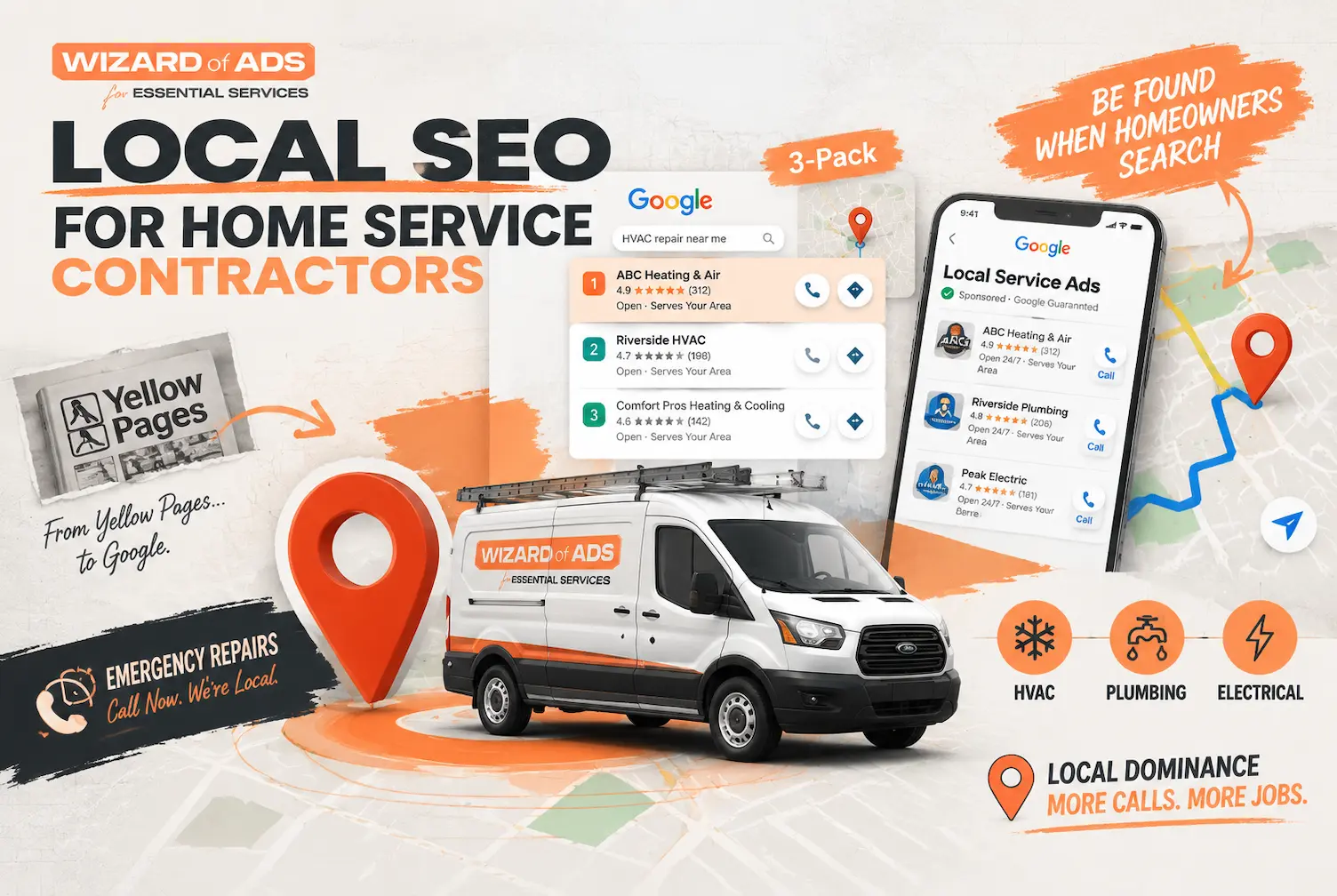
Local SEO for home service contractors comes down to three things: ranking in the Google 3-Pack, running Local Service Ads well, and showing up strong on Google Maps. HVAC, plumbing, and electrical companies win leads by claiming their spot on the map and catching "AC repair," "plumber," and "electrician" searches before competitors do.
Key Takeaways
- Home service contractors see measurable SEO results within three to six months of implementation.
- Local search dominates: homeowners tap maps, skim three reviews, then call contractors immediately.
- Google's AI filters now prioritize contractors appearing real, established, and trustworthy to customers.
Why Does Local SEO Matter For Contractors Now?
Almost every customer looks up a plumber, electrician, or HVAC technician online before dialing a number, which is why home service contractor SEO has become a growth essential. Homeowners search, skim a few reviews, and call whichever company looks established. A contractor invisible in that moment loses the job before a competitor even bids.
Local SEO for home service businesses closes that gap between searching and hiring. Website visits alone don't win the job — what moves revenue is phone calls, booked appointments, and jobs on the schedule. Built right, a local search strategy turns search intent into dispatched trucks.
Is weak advertising actually a targeting problem?
Rarely. Advertising rarely fails because it reaches the wrong people, it fails because it doesn't stick. Prospects forget a brand the moment it stops showing up. Most contractors don't need a bigger audience; they need sharper, more consistent visibility right where the decision gets made.
Why does this matter more now than five years ago?
Search behavior now boils down to a few fast decision points: a map listing, a review score, a click to call. Wizard of Ads for Essential Services helps essential service brands earn that recognition instead of chasing it. Contractors who treat local visibility as core strategy turn searchers into scheduled jobs before competitors even show up.

How Does Google Maps Replace The Old Yellow Pages?
Google Maps is the modern storefront window for home service contractors. A high ranking inside the map pack delivers the visibility a prominent Yellow Pages listing once guaranteed — except competition is fiercer now and the window to be seen is shorter. Ranking well decides whether a plumbing, HVAC, electrical, or roofing company gets found the moment a homeowner needs help.
For decades, printed directories were the go-to tool for finding household services. A homeowner with a leaking pipe or broken furnace flipped through the pages, scanned the bold-print ads, and dialed a number — until real competition showed up.
Why Did Yellow Pages Disappear So Fast?
Search engines dismantled the printed directory business almost overnight. As Google became the default place to find services, phone books disappeared from households faster than the industry expected. Contractors who leaned on directory ads lost that channel outright, with no transition to adjust to.
What Does a Homeowner Do Instead During a Service Emergency?
A homeowner facing a broken air conditioner or a flooding basement doesn't reach for a directory anymore. The phone comes out right away — a quick search names the problem, surfaces nearby providers, and ends in a call within minutes.
That shift changes what visibility actually means for contractors:
- Local SEO for home service businesses now occupies the position directory ads once held.
- Map pack placement replaces bold-print listings as the trust signal homeowners scan first.
- Speed matters more than ever—searches happen in real time, during active emergencies, not weeks in advance.
Contractors who treat map visibility as optional are competing with one hand tied, chasing a customer base that already moved on.
What Makes Your Google Business Profile A Storefront?
Google retired the old "Google My Business" label years ago; contractors still calling it that are working from an outdated playbook. The correct name today is the Google Business Profile, or GBP, and treating it like a plain directory listing costs plumbing, HVAC, electrical, and roofing companies real revenue. Google Business Profile optimization is where a real contractor local search strategy starts.
A well-optimized GBP does three jobs at once: it's a digital storefront, a trust signal, and a booking engine, all in one search result. Prospects size up a contractor before ever clicking through to the website.
Why does the profile double as a storefront and a sales tool?
Homeowners scanning map results aren't browsing — they're deciding. The photos, reviews, hours, and services on that profile carry the same weight a clean storefront window carries on Main Street. Skip the polish, and a competitor with a sharper profile wins the click, the call, and the job.
The stakes climb even higher for essential service categories. Here's how ranking priority shifts with business maturity:
- Established brand with strong name recognition — Moderate priority; GBP supports existing demand.
- Newer plumbing, HVAC, or electrical company — Critical priority; often the primary discovery channel.
- Contractor with no prior brand-building — Essential priority; the 3-Pack becomes the storefront.
Why does the Google 3-Pack matter so much for newer trade businesses?
Companies without brand recognition depend heavily on strong local pack rankings for contractors, those top three map results carry the weight a known name would otherwise carry. Without a name to search for directly, prospects find contractors almost entirely through the 3-Pack. This is where local SEO for home service businesses starts: a neglected profile means being invisible right when demand shows up.
How Do Homeowners Actually Search For Emergency Help?
A broken furnace at midnight doesn't send anyone to a blog. Panic drives the search, not curiosity: open the map, scan a handful of reviews, dial the top result. No research phase, no comparison shopping, just a tap, a glance, and a call.
That exposes a hard truth for trade contractors. A business absent from searches like "HVAC repair near me" or "emergency plumber" loses the job before the homeowner finishes typing. By the time the phone rings, the map has already picked the winner.
What does a homeowner see in those first few seconds?
Three listings, a handful of star ratings, and how far away each one is; nothing else registers during a crisis. Local SEO for home service businesses exists to control what shows up in that narrow window, turning a profile into the obvious, trustworthy choice before a competitor gets the tap.
Why does ranking matter more than having a website?
A polished website means little if it never surfaces at the moment of need. Visibility in the map pack works like a digital billboard planted in the path of someone already searching for help. Contractors who treat that real estate as optional hand every emergency call to whoever occupies it.
The searches that matter share a pattern:
- Immediate-need phrases: "AC repair near me," "emergency plumber [city]"
- Location-anchored terms: service area names, neighborhoods, ZIP codes
- Trust shortcuts: star ratings, review count, response speed
Contractors who understand this map-reviews-call sequence build their local presence around winning it, not around ranking for keywords nobody types at 2 a.m.
Should Local Service Ads Replace Organic Search?
No. Local Service Ads (LSA) work best as a supplement to organic visibility, not a replacement. Google built LSA for businesses providing local residential services — plumbers, locksmiths, HVAC companies among them — helping homeowners find verified, trustworthy businesses fast. That makes it great for quick jobs but limited as a long-term growth engine.
Contractors chasing every paid click lose sight of what builds market share. Local SEO for home service businesses creates durable visibility that outlasts the ad spend. A sound strategy leans away from expensive pay-per-click campaigns and toward direct and organic search, backed by national media buying power.
Is LSA Enough on Its Own?
Rarely. LSA earns trust through Google's verification badge, but that trust lasts only as long as the ad budget does. Once spending stops, so does the visibility — organic rankings and brand recognition don't disappear the same way.
What Should Contractors Prioritize Instead?
Owners chasing sustainable lead flow need both channels working together, not one replacing the other.
- Local Service Ads: fast visibility for residential service categories, verified-business trust signal, pay-to-play model
- Organic and direct search: compounding visibility, brand equity that outlasts ad spend, less dependence on rising click costs
Smart operators treat LSA as a short-term bridge while organic authority builds underneath it. Skip the foundation to chase paid placement, and a contractor is exposed the moment competitors outbid them. Brand-first businesses don't rent their visibility — they own it.
How Long Until SEO Delivers Real Leads?
Real momentum from search optimization shows up within three to six months for most home service contractors. In highly competitive trades — crowded HVAC or plumbing markets — it can take six months to a year before the phone rings with real frequency. Patience separates contractors who build lasting visibility from those who give up too soon.
Local SEO for home service businesses means optimizing a website for customers inside its actual service area, not a vague national audience — a distinction that matters for roofers, electricians, and general contractors competing block by block, not state by state.
Why does the first few months feel slow?
Search engines take time to trust a new or newly optimized site. Those early months build foundational signals — content, structure, local relevance — before rankings climb. Slow doesn't mean broken; it means the groundwork is going in for results that compound later.
What happens once rankings improve?
Earning the number-one spot on Google often decides whether a homeowner calls that contractor or a competitor. That single ranking position carries outsized weight in emergency-driven trades like plumbing and HVAC repair.
Three factors accelerate the timeline:
- Content depth — informative, facts-and-figures content builds trust and gives prospects reasons to choose one contractor over another.
- Competitive intensity — fewer competitors means faster ranking gains.
- Consistency — steady optimization outperforms sporadic bursts of activity.
Contractors who commit to six full months before judging results position their brand to own local search rather than chase it.
Why Does Structure Beat Rankings In 2026?
Rankings alone no longer protect a contractor's visibility. Structure — the underlying signals search engines trust — now decides who survives in local results. AI-generated answers didn't eliminate the need for a strong local search presence; they filtered it, rewarding clean, consistent digital foundations and burying the rest.
Google evaluates contractors faster than ever, deciding within moments which businesses feel real, established, and worth showing to a homeowner in crisis. That raises the stakes for any Local SEO for Home Service Businesses strategy — a number-one ranking earned last year is no guarantee today, since the algorithm rewards structural integrity over a static position.
Three signals determine whether a contractor stays visible or disappears:
- A complete, accurate Google Business Profile that reflects current services and hours
- Clearly defined service areas that match the search intent of nearby homeowners — the backbone of service area local SEO
- Consistent messaging across the website, directory listings, and call center scripts
Weak profiles, blurry service boundaries, and mismatched signals push contractors out of view right when demand spikes. A homeowner searching at night for emergency help never sees a business buried under inconsistency — the call is lost before the phone even rings.
What Makes A Contractor "Feel Real" To Google?
Consistency across every digital touchpoint signals legitimacy to Google's evaluation systems. Matching business names, addresses, phone numbers, and service descriptions builds the structural trust that rankings alone can't buy. Neglect that alignment, and competitors with weaker brand names out-rank by presenting cleaner, more coherent signals.
Structure, not position, decides who gets the call in 2026. Home service brands that treat local visibility as an ongoing discipline — not a one-time ranking chase — protect their place in front of ready buyers.
What Should Contractors Do Next To Build Brand?
Brand-building for contractors starts with pairing distinctive creative to durable media, not chasing another algorithm update. One HVAC company grew from pricing varies million to more than pricing varies million in revenue after a strategic rebrand paired with memorable radio let it own the airwaves in its market — an outcome that comes from creative built to be remembered, not just clicked.
Local SEO for home service businesses earns the calls that come in today, but memory wins the calls that happen months from now. Neuroscience-based creative principles trigger recall in ways search rankings alone can't reach. Mass media builds that recall by repeating a distinctive message until a homeowner's brain files the contractor's name under "the one to call."
How does strategy prevent wasted ad spend?
Strategy has to dictate creative and channel choices before a single dollar moves. When strategy leads, every touchpoint, call centers, digital content, mass media — tells the same story instead of ten different guesses.
What does a disciplined rollout actually look like?
Execution follows a defined sequence rather than a rush to publish:
- Uncover — pinpoint what makes the brand genuinely distinctive, not just different.
- Research — validate the story and the market before writing a single ad.
- Write — craft creative built for memory, not filler copy.
- Buy — secure media placement with clout and intent.
- Approve and Launch — align every channel before the campaign goes live.
That sequence protects contractors from the scattershot habit of running ads first and asking questions later.
Results compound with volume and discipline. A track record built on 211 satisfied clients and 109,033 ads produced shows what sustained, strategic output achieves over years, not weeks. Contractors chasing quick wins skip that discipline and rebuild brand equity from zero every time a campaign underperforms.
The next move: treat brand as infrastructure. Local search brings the homeowner to the door for one job; a distinctive, memory-triggering brand brings them back for every job after that and sends referrals along with them.
Conclusion
In closing, local SEO builds the digital foundation, but distinctiveness builds the demand. Search rankings capture homeowners who already know your name; a strong brand ensures more of them search for you by name at all. Contractors who align technical optimization with strategic, memorable storytelling stop competing for clicks and start owning their market. Treat local search as one instrument in a larger brand strategy, and every ranking, review, and impression compounds into lasting trust and recall.
Advertising

The Campaign Debate
Cute and clever ads get attention. Campaigns get remembered. Discover why the difference matters more than your budget—and what it actually takes to build a brand that surfaces at the moment of need.
Cute and clever gets you watched. A campaign gets you remembered.
And in a business where they don't need you until the day they really need you—remembered is the only one that pays the light bill.
Most businesses think they have an advertising problem. They don't. They have a memory problem. They ran a funny ad. People laughed. Nothing stuck. Six months later, nobody can name the company—or worse, they're confusing it with the competitor down the street.
In this episode, Ryan Chute, Chris Torbay, and Mick Torbay go to war with each other—and themselves—over one of the most misunderstood tensions in advertising: the difference between cute and clever and a real campaign. One's a great joke. The other's a relationship. And most brands are spending real money on punchlines that evaporate the moment the laugh track ends.
Chris makes the case for humor done right—and exposes why the real crime isn't cute and clever, it's cute and clever as a trend-chasing reflex. Mick defends the long game while admitting that in a landscape of boilerplate mediocrity, even a halfway decent joke is ahead of the pack. And Ryan ties it all together with the question no business owner wants to sit with: are you building a character, or just wearing a costume?
Episode Highlights:
- The Character vs. the Costume: Why a campaign builds equity and a one-off ad just gets a laugh at the 19th hole.
- The Competitive Landscape Test: Before you pick a tone, read the room. If your whole market is doing quirky dances, profound is your disruption.
- The Super Bowl Trap: Why the most-watched ad event in the world teaches brands the worst possible habits.
- Brand Tonality Isn't Optional: Guinness doesn't do cute. Mercedes doesn't do quirky. Know what your brand is before you choose your voice.
- Category Entry Points: The science of why the brand that gets remembered at 11pm on a Tuesday—when the AC dies—wins everything.
- Attention Is Cheap, Memory Is Expensive: Anyone can get three seconds of notice. The win is being the name that surfaces eight months later.
- The H.L. Bowman Standard: What campaignable cute and clever actually looks like when it's done with precision and commitment.
- The Optimal Number of Complaints: Why zero complaints means your ads are invisible, and why the target number is never zero.
🎧 Hit play if you're running ads that get attention but never seem to stick. This episode will show you exactly why—and what to do instead.
👉 Are your ads building a character people remember—or just wearing a costume they forget?
On this episode of Advertising in America, we're talking about campaigns versus cute and clever.
I'm a big proponent of cute and clever. I write a lot of material for my clients that embodies that tone. I'm hilarious, and humor sells. Humor disarms people and gets them to think about you and remember you and never realize they're actually internalizing someone's ad campaign.
Me, I'm taking the long game, and I'm not satisfied to allow my clients to succeed simply because their competitors are doing it worse. I'm not going to give that competitor the opportunity to beat my client by doing what they should have been doing all along.
Didn't we already rant about why making your marketing look the same as your competitor's marketing is a bad idea? Why is it a good idea on Insta?
Cute and clever is better than nothing, and most advertising is nothing. Cute and clever is also relatively cheap to acquire because you don't have to be a master strategist to come up with it. You don't have to find somebody as expensive as us to do cute and clever.
Ryan Chute: I already know how this ends. These two are gonna agree. They always agree. They walk in through their different doors, shaking hands in the middle, and then they act surprised about it every single episode. But here's my predicament with this one. I like cute and clever. Cute and clever is fun. It's the talking frog, the wise-cracking lizard, the ad that catches your attention. Nobody ever pulls their truck over and tells a buddy that a friendly staff with great parking and hours that's been open for 38 years with people who really care about your needs. So somewhere in the next few minutes, one of these fellas is gonna look at me in the eye and tell me my favorite thing is a trap, and I can feel it coming. Chris, you're up.
Chris Torbay: If the question is, should I develop a long-running campaign or instead try a one-off cute and clever ad? Then no question the answer is do the campaign. Campaigns work. Campaigns weave their way into the subconscious, and years from now, maybe when people need something in your area, they will have come to identify with you through that campaign.
One charming ad, as quirky and memorable as it may be, does not accomplish that. Now, if the question is, does cute and clever as a tonality work in building a memorable brand, then sure, it absolutely does. But so do other approaches, trendy right now or not. I'm a big proponent of cute and clever. I write a lot of material for my clients that embodies that tone. I'm hilarious. And humor sells. Humor disarms people and gets them to think about you and remember you and never realize they're actually internalizing someone's ad campaign. People love to hear that little GEICO gecko prattle on in British and never realize they're actually paying super close attention to an insurance ad.
And lots of brands suit the personality of cute and clever. Macs are quirkier than PCs. Mountain Dew is quirkier than Coca-Cola. Volkswagen Beetles are quirkier than Cadillacs. If it's a tonality that matches your brand personality and the sensibilities of your target audience, then have at it. Do both.
Create a campaign and make it cute and clever. What surprises me is the number of brands that have turned to cute and clever because that's what's trendy these days. It started out that Taco Bell was snarky and funny on social media, commenting on events in real time. Then suddenly KFC started being quirky and snarky, then Wendy's. Now every fast food social media feed has some Gen Z social media wisecrack vibe. Why? Because every company hires a 20-something Gen Z wannabe influencer to run their social media feed, and they all sound the same, but the brands they represent aren't.
I have a number of clients where we took the campaign the other direction: serious, thoughtful, earnest. The campaigns are just as disruptive in a quality service selection wasteland of generic advertising because of how deep and committed they are. People think, "Wow, these guys really think hard about stuff I've never even thought about." So cute and clever is a disconnect for brands like that. What's funny to me is when the same brands hire a 20-something Gen Z wannabe influencer to run their social media feed, and suddenly they're doing trendy dances, and wacky challenges, and goofy dad jokes just like every other advertiser.
Somebody decided the way to win socials is to post every day, more than once if you can, and make it light and goofy and quirky because that's what everyone else does. Wait, didn't we already rant about why making your marketing look the same as your competitor's marketing is a bad idea? Why is it a good idea on Insta?
Advertising has always followed trends. When Budweiser released the frog spot in the '90s, people started using animals in their advertising all over the place. When MTV was popular, beer commercials all looked like music videos. These days, on-screen graphics and TV ads all look like the captions on TikTok videos. Go ahead, be trendy. Be cute and clever, but do it because it's the right thing for your brand and says the right thing about you to your audience.
Ryan Chute: See, this is the thing nobody warns you about. Chris is for cute and clever, and he still made it sound like homework. Do both, but do it right. That's my doctor telling me I can have the cheeseburger as long as I have it in a kale bun. And Chris, you went after that 23-year-old social media intern pretty hard. Somewhere out there, a kid just lost their light, and an angel lost their wings. Mick, you're the one who's gonna tell me that cute and clever is a trap, aren't ya? Go ahead.
Mick Torbay: I've gone on record as saying the campaign has all but disappeared on American radio and TV advertising, but does that mean there's no other way to do it?
Yes. I'm always right. Unless I'm wrong. We have to remember that the ideal is exactly that. It's an ideal. You can't judge every piece of work by what it could be. You have to judge it against what else there is. That's how your audience is judging it. What's the norm? What's the status quo? Lucky for us, the status quo is rubbish. It's not a good campaign. It's not even cute and clever. For the most part, it's a sad rehash of, "Here's who we are and here's what we sell," which is, of course, answering two questions that nobody is asking. Who are you and what do you sell? So if you're struggling with how to stand out in mass media marketing today, you could do a lot worse than cute and clever.
Hell, in a lot of cases, cute and clever could make you a leader. Me? I'm taking the long game, and I'm not satisfied to allow my clients to succeed simply because their competitors are doing it worse. I'm not going to give that competitor the opportunity to beat my client by doing what they should've been doing all along.
But that's me. I'm competitive, and I do this for a living. My standards are high, but so are my fees. What you, the business owner, have to do is first take a good, hard look at the competitive landscape. What's everyone else saying? Is it boilerplate stuff? Quality, service, selection, price, convenient location, free parking, a professional staff who really cares about your needs.
Okay, then you're in a safe place. Half your work is done by simply not just doing that some more. And if you can replace the table stake shit with something that's interesting or memorable, you can pass all of these guys, no matter how big they are and no matter how long they've been doing it.
Because all of those things are easily dismissed the minute you give them a reason to remember you. Never forget, radio listeners and TV viewers are watching because they want to be entertained. So entertain them, for crying out loud. Give them what they want and slip your stuff in while they're laughing. It's a legitimate way to cheat your way to the top, and your competitors are probably handing you the opportunity because they can't be bothered putting in the most basic effort. Cute and clever is better than nothing, and most advertising is nothing. Cute and clever is also relatively cheap to acquire because you don't have to be a master strategist to come up with it.
You don't have to find somebody as expensive as us to do cute and clever. Just remember, when someone decides to raise the bar, you'll have to raise your game, too, because whoever makes the first move into the big leagues will be hard to beat.
Ryan Chute: So Mick's whole pitch is, "Cute and clever is great. Please go do the cheap version your competitors are too lazy to do. And oh, the second somebody gets serious, you're toast, because I'm always right." That's the most Mick thing I have ever heard. This is a pep talk and a threat holding hands. We'll be right back.
Ryan Chute: We're back. So the twins agree. Shocker. But listen to what they agree on. Cute and clever isn't the enemy. Cute and clever with nothing holding it together is the enemy. One's a character, the other's a costume you wear once. Let's pull it apart.
So jumping into it, we're talking about cute and clever does work, but you have to decide how you're gonna place these things out. And you'd mentioned, Mick, about the competitive landscape. How do you tackle this when you're starting to look at what should I actually create for advertising that's going to make a difference?
Mick Torbay: You need to know is there someone in your marketplace who is a leader? Are you number one, are you number two, are you number three? Is there somebody else who's much bigger, much stronger than you, and if so, why? What are they doing? Is it just that they've been around longer and nobody's bothered to take them down, or are they actually very good at their marketing?
Because your response to that has to be proportional. If you've got a guy who has a very strong, memorable, meaningful campaign, you can't beat him with cute and clever; you have to beat him with what he's doing, only more. But the truth is, I think statistically, that's the outlier market.
Where I live, which is a market the size of Chicago, there is nothing. So anything cute and clever would easily beat that guy. But you need to know, are you going up against Heinz Ketchup? Are you in the ketchup category? Because you've got someone strong you need to beat, and they've got a campaign, and they've been working on it for a long time. That’s what I was getting at.
Ryan Chute: Yeah, absolutely, and we see that in a large market. It's a huge market. There's really nobody that's owning that space.
Mick Torbay: Lot of money to be made, and no one has decided to take that role.
Chris Torbay: Yeah, but I think a lot of people start with the style of how they write rather than starting with the brand, right?
I think a lot of the tonality in advertising comes from the fact that a lot of the copywriters are 28-year-olds, and they're writing in the tonality that they would speak to other 28-year-olds, rather than digging into the brand and saying, "What is the tonality of this brand?" And for some brands, cute and clever and snarky and fun and parody and all that kind of stuff will make a ton of sense.
If you're selling Skittles, it totally works. The interesting comparison for me is the beer brands. If you're selling what the Brits refer to as a session lager and the Budweisers and the Millers and the Molson Canadians and the Heinekens of the world and things like that, by all means, be fun. That's what beer is. It's a party atmosphere. But if you're selling Guinness, you don't also play in cute and clever because Guinness will be different from those beers by going the other way, and it'll be Guinness, and it'll be proud, and it'll be about waiting, and it'll be watching the bubbles rise. And it will go as far as you went into quirky; it'll go the other way as well, and it is equally powerful, and it comes from the brand. If you're a 28-year-old copywriter and you get put on the Guinness brand, you need to learn what Guinness is and start writing to that emotion. Then to say, I was really successful last week when I was writing for Kit Kat, and so now I wanna take that quirkiness and make it work for this next assignment that I've been given.
Ryan Chute: I think that really reflects at what Roy H. Williams is about. He's a person who deeply studies fine art, classic literature, and poetry. He's a renaissance man who's able to create a unique angle of entry. And he certainly encourages the writers in our group to do the exact same thing.
But in a way that doesn't run out of metaphor, right? Doesn't run out of the stories that we can tell to continue deepening the relationship with the characters. And I think that's the truth about any good sitcom or series that's been going on for decades, is that they might be doing the same old shtick, but they're doing it from a new angle of approach.
Chris Torbay: And you need to define yourself as a brand, then, that's different from the other one. If the leader in your category, in your market, is doing two quirky guys who banter with each other and bust each other's balls, then don't do a campaign where you've got two people who are being quirky with each other and busting each other's balls. Do go a different direction. If you have two quirky people bantering and they have two quirky people bantering, then essentially those two brands are gonna get mushed up in people's minds, and they're not gonna remember which one was which. And frankly, they may reflexively go to the one that's been around longer, right?
If you're the upstart, come in with a different perspective. Maybe you're the one who just thinks so deeply about hat you have a sort of profound contemplative approach to it. And that is gonna be equally disruptive. Because in a market where the beer commercials are trying to be quirky, and the candy commercials are trying to be quirky, and Mountain Dew's trying to be quirky, and half of the automakers are trying to be fun and "Hey, pile the kids in the car, let's go have a good time," you're gonna be the one that comes in and says, "I'm gonna think about this at a profound level." And you say, "What the heck is this about?"
That's gonna disrupt just as much. And it's gonna carve out a different space for you. So it's not- while it is trendy, and while humor often conceals you trying to say strategic things in a way that makes being advertised to more palatable, it's not the only way to do it.
Mick Torbay: You know who I blame? I blame the Super Bowl for all of this. Be- if you think about it…
Chris Torbay: Who can do the funniest ad ...
Mick Torbay: because we build our whole freaking calendar around the Super Bowl, I'm talking about big brands. Where you cannot do a campaign on the Super Bowl. So we'll talk about the ads through the years that have made such a big deal; we still quote them. I'm still talking about this stupid ad where Seal turned into a freaking seal. And I still can't tell you the name of the client. But the point is, what a great ad, what a cute and clever ad, what a shocking ad.
We're all talking about it the next day at the water cooler. But you can't do a campaign on the Super Bowl, and are you gonna waste the freaking $4 million it costs to run a 60-second ad on the Super Bowl to be number 27 in your campaign, right? Instead, they're gonna probably dedicate a whole budget and a whole team to, "Yeah, but on the Super Bowl, we're gonna do this crazy one-off ad."
Chris Torbay: The challenge becomes what's the most outrageous gag we can pull.
Mick Torbay: So they talk about our thing tomorrow instead of talking about the Seal ad. Except that, that is a one-off thing and has nowhere to go, almost by definition. And therefore, it's actually, it doesn't serve your brand. If you're planning on continuing to do business for the next 12 months, you can't ride on your laurels of your Super Bowl ad for the other 11 months, can you? No, exactly.
Ryan Chute: And I guess that's the fun part of it, though, right? And we're also, again, we're reflecting on things that are internally triggered identity purchases. These are things like, "I'm fun. I like to hang out with pretty girls and drink beer. Let's do that," right? "I like to wear plaid shirts and have a beard. Let's do that," right? Like, all the things that you see in beer ads. Or Lululemon ads, or whatev- like insert interesting thing here that aligns with your identity very easily. These lessons that we are learning are teaching us bad habits for the future.
Chris Torbay: And that's what gets me is I sometimes feel like all the copywriters are developing their chops by watching late-night TV.
So they're listening to the Jimmy Fallon monologue, and they're listening to all the late night monologues, and they're all watching SNL, and they're all watching funny TikTok videos and Instagram videos and things like that. And so that's the vibe of all the writers, as opposed to take it from the brand.
What is it about the brand? Your tonality should come from what your brand is, and then you can make it a campaignable idea. And interesting, it just occurred to me: Budweiser in the Super Bowl will always do a Clydesdales ad. And so for years, they have built the campaign of the Clydesdales ad. And they will try to do a more and more profound one each year in the Super Bowl. But also, they have stuck with that idea over time.
Ryan Chute: Orlando Wood, very famous market researcher out of System1 Ad Testing Data, he's saying, look the advertiser's brain has turned sour in his 2019 post of the same name research document. And it's talking about how the characters, the sense of place, the story that unfolds is gone. It's replaced with this... It's almost shove a square-peg-in-a-round-hole kind of thing, and it doesn't make any sense. It's like it's this mismatch to the brand. And it's empty and vacuous.
It's the Barbie doll of copy because we're not celebrating or embracing what is true to the brand, which has huge ramifications. If you look at companies like Call Dad, they are the brand. Their culture is the brand is the culture. Their mechanism of making decisions is what would Dad do, and that's the start of the conversation. That is purely and 100% oriented to the brand in their structure so that they show up right. That's often very manufactured. Like, when you have three random letters, and all of a sudden you just have to make stupid shit sound funny enough for you to get a laugh at the water cooler. Or people who are gonna do goofy dances in front of their trucks and hope it sticks. Look, if you're relatively good-looking fellas, and you can pull off a Chip and Dale thing long enough to not emasculate all of the husbands out there that are gonna feel like you're gonna go in there and take advantage of their wives.
Mick Torbay: The way it would happen if you and I were to do that.
Ryan Chute: It would ... This is the problem, right? It's just, it's one of the things.
Chris Torbay: And this is an extension of the thing, and I think we've talked about this is that sense where a lot of times clients will say to us, "Hey, our competitors are to doing this. We should do what they're doing. In their ads they're talking about this, so in our ads we should be talking about this."
It's any time that's what your competitor is doing, my first instinct is what could we do that's different than that they can have that, and we will take some other territory, and we'll make more hay out of that.
Ryan Chute: It's a lot easier to take the hill that's not being defended by the competition.
Chris Torbay: And this is what gets me, especially on socials, is people say, “These other guys are doing, like, quirky videos. Should we get a person, or should we do quirky videos?" I don't know. Are you the brand that does quirky videos? They seem to think they are a brand that does quirky videos. Before you go do that, if you're Mercedes, kike I say, if you're Mini, or if you're, I don't know a, a various sort of maybe younger focused car brands and stuff maybe you're fun. Maybe you're happy-go-lucky. Maybe you're a young couple, out having joyrides. If you're Mercedes- you're serious ... is that the same thing to do? Or should you be talking to that person and saying, "Where's, where is that person's head? What, how do they think about the world?"
What are the, are they gonna respond to something else because of who they are?
Ryan Chute: Probably white trench coats and tigers on chains. Walking in slow motion all over the place, right? It's yeah, there is a different vibe, and we have to recognize that. But this isn't an exercise of story writing so much as it is an exercise of being remembered and specifically your name.- and this is,
Mick Torbay: This is a strategic question.
Ryan Chute: being remembered ...
Mick Torbay: I have to wonder, are we sometimes, as advertising people, giving ourselves permission to do it the easy way? Do we so easily dismiss the consumer and say, "They don't have the, they don't have the attention span to stick with a campaign, so we just have to bombard them with cute and clever over and over again, one-off ads the way we do at the Super Bowl.” Which might go over very well at a meeting, but I think we make a mistake when we under- underestimate the attention span of the consumer, because I think they've got it. If we would just freaking deliver something that they, that's worth paying attention to.
Ryan Chute: I think this is, if I'm gonna be so brave and bold as to to say that there's a lot of self-esteem baked into this, and ego, where one, they might not be completely convinced that their people can deliver on the promises that are being made in these feeling-oriented campaigns.
Chris Torbay: Yes, because you have to stick with it.
Ryan Chute: Beause you not only have to stick with it, but you gotta do what you say you're gonna do and then do a little bit more.
Chris Torbay: And you have to do it equally well to win the game. I think some people think cute and clever is easy, because it's easy to make a kind of a bunch of small jokes. And it's interesting. I wrote a a campaign years ago when I was working in London, and my British creative director I'd written a script, and it was quite thoughtful. And I'll never forget what he came up, he came up to me, and he looked at the script and he said, "It's a bit worthy, Chris."
Meaning, you're a bit full of yourself. You're a bit proud of your own intellect here. And, but I think the takeaway from that is not that is not a way of doing advertising, but boy, you better do it well. And so if you think it's easy to just knock out a wisecrack, and hey, people will go for that. Yeah, just go put a couple jokes in there. Yeah, because if you're gonna, if you're gonna commit yourself to a, a dramatic or a philosophical perspective, you need to be-
Mick Torbay: Very good at that.
Chris Torbay: ... interesting and make me go “Never thought of that." Because if it's just you trying to sound a little bit full of yourself, then I'm gonna go, "Oh, look at this guy who thinks he's," "he's the be-all and end-all of beer. It's just freaking beer, man. Stop being so full of yourself." And the ones who do it well, you need to be good at it that way and yeah maybe we take the easy way out and go, "You know what? I can just pull the rug and do a joke and finish."
Ryan Chute: And look, I think that people hide behind the quantity of crap, slapstick comedy to be, do something of actual worth without being worthy. It's not about pretension or esotericness or that's not a word but esotericism.
Chris Torbay: Esotericism
Ryan Chute: Is the word ... eso- sosily. I think there's a, I think the T is silent.
Chris Torbay: It's,
Ryan Chute: as is the X. Yeah, it's like a pterodactyl.
It's not a philosophical righteousness. It is a, "I've chosen to have a North Star that I stick to, that I fight for, that I'm in the foxhole with the client with." And, that's frankly hard, because it's way easier to have interchangeable beliefs that you just turn on and off based on the situation.
Mick Torbay: And in the topic of that long-term promise, you can try shit out with Cute and Clever that you can't try out with the campaign. Once you're campaigning an idea, you better be committed to this for years, whereas you can try a thing out on a Cute and Clever ad, and if you change your mind, it doesn't work out, it's like, "Oh, just stop doing that." And six months later, everybody will forget. It's, yes, six months later, everybody's forgotten your fucking ads. That's bad. Exactly.
Ryan Chute: That’s kind of the whole problem.
Mick Torbay: That's what we're trying to avoid.
Chris Torbay: Or it can't be campaignable. This is, Budweiser did the What's Up spot, and it's okay. They, and then they did a sequel, they did one more because of how well it did, but you can't campaign that sucker- No ... out for five years.
Mick Torbay: You can't stand for What's Up.
Ryan Chute: But, and as much as we don't go in and write, social media campaigns that's, beyond a scope that we're looking to do. We have had it a number of times where we have outlined the campaign idea to have campaign-ability.
If you're the company that is just doing what everyone else is doing, tugging on the current trend and doing the goofy thing, you're not getting remembered. You're getting a laugh, right? You get a little chuckle, and the, and your buddies will give you a little bit of the gears because they're like, "Oh, doing dances and dude, you look like a dipshit," and you're, like, all laughing around the golf at, on the 19th hole. Great. That did nothing for you, right? Could you grow a little bit from that? Yes. Does it have legs? No. Does this have the ability to actually anchor you in and do the thing that matters in your trade area?
Arguably not. Right now, you look at building out something that you can repeat and continues to evolve, change, and have flavor that can be added to it in different ways. Absolutely. There's a number of things that are being done right now with clients of ours that have consistency to them so that they do anchor the brand and elevate the equity, which is golly, if you're not chasing after, like, building more worth in the hearts and minds of your customers, you're gonna spend an awful lot of time farting around doing goofy dances, when what you need to be doing is running your frigging business.
Fun fact number two: Jenny Romanek. This is, again, Ehrenberg Institute: the category entry points; these are the cues a buyer's brain uses to locate a brand at the moment of need. The when, the why, the situation. It's 100 degrees, and the AC died, right? Brand grows by linking themselves to those cues; I call them anchor points and triggers. You've got the trigger that happens; an event occurs. How did you anchor your business in a negative situation to a positive result that has them compelled enough to go, "Them"? We've already decided. It was decided weeks, months, years ago. That's frigging hard in home services. Super easy in Lululemon and in cars.
Chris Torbay: One day, when I'm old enough and rich enough, I will finally buy myself a Ferrari.
Ryan Chute: Exactly. And then drive it off a cliff before the first payment's made. Exactly. I have just enough credit to die in this thing.
So this has been studied. This is proven data. This isn't a guess of “oh golly, we hope a campaign's gonna do it this time." It always friggin' works. Where it's going to fail is if you don't do something that's good. And it's gotta make them laugh, cry, or angry. And not angry at you, but angry at the villain that you're fighting. And the villains are proverbial villains. They're not real villains. They're not Marvel movies. They're hot weather and sweat and frustration for waiting for bad people to do the thing that's right for you, and all the stuff that we can play with.
So educating yourself is really about sneaking in the vegetables into the spaghetti sauce. Or in your case, Mick, it would be sneaking the meat into the vegetable sauce so that he doesn't know that he's eating meat, because he's a vegetarian.
So as we've been talking about this, the thing that kind of sticks in my mind is this, this notion of getting attention and getting attention is super easy. Holding attention is really hard. Now, if you have a long purchase cycle and a higher average ticket and a grudge purchase and an externally triggered, some event has to happen, geez, getting attention is pretty empty because it's how many times do you have to get attention over and over again. That's never going to get the know, like, and trust factor in there. You might be likable, but you're also equally forgettable.
So how are we balancing this out? Martin Lindstrom talks about it in his book Brandwashing, 2011, about how brands plant subconscious cues. These jingles, these sound signatures, these, these brandable chunks, as we call them at Wizard of Ads, where you can anchor things in over and over again that they go click world connection. As Robert Cialdini would say in his book, it's about that immediate I see this, hear this, and I'm going to-
Chris Torbay: Respond that way
Ryan Chute: trigger that into existence. And that's an important piece of this whole idea of why we're doing this, is because we want to be able to say the same stuff.
Chris Torbay: Yeah. And that can be a cute and clever thing if that's your brand and if you can replicate it. If you've always got to use Call Dad, there's always a dad joke, right? Or there's always the GEICO gecko always says funny, sarcastic things. We continue to get his personality in every spot.
Ryan Chute: I think of H.L. Bowman. Why don't you give the H.L. Bowman example?
Chris Torbay: Yeah. We've got the, we've created a character, the H.L.Bowman Bow Man, and he's a superhero, but he's so over the top that we're making fun of him, and he is overly proud and overly triumphant in everything that he says.
Once you've created that character, if you can continue to write him in that way, like a great sitcom character, there's always the crazy guy next door, right? Then yes, that is cute and clever. But it is a replicable cute and clever and it plays, and campaignable directly into the brand because that's their logo, and that's the, that's their identity. So if it is in your character, and if it is something that you can continue to develop, then you can campaign cute and clever. What doesn't work is cute and clever just once for a brand that is generally not that personality.
Ryan Chute: Yes. We see that down in south Texas, where we have characters that have been evolving at the pace of the dinosaur age. And it's like it's taking forever for it to happen, but we're also playing ads for a month, and then they disappear and never get seen again.So we're baking this kind of evolutionary process. The people are deeply invested in the two characters.
Chris Torbay: You're drawing people into that story to see where it goes.
Ryan Chute: Yeah. And they, love or hate, does not matter. The truth is remembered is what matters.
Mick Torbay: Just don't confuse me with the competitor.
Ryan Chute: That's right and that's where the flavor comes in of the anchors. Yes, the H.L. Bowman bowmen, campy 1950s superhero, over-the-top, over-exaggerated in every way to get anchored. But then we have the ability to sing the H.L. Bowman bowmen, and we have the, the, the constant character development of the different quirky thing that he's shooting an arrow into this time.
Mick Torbay: Which is always never quite the thing that he's supposed to be shooting at.
Ryan Chute: It’s never the right thing. It's right, "Oh, that's my fridge."
Mick Torbay: Yeah. Sorry about the window. Sorry. Sorry. Yes.
Ryan Chute: But there's a lot of comedy in that, and that is, you guys are meticulous with those things. But there's a precision to cute and clever that a lot of people lose sight of, and I think it's important to recognize, hey, this isn't careless humor.
If you had me writing your stuff, it would be tragic, right? I would go off the rails. I would get you banned. I'd get you canceled. There'd be all kinds of issues that would arise from the goofy crap that I would do that seemed whimsical and funny to me in the moment, but doesn't actually strategically play out the way it needs to do the things that we're doing and remembering behind every campaign there are anchor points and consistency and pulling and deepening that relationship, not testing the waters and seeing how funny we can be, and some people will or will not like it and cancel us because of it. Now, that's not to say that we won't have people that'll be mad at the ads.
Mick Torbay: It's always gonna happen. And we encourage it ...
Ryan Chute: As Mick Torbay says.
Mick Torbay: There's a certain number of complaints we're looking for, and that number is not zero.
Ryan Chute: That number is not zero. The optimal number is never going to be zero. Is never gonna be zero. Because if, look, if we don't get some reaction, we know that we haven't gotten any reaction, and people are much more primed to stick their hand up on something negative than they are on something positive.
Mick Torbay: I understand people who complain better than I understand ... Some people call to say how great the ads are, and I never get that. I can never figure that out. I've never- thank you ... I've never under- it's lovely when it happens. Yes, sure. Appreciate it. But I do not understand it. Wow.
Ryan Chute: Yeah, how many times can your mom call, though, and-
Mick Torbay: She's awesome. That's right.
Ryan Chute: And this has been a fantastic episode. I appreciate the conversation here.
Ryan Chute: So look, if you're running an essential home service business in America, heating, cooling, plumbing, electrical, here are the things I'd want you to walk out the door with. One, keep the funny. Just make it a character, not a costume. Cute and clever isn't the problem. Cute and clever with nothing holding it together is. Give the joke a recurring home, and you've built a campaign. Tell a different clever joke every quarter, and you've built a highlight reel nobody can name.
Two, pick one big thing and stay married to it. Your campaign is your North Star. One idea told as an episode for years. The water heater is just the vehicle. The character's the thing they actually fall in love with.
And three, attention is super cheap. Memory is the real money. Anyone can get noticed for three seconds. The win is being the name that floats up eight months later when it breaks at 11 at night. That's not a clever ad. That's a cue you planted on purpose over and over.
If you don't hear anything else, hear this. Cute and clever gets you watched. A campaign gets you remembered. And in a business where they don't need you till the day they really need you, remembered is the only one that pays the light bill. So go be that character. Then show up again next week. Until next time, this is Advertising in America.
Thanks for tuning in.
Thank you for joining us on Advertising in America. We hope you enjoyed the show and captured a nugget of marketing magic. Want to hear more? Subscribe, leave a review, and share this podcast with your friends. Do you have questions or topics you want us to cover? Join us on our socials at Advertising in America.
Want to spend your marketing budget better? Visit us at wizardofads.services to book your free strategy session with Wizard Ryan Chute today. Until next time, keep your ads enchanting and your audience captivated.
Marketing

What Are the Long-Term Benefits of SEO Versus the Immediate Results of SEM?
Discover why construction companies choose SEO over SEM. Wizard of Ads for Essential Services reveals lasting organic rankings beat expensive paid search for contractors.
What Are the Long-Term Benefits of SEO Versus the Immediate Results of SEM?
SEO builds organic rankings over time at a lower long-term cost. SEM buys immediate visibility through paid search. SEO suits contractors building durable market share; SEM fills short-term lead gaps but grows expensive fast. Organic search beats unreliable, costly PPC for lasting brand equity and cheaper leads.
Takeaways & Easy Wins
- SEO focuses on organic ranking through long-term optimization requiring sustained strategy and patience.
- SEM combines organic and paid search, delivering faster results through paid placement.
- SEO is one element within SEM, but not all SEM campaigns use SEO tactics.
- Construction companies using both gain immediate paid visibility plus long-term organic growth.
Why Are Contractors Confused About SEO and SEM?
Confusion stems from constant advertising noise and near-identical terminology. Contractors face a marketplace where search engine optimization and search engine marketing get treated as synonyms, yet the strategies diverge sharply.
General contractors already compete against a wall of noise before a prospect ever searches for their services. The average American encounters roughly 10,000 advertising messages daily, and a generic contractor ad gets buried in that flood before it earns a second glance.
Industry sources routinely use SEO and SEM interchangeably, blurring a distinction that matters for budget planning, and leaving owners guessing which strategy pays off when.
Is SEO the Same Thing as SEM?
No. SEO is organic ranking, the steady work of climbing search results without paying for placement. SEM is broader; it can include organic tactics but is most commonly paid search that buys visibility instead of earning it.
- Ranking method: SEO is organic; SEM combines organic and paid.
- Timeframe: SEO is long-term; SEM is short-term.
- Cost structure: SEO requires ongoing content and technical investment; SEM runs on pay-per-click spend.
- Common confusion: SEO is often assumed identical to SEM, and vice versa.
Mixing up the two often means underfunding organic ranking while overspending on paid clicks that vanish once the budget stops.
What Is SEO and How Does It Work for Contractors?
Search engine optimization (SEO) optimizes a construction company's website to rank higher in organic results, without paying for placement. For contractors, this matters because homeowners with a burst pipe or a failed furnace search Google, not a printed directory, the moment trouble hits. A contractor invisible on that page loses the job before the phone rings.
SEO works through several layers reinforcing each other:
- On-page SEO: content quality, headings, and keyword placement that attract traffic
- Technical structure: pages that load fast and display correctly across devices
- Content depth: answering the specific questions homeowners search
- Authority signals: trust markers search engines weigh over time
Unlike paid placements, SEO leans entirely on organic strategy. No bid, no click charge, no budget cap throttling reach; a page climbs because the content and relevance earn the position.
How long does SEO take to show results for a contracting business?
SEO builds gradually. Rankings shift as search engines credit on-page improvements and accumulated authority, so results compound over months rather than days. Contractors who commit early keep that visibility long after competitors quit.
Does SEO cost money like paid ads do?
Organic visibility carries no per-click charge. Owners invest in the optimization work itself, content, structure, technical fixes, rather than paying per click. That structural difference separates SEO from SEM at its foundation.
What Is SEM and How Fast Can It Generate Leads?
Search engine marketing (SEM) covers both organic rankings and paid ads used to appear in search results. Speed is the trade-off: paid placement can put a contractor at the top of results within hours, but that visibility disappears the moment the budget stops.
Most marketers use SEM specifically to mean paid search advertising, even though the category technically includes organic tactics too. A "SEM package" often just means pay-per-click.
Is paid search worth it for contractors?
Paid clicks generate leads fast, but costs climb as competitors bid up the same keywords. Wizard of Ads for Essential Services bypasses unreliable, expensive PPC in favor of direct and organic search, backed by national media buying power that secures stronger rates than most local firms can negotiate alone.
Why did digital search replace print advertising?
Print directories vanished almost overnight once search engines like Google became the default way households found services. That shift pushed budgets toward digital channels, but not all digital channels perform equally over time.
- Speed to results: paid search is immediate; organic is gradual, building over months.
- Cost trend: paid search costs rise with competition; organic costs stabilize.
- Visibility after spend stops: paid ends immediately; organic persists.
- Trust signal: paid search carries lower trust; organic carries higher trust.
SEM answers today's emergency. It rarely builds the lasting brand recognition that keeps phones ringing once ad spend stops.
Long-Term SEO Benefits Versus Immediate SEM Results
The trade-off is simple: patience builds equity, speed rents attention. SEM delivers a short-term ranking boost by blending organic tactics with paid placement, putting a company at the top of results within days. That speed carries a cost: the moment ad spend stops, the ranking and the lead flow disappear. Contractors who lean only on paid clicks rebuild visibility from zero every budget cycle.
SEO plays a longer game. Rather than renting a slot, it compounds brand recall through neuroscience-driven messaging paired with sustained mass-media reach, training a prospect's memory long before a pipe bursts, so the contractor's name surfaces first, not a competitor's paid ad.
Which strategy actually keeps a contractor top of mind?
Emotional resonance does the heavy lifting, not click volume. A contractor who invests in brand recall stays present in a homeowner's mind between projects. When an emergency hits, the search doesn't start from scratch; it starts with a name already remembered.
Does SEM ever build lasting brand value?
Rarely, because paid placement disappears the instant spending pauses, leaving no residual memory. SEO-driven distinctiveness separates a brand that lasts from one that fades once the campaign budget dries up.
- Speed to results: SEM delivers in days; SEO builds over months, compounding.
- Cost after spend stops: SEM visibility vanishes; SEO recall persists.
- Builds memory: SEM builds minimal memory; SEO builds it through neuroscience-driven messaging.
- Best for: SEM suits short-term gaps; SEO suits market ownership.
Contractors chasing quick jobs may still use SEM for pipeline gaps. Those building a company that outlasts competitors need the distinctiveness only sustained brand strategy delivers.
How Do SEO and SEM Costs Compare Over Time?
Cost curves for these two strategies move in opposite directions. Contractors chasing fast leads pay a premium for speed; contractors playing the long game pay less per lead as time passes.
Does SEM cost more than SEO in the long run?
Yes. Paid clicks keep charging full price every month, while organic rankings compound in value. SEM stops appearing the moment ad spend stops; SEO builds equity that keeps generating calls long after the initial investment.
- Cost trend: SEO costs decline per lead as rankings mature; SEM stays flat or rises with competition.
- Speed to results: SEO is slower but compounding; SEM is immediate but temporary.
- Value after spending stops: SEO value is retained; SEM value disappears.
An agency track record built on billions of dollars in media buying shows how national purchasing power drives down the cost of reaching an audience, savings that rarely show up in a self-managed PPC account.
What does long-term brand investment actually deliver?
Brand-building outperforms rented traffic. One HVAC company grew revenue several-fold by owning the airwaves through a strategic rebrand and memorable radio, not by chasing clicks. That growth came from durable brand recall, not a paid-search budget resetting to zero every billing cycle.
Can SEO and SEM Work Together in One Strategy?
Yes. Contractors gain the most ground when SEO and SEM run as one coordinated system rather than two separate budgets. SEO is a single component inside a broader SEM strategy; not every SEM campaign includes SEO work at all.
Wizard of Ads for Essential Services aligns auditory messaging and brand identity across radio, digital content, and call centers so a prospect hears one consistent story everywhere, giving construction and trade businesses a head start most SEM-only campaigns never achieve.
Does a contractor need a formal process to combine SEO and SEM?
Structure prevents wasted spend. A defined sequence, uncovering brand truth, researching the market, writing creative, buying media, and securing approval, keeps SEO and paid efforts pointed at the same target before launch.
Which strategy should come first, SEO or SEM?
It depends on goals and current market position, not a generic formula. A company with steady organic traffic but weak brand recognition benefits from SEM-driven mass media first; a newer business with no digital footprint often needs SEO groundwork before paid spend pays off.
- Current market position: established reputation versus new entrant
- Timeline pressure: leads this quarter versus next year
- Existing brand recognition: whether the name already carries trust
- Available budget: capacity to sustain both efforts
No universal ratio applies; the right mix follows strategy, not habit.
Why Do Most Construction Ads Get Ignored by Homeowners?
Clutter buries most construction advertising before a homeowner ever reads the message. Generic ads compete against TV, social feeds, billboards, and even mobile games for a fraction of a second of attention, and bland creative loses that fight every time. Advertising shapes what people think and want, but only when the execution earns attention rather than assuming it.
Industry award shows compound the problem, often rewarding creativity over effectiveness, celebrating spots that impress fellow marketers rather than campaigns that generate calls.
What makes a construction ad actually stick?
Informative advertising works by presenting facts that convince a homeowner a service is needed right now, and only pays off if the message survives the surrounding noise. A generic "quality work, fair prices" tagline delivers zero facts and zero recall value.
- Undifferentiated positioning: the same claims every competitor makes
- No specific proof points: vague promises instead of concrete facts
- Forgettable creative: safe, award-chasing production with no distinct voice
- Single-channel thinking: one format expected to cut through everywhere
Why does creativity without strategy fail contractors?
Creativity alone does not generate booked jobs. An ad can win design praise while producing zero increase in service calls, because peer admiration and homeowner action rarely align. Strategy has to dictate the creative, or the budget disappears into noise nobody remembers.
How Should Contractors Choose Their Marketing Mix Today?
Contractors choose their mix by matching channel strategy to how homeowners actually search today. Print directories no longer decide who gets the call; digital resources now cover the entire customer journey, and a contractor absent from that landscape loses the job before the phone rings.
Why does digital research matter more than print listings now?
Homeowners no longer flip through directory books. The internet hands them reviews, service pages, and past project photos long before a call gets made. A contractor's digital presence is the new front door.
- Homeowner behavior: long-term SEO serves homeowners researching maintenance and options; immediate SEM serves those searching for emergency help now.
- Resource replaced: both have taken over for print directory browsing.
- Vetting process: SEO relies on reviews, content, and reputation; SEM relies on quick-click ad response.
Does one channel replace the other?
Neither works alone. Emergency-repair searches demand immediate visibility, while maintenance and reputation-building searches reward sustained presence. A deliberate, research-backed mix, not guesswork, determines which jobs a contractor wins.
FAQ
Is SEO the same thing as SEM?
No. SEO means organic ranking effort earned over time. SEM is broader and most commonly refers to paid search campaigns that buy visibility instead of earning it.
Why do contractors mix up SEO and SEM?
Industry sources routinely use the terms interchangeably, blurring a real distinction. This leaves contractors unsure which strategy fits their budget and lead-generation timeline.
Should contractors choose SEO or SEM for leads?
SEO builds lasting organic rankings and cheaper leads over time. SEM delivers immediate paid visibility that fills short-term gaps but grows expensive fast. Wizard of Ads for Essential Services favors direct and organic search for lasting brand equity.
Conclusion
The choice between SEO and SEM isn't really a choice between rivals; it's a matter of timeline and budget priorities. SEO builds lasting organic visibility through strategic content and technical optimization, while SEM delivers immediate visibility through paid search. The most effective construction brands integrate both, using SEM for urgent lead capture while SEO compounds market authority over time. Construction companies that treat search as part of a larger brand identity, rather than a standalone tactic, build the kind of recognition that outlasts algorithm shifts and bidding wars. That recognition, not clicks alone, is what builds a brand contractors remember when the need finally arrives.
Lead Generation
Lead Generation vs. Lead Capture
Lead generation is a myth for home service businesses. In this episode, why advertising to capture leads doesn't work and why brand building is the only strategy that earns customers before they need you.
Somewhere in the back of your operation, there's supposed to be a machine.
You plug it in. It hums. Out come the customers, like a gumball machine, but for people who need a new water heater.
That machine doesn't exist.
In Episode 36 of Advertising in America, Ryan Chute, Chris Torbay, and Mick Torbay take apart one of the most expensive myths in modern marketing: that leads can be generated on demand. They can't. The weather makes the lead. The broken furnace makes the lead. Your only job, the only thing advertising has ever been able to do, is make sure it's your name they reach for when it happens.
From grudge purchases versus identity purchases, to the 95/5 rule, to why Google's Zero Moment of Truth is actually the last moment of truth, this episode hands essential home service operators a clear framework for understanding where their marketing dollars actually go and what they're actually buying.
Episode Highlights:
- The Gumball Machine Fantasy: Why "lead generation" is a myth and why your vendors profit from you believing it
- Grudge Purchase vs. Identity Purchase: Why furnaces aren't yoga pants, and why that changes your entire advertising strategy
- The 95/5 Rule: At any given moment, only about 5% of your market is actually shopping. Who's getting them?
- Lead Capture vs. Lead Generation: The four thresholds every customer crosses before they pick up the phone
- What Lead Gen Actually Is: Brand building, sales activation, and 30 years of Binet & Field data
- Google's Hallway Problem: Why all the doors look the same, and what makes yours different
- The Zero Moment of Truth Myth: Why Google took credit for work your brand already did
- Pay-Per-Click Equity: Spoiler: it doesn't exist. Here's where yours is actually going.
🎧 If your phone rings when the furnace dies, you didn't generate that lead. You captured it. This episode shows you how to make sure it's always your name they reach for before the cold snaps, not after.
👉 Are you building a brand, or just renting space in a hallway where all the doors look the same?
On this episode of Advertising in America, we're talking about lead generation versus lead capture.
I don't think there's any such thing as lead generation, and deep down, I don't think clients do either. But the problem is they use this grammatically incorrect term so often their brains actually start to think it's a real thing.
Lead generation suggests you can generate a lead, make someone who is not interested in your product or service. That doesn't happen.
It's possible I'm going to get myself in trouble here, if only due to differences in terminology. Ferrari can generate leads. They can take someone who doesn't want a Ferrari, put them in a Ferrari on a racetrack, and now you've just generated a lead in the form of a guy who wants to buy a Ferrari.
If you're in the air conditioning business, lead generation is going around a neighborhood and smashing up all the air conditioners with a sledgehammer. Congratulations. You just put all of those homeowners in the market for a new AC. That's lead generation.
Ryan Chute: And out of the gate, I got a problem, because those sound like the same thing, wearing two different hats, like couch and sofa, or pop and soda. Like my wife saying, "I'm fine," and my wife saying, "I'm fine."
See, I always figured lead generation was a machine somewhere in the back where you plug it in, it hums a little, and out come the customers, like a gumball machine, but for people who need to sell water heaters. Turns out one of these things is real, and one of them is mostly a fella in a trench coat trying to sell you something, and I've apparently been buying the wrong ones for years and feeling pretty good about it. Chris says he can sort it out. Chris says a lot of things, though... What you got?
Chris Torbay: I don't think there's any such thing as lead generation, and deep down, I don't think clients do either. But the problem is, they use this grammatically incorrect term so often, their brains actually start to think it's a real thing. And like Big Brother in 1984, I'm here to take this word out of your vocabulary so you no longer have those thoughts. Sorry, there is one 20th century literature scholar out there who understood that reference, and they totally appreciate it. I thank you for listening, ma'am.
Lead generation suggests you can generate a lead, make someone who is not interested in your product or service interested in your product or service.
In almost every category and almost every scenario, that doesn't happen. If someone doesn't want to buy something, good advertising can't make them buy it, even from you, even with a good ad. Advertising can make you the brand they instinctively go to when they want that thing, but you can't make them want it.
Jewelry stores need to know that the thing that generates leads in the engagement ring business isn't advertising; it's falling in love. Advertise all you want, but until someone finds themselves so much in love that they want to get married, you're gonna have a hard time selling the rings until they become a lead.
Home services companies need to know that the thing that generates leads in the air conditioner business isn't advertising; it's hot weather. Advertise all you want, but until it gets hot, people won't budge on a new air conditioner. I wrote commercials for a Goodyear dealer up in Canada a few years back, a client of Mick’s actually, and every fall, she'd ask for ads encouraging people to come and get their snow tires on before the big rush in November. Crickets every year. First snowfall comes, suddenly everyone in town was ringing her phone off the hook to get their snow tires. Advertise all you want; you cannot generate the lead. Now, what advertising can do is make you the one who gets that lead when it generates itself. When everyone scrambled to get their snow tires on the day after that first snowfall, all that advertising made her get the most calls.
My job isn't lead generation; it's lead attraction. Thanks to my work, there are brands that will now attract a person when they become a lead, or probably before they're a lead, but you don't get to enjoy it until they finally become one. There is a beer that you would like right now if you were ready for a beer. There is a sports car that you would buy right now if you suddenly had the cash to blow on a sports car and had your wife's permission. There is a toothpaste or a snack food or a fabric softener that you would totally put in your cart right now, but only if that need had arisen, not before. There are exceptions, but they only prove the rule.
A couple of episodes back, I was the guy who brought in that wacky little credit card thingy that turns into a cell phone tripod. I saw the ads for that, and I had to have one. They generated a lead out of thin air. Never happens. Proves my point. Be the brand that takes up a position in people's minds before they need what you sell. Make them like you. Make them remember you. Get them to remember how to find you in the future, and one day when they become a lead, that lead will come to you.
Ryan Chute: Lead attraction. I like that. Sounds a whole lot better than what my dating years ran on, mostly lead avoidance. Chris, you brought up the snow tire lady. That's Mick's client. So either Mick's about to back up the whole story, or we're fixing to learn these two share clients the way that my kids share the one French fry, badly and with violence. Mick, same question. What you got?
Mick Torbay: It's possible I'm going to get myself in trouble here, if only due to differences in terminology.
And on this program, we have two marketing guys, advertising guys, really, and we have a sales expert. And we sometimes use the same words or phrases that mean different things in our respective worlds, and we each think we're right. So I'll define it my way, and these other idiots can say stuff that's wrong.
From my perspective, lead gen, lead generation, is a misnomer. It suggests a lead can be generated, like electricity. There's no lead; nobody wants to buy what you sell. I turn this handle; now there's a lead. Somebody wants to buy what you sell. That's horseshit, if you'll pardon my equestrian reference.
What sort of business are you in? Most people watching this program are providing products and services to families and homeowners across America, and for the most part, the things they want to buy, the things you sell, are not things they actually really want to buy. Air conditioners, roofs, water heaters. Grudge purchases. Let's not confuse that with a flashy new shirt or a Ferrari. Ferrari can generate leads. They can take someone who doesn't want a Ferrari, put them in a Ferrari on a racetrack, and now you've just generated a lead in the form of a guy who wants to buy a Ferrari.

If you're in the air conditioning business, lead generation is going around a neighborhood and smashing up all the air conditioners with a sledgehammer.
Congratulations, you just put all of those homeowners in the market for a new AC. That's lead generation. It's noisy, and it's illegal, but it's totally achievable if you're that kind of business owner. If you're not prepared to do that, then let's talk about something that's actually possible: lead capture.
That's acknowledging that there are a certain number of people in the market right now. It varies with seasonality and local weather and market conditions, but for the most part, you really can't change that number. However, you can capture them. That's what advertising can do. Convert someone from "I want to buy something, to "I want to buy something from you."
But remember, they already wanted to buy something. Create a powerful ad campaign that makes consumers remember you, like you, feel good about you, and think of you first, and then when they find themselves in the market, they become really easy to capture. Hell, they might even fall into your lap. Ryan could teach you how to reel them in. But reeling is easier when you're already inclined to jump into the boat. Anyone who says they're going to generate leads, I'd make sure you're talking about the same things. Is this guy a thug with a sledgehammer? Okay, that might work. If he's not, make sure you define your terms. One of these plans has a clear path to making you money.
The other could be a load of horseshit.
Ryan Chute: Mick says I could teach you how to reel them in. That's about the nicest thing he's ever said to me, and he said it directly between a story about smashing air conditioners with a sledgehammer and the word horseshit. Thanks, Mick. Compliment, felony, compliment? We'll be right back.
Ryan Chute: We're back. So both fellas coming in from two different doors just told you the exact same thing. You cannot generate a lead. You can only get good enough that the lead picks you, which means the whole ballgame is what's happening way before anyone gets shopping. Let's pull that apart.
Mick Torbay: So two marketing guys using sales terminology. Are we getting ourselves in trouble here? Like, how close we were, how close were we?
Ryan Chute: The thing is that it's not really sales terminology if we go back to Binet and Field. Binet is talking about brand-building, and we have digital marketers who are talking about lead generation, and that's really what's confusing today. Most people think lead gen, brand-building- you gotta do one or the other. You could maybe do a little, and if I do a truck wrap, I've got my brand done and a little bit of community work. No, that's just not how it works, right?
Lead gen is the brand-building and sales activation stuff that Binet and Field talk about, and then it's the lead capture stuff that we start getting into when we talk about the infrastructure, the nuts and bolts of what it is that we're actually creating a presence with both online and offline. There are really only four thresholds. Two of them are on, two of them are off. Phones, SMS, text messages, then emails and form fills. Those are the only ways that people can contact you or step over the threshold, as it were, to get into lead capture mode. Everything else is that door. I think of it like The Matrix. You remember the scene where he passes out of the Oracle's apartment building, and he walks into this hallway of white, both directions, and it's doors in front of him. Just nothing but doors, right? But all the doors look exactly the same.
And that's Google. When you walk up, and you look like everyone else, what's the discerning factor? Maybe there's a ding on the door, a little one; one of the doorknobs is brass. That's not enough to
Mick Torbay: make a decision ...
Ryan Chute: <ake a good decision. That's not branding.
Mick Torbay: I kinda look at the w-y people sell lead gen; at the risk of getting very meta here, calling it lead gen is an excellent marketing example.
Chris Torbay: It sounds very attractive, yes. Can you do that for me?
Mick Torbay: ... for a sales tool. Yes, in a sense, what they've done is they have found the felt need. I look at the title or the name Lead Gen as an example of a good marketing way of selling a sales tool. They found the felt need. What the business owner wants is leads, targeted leads. Good leads. The Glengarry leads. So if I say, "I will give you qualified leads," that business owner's "That's exactly the fuck what I want. How much money can I throw at you to give me that?"
And is anybody saying, “No, that's not a thing"? I literally get emails weekly saying, "I run a lead company," and your LinkedIn profile will tell people that I'm a copywriter, and I write commercial. They're like, "So you're looking for clients? We can deliver 100 qualified leads a week for this much money." It's like, okay, I work with owner-operated businesses between $5 million and $200 million. I'm basically operating to capacity now. I'm not taking on new clients at the moment. You can't do that. Fuck you. There are no 100 leads that are what I'm looking for available. I don't care who you are; you cannot deliver that. And yet that's exactly what they're promising. If I were in a position where I really desperately wanted the phone to ring, I would find that very attractive.
Chris Torbay: But the problem is it is the semantics of the word. Like, all the things you just said, that's lead delivery. That's lead sniffing out. That's lead stealing leads from other people and giving them to you. The problem is, at some point, one of these sales companies used the word generation, and it makes it sound like we can make you a lead. It's like, no, we can borrow the lead that was gonna go somewhere else, or we can find where the leads- steal ones from somebody else, or are looking around on their own- and we can point them to you. But what we can't do is generate them.
And then the problem is clients suddenly do take the word generation literally. And if it's the beginning of summer, and it hasn't gotten hot yet, and they got a bunch of air conditioning installers sitting around with nothing to do, they come to us and say, "Can you generate some leads?" You cannot generate some leads. You gotta wait until it gets hot, and those leads are out there, and we can swipe them.
Mick Torbay: But if you could, you wouldn't have to do all the bullshit we do. If you could just make the phone ring, like, building a brand is hard. It takes time, and it's expensive. If you could skip that and go straight to just the phone rings because you generated a lead, why the hell wouldn't you do that?
Ryan Chute: The truth of it is, and I'll go back to the Binet and Field study that ran over 30 years of data, and what we're talking about is sales activation. You've got a generally desirable thing that you can provide a solution for a customer, i.e. make your brand better, and could we capture those leads? We can. The job is prospecting. Prospecting is sales activation. Sales activation is not infrastructure. That is a canvassing effort. That is a digital or offline canvassing effort, from knocking doors, phoning people, doing whatever you need to do to get them to say, "Oh, yeah, I'll talk to that guy." And there's always a guy that's gonna talk to the guy, but it, now we're talking; it's super transactional. Now we've got a transaction in place for x equals y gets me z.
Ultimately, the person's looking at that and going, "Show me what you got," and we're in transaction mode. So did we win, or did we just overpay a guy who's gonna want 5 or 10% of whatever that lead creates for revenue? Which now deletes all of your profit. Why would we do all of these things? Why wouldn't we look for the more economical way and appreciate that things that work fast rarely work well, and don't often work long? So we struggle with this.
I'm gonna go back to what you said about who came up with this. This was not a marketing guy. This was a marketing guy, but it was the sales guy in the marketing department who's like I know what to do."
Mick Torbay: We can create customers out of thin air. We marketing people love that guy. Yeah, he's our favorite guy.
Ryan Chute: Because he got you a sale. And he brings you the big check, and now you gotta deliver this absolutely astoundingly unreasonable thing to deliver. And I frankly feel sorry for digital marketers today who, who are stuck in this loop of lies that came from some overzealous salesperson one day who decided that we're gonna call it generation, not capture, because that's sexier.
Mick Torbay: And attractive.
Chris Torbay: And it sounds like you're doing a more magical thing. I'm creating customers. I'm taking people who hadn't even thought of it, and I'm making them go, "You know what I need? I need what that guy sells."
Ryan Chute: Look, we all agree that there is the internally triggered identity purchase, and then there is the externally triggered grudge purchase. There is a dramatic difference between selling Lululemon pants and furnaces. And the truth is that you're just not going to inspire people's identity to feel like they have to buy that furnace from you because it's gonna make them look better to the world.
Chris Torbay: I'll be that kind of person who has a J2000 model.
Ryan Chute: Come back here, guys, I need you to see this. Open the closet and reveal this furnace. It's just not the same kind of impact.
Mick Torbay: Whereas when you wear those Lululemon pants, Ryan, I mean-
Ryan Chute: Damn ... oh, gosh.
Mick Torbay: Yeah.
Ryan Chute: They make my ass look fabulous.
Mick Torbay: They do.
Ryan Chute: And this, that in itself generates leads.
Mick Torbay: Sorry, ladies, he’s married.
Ryan Chute: I'm married. You can't have me.
This is exactly it, though, if it's an under $200 purchase, the path from attention to acquisition is shockingly high. You're selling a 5,000, $10,000 furnace solution; that's a different world. One, they came in negative. Two, they wanna be as transactional as heck because you haven't given them any reason to be relational. And now we're saying, “Did you generate that lead?" No. The broken furnace generated the lead. You didn't do anything. What you did was capture it, and you either captured it because they know and trust you ahead of time, or you got lucky, and they picked your number on the roulette table. Congratulations that you won a round, with all those pay-per-click dollars that you're putting out in the chips.
Chris Torbay: One of them happened to land.
Ryan Chute: But it didn't go back to the house, because most of them are just being scooped in by the dealer, right? Into that little hole that just keeps making chips disappear. This is the challenge that people are dealing with. Look, the cost of capturing a lead is astronomical today.
Almost to the point of being impossible to leverage the profitability that you should be able to leverage because there comes this tipping point with the client that says, "Guys- we've had enough, right? We can't sustain your 20-point margin net profit. We can't afford that.”
And as I travelled around the world, I saw this. There are many countries that are heavily regulated, including the car industry, that say no. The car dealers make no money. Good- you are not making money anymore because we have put a stop to all of this horse-and-pony Wild West kinda show."
So that's a reckoning, right? The AI search is a reckoning. Pricing online and transparent is a reckoning that home services are going to have to face, as automotive spaces are continuing to bob and weave right now. So where is the win going to come from for customers, our customers, the clients that are trying to stay within a reasonable marketing budget?
Because we've seen marketing budgets creeping up every year just to hold the line, and then you throw uncertainty and the cost of living on top of that and things get pretty dicey for these clients that, that are operators that are trying to make a buck and provide and make sure they pay payroll. So knowing the difference is just an astoundingly important thing. And it leads us to our second point here. You can't make somebody want a furnace. You can only be the first in line when they do if you do a good job. So back to this Binet & Field. Lead, sales activation, brand building, lead capture: one of the four ways: online, offline, Val-Pak, pay-per-click. There are all kinds of places where you can present a door to walk through, and there are four ways that you can walk through that door. Whether you're online or offline, there are two. So it's not as complicated as it needs to be.
The question is, where can we best put our money to capture the leads at the lowest price, and how much can we invest in the brand building and sales activation side on the other side of the budget that says “here's where my split on messaging should go"?
Mick Torbay: Assuming that there was such a thing as lead generation, where would outbounding or cold calling fall in? Would that sneak up to that-
Ryan Chute: That's sales activation.
Mick Torbay: Cause it seems like lead activation, or it seems like lead generation in the sense that, "Hey, no one's calling. Fuck you, I'll call them and see if I can't get it.”
Ryan Chute: It's like walking up to a door and saying, "Hey, open this door."
Mick Torbay: Ding-dong, I brought a door.
Ryan Chute: I brought a door.
Chris Torbay: And people wouldn't think of certain things. They would think of replacing their furnace when it breaks down, but they wouldn't think of every fall I should have it tuned up and make sure it's gonna make it through the winter. So then if you do an outbound call and you say, "Hey, would you like us to come and do a fall tune-up on your furnace?" You might go, "Oh, okay. Yeah, no, I see how that could make sense." And now you've been introduced to the idea of getting a tune-up, and so you have generated a lead for a tune-up that wouldn't have been there otherwise. You’re inherently in the consumer's mind because they don't think that way about their equipment.
Ryan Chute: And but again, that, so lead generation, brand building, sales activation- what Binet and Field studied for 30 years- that's your real lead gen.
What we know as lead gen is not real. So our shocking statement of lead gen isn't a real thing, no, the thing you think is lead gen is not lead gen. It's a pet rock. And what lead gen actually is is a cute little puppy and unicorns and, you know, rainbows and sunshine. The truth of it is it's bui- brand building; it's sales activation. Prospecting, canvassing, heck, you could go knock on their door. You could leave a business card.
Chris Torbay: But again, even that stuff, even that stuff which is generating a lead where it wouldn't have come to the consumer's mind to do that, still only is possible because you have built the brand in the first place.
If you get someone to go to Lululemon because they know they need yoga pants, and so they're gonna go to Lululemon because they're the leading brand for that, and then they get there, and you say, "Hey, how about a pair of socks?" That's a generation of a lead on a pair of socks that wasn't there. But again, the whole thing only works because you've created the brand of Lululemon. This is the one with the yoga pants that everybody's talking about, so maybe everybody's gonna be impressed when I have the socks as well.
Ryan Chute: And what we're getting into now is as if it were a linear process. And the truth of it is that it's not a linear process. It's a relational process. Yeah. So lead generation lives in the big bubble. Lead capture lives in the little buttle- bubble inside the big bubble. So this doesn't happen without that. Once you've got them in, you're just doing a cycle of sales activation. Sales activation. You're producing and presenting more opportunity, and that comes from trust, which comes from brand building.
Chris Torbay: Which comes from the relational relationship that you built.
Mick Torbay: I brought up outbounding and cold calling for two reasons. One for that reason is that if you're outbounding or you're cold calling, but you're calling from a company that I've heard of, you are so much farther ahead in getting anywhere. But the other reason why I bring it up, and you might have some data on this to back up my speculation, is that my guess is that the success rate, the close rate of an outbound call or a cold call is probably magnificently low. Shockingly low.
Ryan Chute: The industry standard for cold calling an existing client base is 8%.
Mick Torbay: And also, how about not from my list? How about a block list? "Hey, we're doing work in your area." Like, you're part of my club, or you've done business with me. I'm just calling you up saying, "Hey, we're doing tune-ups, AC tune-ups, and we wanna do one for you." 100%. You've never heard of us. What's the close rate on that?
Ryan Chute: It's under 1%, and it's all proportionate to if you have somebody that's got social proof in proximity to them, a neighbor and they can walk over to Jim's house and say, "Hey, Jim." And the truck's right there ... “How did the guys do?" Yeah. And he's like, "Oh, they're good fellows. You'd like them. You should probably give them a little go there." And then Bob says, "Yeah, okay. Yeah, I'll give you a run here."
Others are just undecided, but it also comes down to, "Hey, we're going around door to door and trying to sell you a $20,000 roof" is a lot different than, "Hey, we're going around and offering a free tune-up." Now, when you look at solar salespeople, roofing salespeople, there's a value proposition there, or there is some sort of fear tactic there. Now, in solar, it's more value proposition. In roofing, it's more like, "Oh, see some damage up there. I'll give you a free estimate on that." And it's always an allusion to a repair that turns into a sale, and then they're gonna play the horse and pony game on whether or not it's insurance or not. So all kinds of interesting ways, different parts of the country, different scenarios. There are ways to generate a lead doing that. That is sales activation.
Mick Torbay: And it's hard, and it's low return. A lot of work. High investment. A lot of work to get an 8% return, and those are that's a best-case scenario you're describing.
Ryan Chute: A door-to-door knocker in an otherwise undamaged neighborhood for roofing isn't going to work; they might see a 2 to 3% on success rate. Just getting a person to open a door is half the challenge. The second one is, of course, them letting you on their roof. Everybody under the sun promotes that they can do a free estimate for a roof, so what is the defining factor that makes you special? How are you actually generating the lead? You have to brute-force it with charm and good-looking kids that are gonna go out there and do the dance to get a customer to feel relaxed enough to let you in. You're borrowing their brand ability, their personal brands, to get the job done. If you didn't have a sales unicorn out there, guess what you'd have? No sales.
No sales. And we've dealt with lots of guys who are the good guys in the marketplace.
Chris Torbay: And even then, the struggle, you still need something, even then, when that unicorn shows up at the door and tries knocking on the door and generating something from zero. It has to be an older roof so that at least it's believable that this thing's gonna go bad soon: “Ma'am, would you like me to take a look at it?” Or there has to be some damage or some, you know, leakage marks or something on the side of the building for you to start with making a legitimate point. In which case, that is arguably something that has already generated the lead. Maybe it needs to be clarified for the homeowner.
But you cannot show up at a house where they just replaced the roof last year and say, "Let me see if I can generate this thing." There still has to be something, even if it's on sale inherent to the quality of the roof, for that great salesperson to latch onto and say, "I can turn this into a reason to say we should fix your roof, we should replace your roof," whatever.
Ryan Chute: And that's exactly what great salespeople do. And now we're starting to dip into this: where are we in the sales process here? If we force-feed that sales process aggressively, the guy gets into the house with a maintenance call, he notices a whole bunch of things, and he's able to elevate the fear or discomfort of the situation at hand given what he sees, ideally with ethics and sincerity and a base of really solid knowledge that he can back up with evidence, but not always, sadly. And ultimately, that is a hard call to action and a soft call to action. The discretionary purchase: "Oh, we're having a little promo on this week. Here's a business card. Zap that code and get a discount."
Soft call. "We sell this." Soft call. Ken Goodridge and Roy Williams would write these brilliant ads, and I know they showed me texts of them back and forth, talking about this one little weird thing that was really problematic, but kept showing up all the time. And Roy would write an ad about it, and Ken would talk about it, and that would generate a lead. A soft call to action. "When you're getting your tune-up that you're gonna get anyway, we're gonna take a look at this." Authority of position. Ken has a value proposition. He's passing along the torch. He's making Gettle what it is as a value-based oriented business again. And all of a sudden, volume kicks up. So lead generation- that was generating a lead. Ken did that on a radio ad. It didn't happen at the doorstep.
So much so that he got to the point where basically we have a number of clients that have turned off sizable amounts of unbranded pay-per-click in various ways that they have, and are much more strategic about how they go about it because it's not about dumping all your money in the most expensive spot to be where everyone's looking at that last moment.
Mick Torbay: We all acknowledge that is the most expensive way to bring a customer.
Ryan Chute: It is, right? And hurrah. We love to go up against those because it's an opportunity. We've covered a few of these things.
A couple of the fun facts that, that wrap around this: John Dawes at the Ehrenberg-Bass Institute calls it the 95/5 rule. At any given moment, only about 5% of the market is actually in the market. Do you wanna be the guy that's spending all your ad dollars on the 5%? Now let's get precious about the 5% for a second here. Of that 5%, how many of them already have a guy? How many of them couldn't finance a hot dog if they wanted to?

Mick Torbay: Let's not pretend that 5% is actually real.
Ryan Chute: It's not 5%. It's way less. If you're lucky, it's 1%. Particularly if you have no brand. At the very least, when their guy lets them down, you wanna be the second guy they call because they already had a guy that let them down.
Now, that's where you're picking up this disproportionate volume, particularly in the early days, until you get a little bit of brand equity going on. Why do they call it brand equity? They call it brand equity because you get to charge more, and you get more customers. Equity, more profit in your business because your brand did something.
Mick Torbay: Because you have something that's valuable.
Ryan Chute: Have we ever heard of pay-per-click equity? Not a thing.
Chris Torbay: I hear he's the one who gets lots of clicks.
Ryan Chute: That's right. You know who's getting all that money?
Mick Torbay: The Google guys, lots of pay-per-click equity.
Ryan Chute: That's right. Buy shares in Google; that's what you should be doing. They're getting all the clicks. That's where your equity is going, so buy shares in Google.
And whatever the new shiny object's going to be when it comes to the next search engine, certainly as we start to see into it. So this heuristic that we're using, again, is a very broad-stroke heuristic, like we do not want. Like, some say I've heard three, I've heard five, I've heard seven, I've heard eight, I've heard all kinds of different numbers. It's all because it's all a guess. It's a general idea, and it's based on this stuff that John Dawes did. So really interesting to see. And a few episodes back we talked about Robert Zajonc, the 1968 Journal of Personality and Social Psychology back in episode 32. If you haven't watched that episode, go back and check that out.
Mick Torbay: I've got that committed to memory.
Ryan Chute: Yeah, you get to do the audio for it, so you live and breathe it.
The more your brain bumps into something, the more you like it, even when you don't remember seeing it. Familiar gets the call. And we'll get into other episodes where we'll talk about the impact quotient, familiarity, and whether or not you have a whole bunch of competitors or not who are doing a good job, and how hard it's going to be. That's a big deal. But familiarity gets the call. Even if you're not good at your advertising, doing advertising that talks about your brand is better than not doing it at all. Because that's generating the lead. And last but not least, 2011: the Zero Moment of Truth. I don't know, I'd like to take Jim out back and give him a whoopin'. This guy worked at Google on online research and validation steps, saying that the last moment of truth is Google. They end up being the end-all, be-all of the universe for people making purchase decisions. The truth of it is it's not the zero moment of truth; it's the last moment of truth.
Mick Torbay: It's the last touch.
Ryan Chute: The zero moment of truth happened way beforehand if you did it right. And if you're relying on the zero moment of truth starting the day that they show up into the hopper of, "I need to fix this broken shit now," you're paying a fortune for that.
Chris Torbay: The problem is that Google, in that case, is taking credit for being the last moment of touch and thinking, "See how everyone always uses us." That's it. If what they Google is the guys with the dancing penguin, then it's just a technicality that they Googled that in order to get the contact details. The fact that they Googled that means that they had already had that zero moment way back.
Mick Torbay: I think people get that sometimes backwards. I think the point he was trying to make with the zero moment of truth is that before there was Google, there were basically three moments of truth of the purchase. The first moment of truth is walking through the door of the store.
The second moment of truth was seeing the product on the shelf and making the decision to buy, and the third moment of truth was going to the cash register, money changes hands.
This is so three moments of truth. Walking through the door, experiencing the product, making the purchase. And what he was saying is that there's one before that. The zero moment of truth, which is basically what he's saying, is none of that shit happens without Google. I think he worked at Google at the time.
Ryan Chute: He worked at Google at the time.
Mick Torbay: So basically what he was saying is that there's one before that, which is why we got from one to zero. Where he was saying none of that shit matters because you have to put all of your effort into the thing that made them go to the store in the first place, and he conveniently took credit for 100% of that.
Ryan Chute: Because that's how he gets paid. And before Google existed, before the internet existed, it was Yellow Pages.
Mick Torbay: It was the same thing. And they would've made the same arguments.
Ryan Chute: Yeah, absolutely they would've. In fact, they formed a lot of these original arguments like "How did you hear about us?"
Mick Torbay: "How did you hear about us?" They're holding the fucking, you know, the Yellow Pages in their hands when they ask the question.
Ryan Chute: Bless their sweethearts. A brand decides whose door they pick. You can either choose to write your destiny into your brand or rely on Lady Luck to supply you with all the endless leads that you need. I'm not going to leave my business to Lady Luck and pay her out the ass.
Mick Torbay: Especially since she will keep raising her prices until you are making no profit.
Ryan Chute: So look, if you're running an essential home service business in America, heating, cooling, plumbing, and electrical- here are the three things that I'd want you walking out the door with. You can't generate a lead on demand. You can only be the name they reach for when the lead generates itself.
The weather makes the lead. The busted water heater makes the lead. Your only job is to already be living happily in their head when it happens. Two, what most folks buy as lead generation is actually lead capture. Capture is the door, the click, the coupon, the form fill. Brand is the reason they walk through yours instead of the identical one right next to it.
Quit paying Google rent on a hallway where all the doors look the same. Three, spend as you believe in tomorrow. When you invest in your tomorrow customers, you don't lose today's customers. Find the most affordable places to put up your door, then paint it pink and tell the whole world a funny story.
Build the brand for the ninety-five percent of people who aren't shopping yet, and capture the five percent who are. That doesn't have to be two strategies. And when you make it one, your marketing becomes more fun and fruitful. If you don't hear anything else, hear this. There is no machine in the back that makes a stranger want a furnace that you're selling.
There's only the company they already trust the night it decides to quit. Be that company before the cold snaps, and you won't be generating leads. You'll be capturing them. Until next time, this is Advertising in America. Thanks for tuning in.
Thank you for joining us on Advertising in America. We hope you enjoyed the show and captured a nugget of marketing magic. Want to hear more? Subscribe, leave a review, and share this podcast with your friends. Do you have questions or topics you want us to cover? Join us on our socials at Advertising in America.
Want to spend your marketing budget better? Visit us at wizardofads.services to book your free strategy session with Wizard Ryan Chute today. Until next time, keep your ads enchanting and your audience captivated.
No results found!
Frequently asked questions
Questions? We’ve got answers.
Why Wizard of Ads for Services?
Are you ready to transform your business into a distinctive, emotionally resonant brand? Here's why hiring Ryan Chute, Wizard of Ads for Essential Services is the game-changer your business needs:
Distinctiveness Beyond Difference: Your brand must be distinctive, not just different, to stand out. We specialize in creating an emotional bond with your prospects to make your brand unforgettable.
Building Real Estate in the Mind: Branding with us helps your customers remember your brand when they need your service again, creating a lasting impression.
Value Proposition Integration: We ensure that your brand communicates a compelling value proposition that resonates with your audience, creating a powerful brand-forward strategy.
Who Should Work with The Wizard of Ads for Services?
Wizard of Ads for Essential Services start by understanding your marketing challenges.
We specialize in crafting authentic and disruptive brand stories and help build trust and familiarity with your audience. By partnering with Ryan Chute, Wizard of Ads for Essential Services, you can transform your brand into one people remember and prefer. We understand the power of authentic storytelling and the importance of trust.
Let us elevate your marketing strategy with our authentic storytelling and brand-building experts. We can take your brand to the next level.
What Do The Wizard of Ads for Services Actually Do?
Maximize Your Marketing Impact with Strategic Alignment.
Our strategy drives everything we do, dictating the creative direction and channels we use to elevate your brand. Leveraging our national buying power, we ensure you get the best media rates for maximum market leverage. Once your plan is in motion, we refine our strategy to align all channels—from customer service representatives to digital marketing, lead generation, and sales.
Our goal is consistency: we ensure everyone in your organization is on the same page, delivering a unified message that resonates with your audience. Experience the power of strategic alignment and watch your brand thrive.
What can I expect working with The Wizard of Ads?
Transform Your Brand with Our Proven Process.
Once we sign the agreement, we visit on-site to uncover your authentic story, strengths, and limitations. Our goal is to highlight what sets you 600 feet above the competition. We'll help you determine your budgets and plan your mass media strategy, negotiating the best rates on your behalf.
Meanwhile, our creative team crafts a durable, long-lasting campaign designed to move your brand beyond mere name recognition and into the realm of household names. With an approved plan, we dive into implementation, producing high-quality content and aligning your channels to ensure your media is delivered effectively. Watch your brand soar with our comprehensive, strategic approach.
What Does A Brand-Foward Strategy Do?
The Power of Strategic Marketing Investments
Are you hungry for growth? We explain why a robust marketing budget is essential for exponential success. Many clients start with an 8-12% marketing budget, eventually reducing it to 3-5% as we optimize their marketing investments.
While it takes time to build momentum, you'll be celebrating significant milestones within two years. By the three to five-year mark, you'll see dramatic returns on investment, with substantial gains in net profit and revenue. Discover how strategic branding leads to compound growth and lasting value. Join us on this journey to transform your business.
Ready to transform your world?
(do it - you
deserve this)
deserve this)