Browse all resources
Thank you! Your submission has been received!
Oops! Something went wrong while submitting the form.
Branding
.webp)
The Thinking Behind the Rebrand -Owning a Headspace
Learn how strategic branding, memorable storytelling, and distinctive design transformed Cornerstone Garage Doors into a scalable, nationally recognizable brand.
For years, Cornerstone Garage Doors was a solid, dependable name in the Tennessee garage door market. So when the team behind Cornerstone decided it was time for a bold new chapter, they didn't just want a new name. They wanted a brand with a soul - one built to scale nationally, told as a story, and impossible to confuse with anyone else in the category. The result is Dad & Daughter Garage Door Service, an incredibly rewarding project for Elastic Studio.
A strategy worth building on
This rebrand started in exactly the right place: strategy. The Ryan Chute Group did the foundational work — the positioning, the market thinking, and the name itself - and it's a genuinely brilliant one. "Dad & Daughter" instantly does three things at once. It signals family-owned and trustworthy. It promises something warmer than the typical trades brand. And it sets up a story - a real, ongoing narrative about a father and daughter building something together - that can carry the company across radio, advertising, vehicles, uniforms, and community touchpoints for years to come.
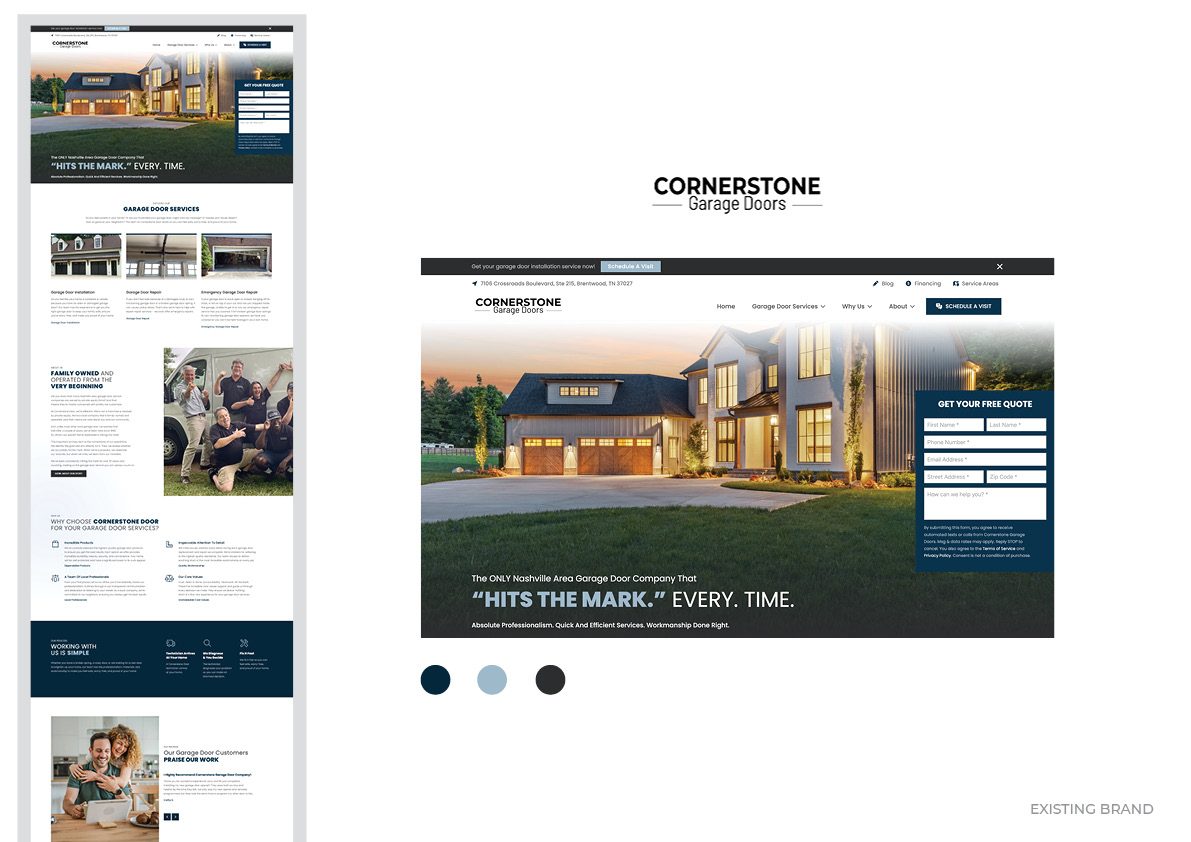
Once that foundation was in place, the Ryan Chute Group brought Elastic Studio on board as their creative partner to bring it to life — to take that strategic platform and give it a face, a voice, and a visual system strong enough to carry the weight of that story. One that would work as well on a van in a driveway as it would on a billboard, a t-shirt, or a business card.
The "best of both" concept
The heart of the brand comes down to a simple but powerful idea: book smarts meets street smarts. Dad brings decades of hands-on, hard-earned installation expertise - the guy who leads a team that can can diagnose a garage door problem and delivers precision work. Daughter brings a university education and sharp business acumen — the person modernising operations, building the customer experience, and thinking about where the company goes next.
Crucially, this is a partnership of equals. One of the clearest creative briefs we worked from was an explicit rejection of the tired "dumb dad" trope so common in family-business branding. Neither character outshines the other. They stand back-to-back, arms crossed, equally confident - a visual handshake that says "we've got this, together."
"Tough and technical, but never flashy for its own sake."
To find the right tone, we looked at brands and cultural references that captured this dual identity: the rugged dependability of a Ford F-150, the understated sophistication of an Audi Q4, and the disciplined teamwork of a NASCAR pit crew — tough, technical, and tightly coordinated. That blend of toughness and intelligence, of blue-collar and white-collar, became the DNA of everything that followed.
Standing out in a crowded, colourful market
Before a single pixel of the new identity was designed, we did our homework. The residential garage door category in the region is dominated by two major players - and both of them lean hard into bold reds, oranges, and deep blues and greens.
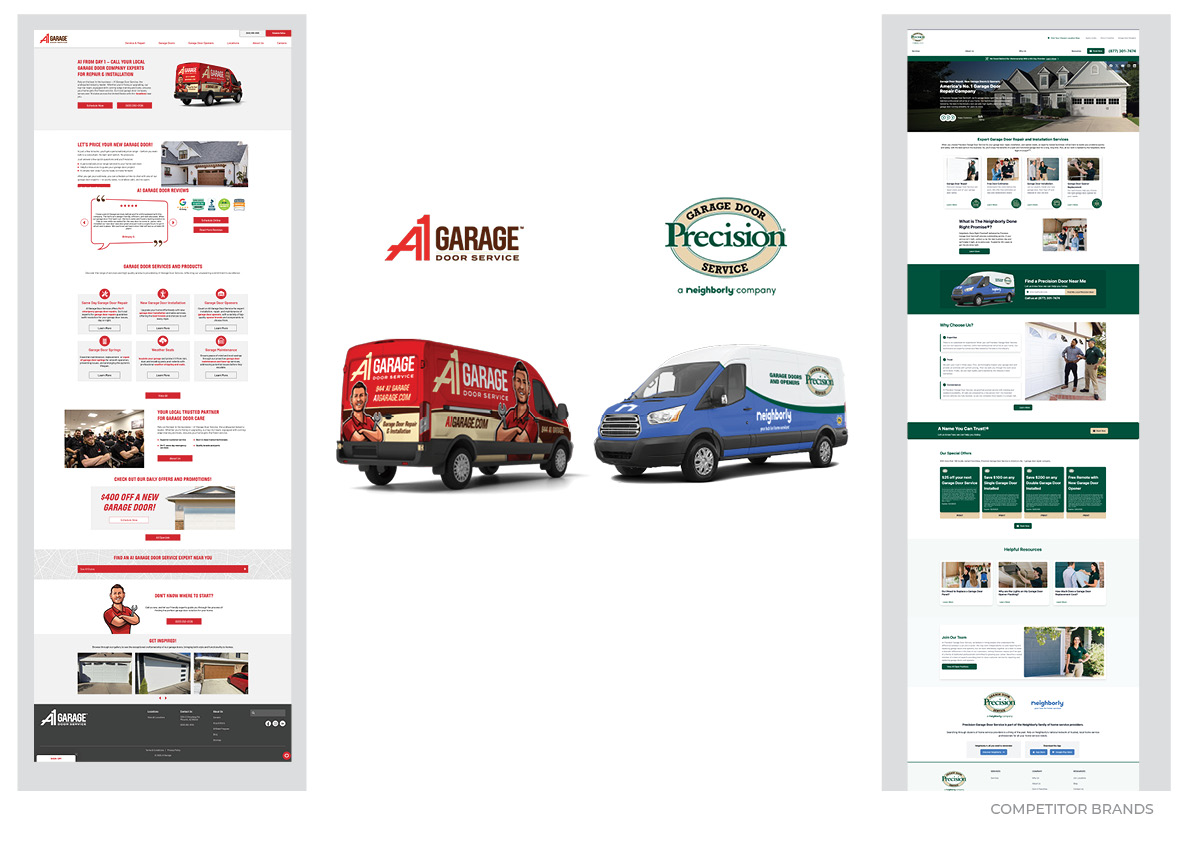
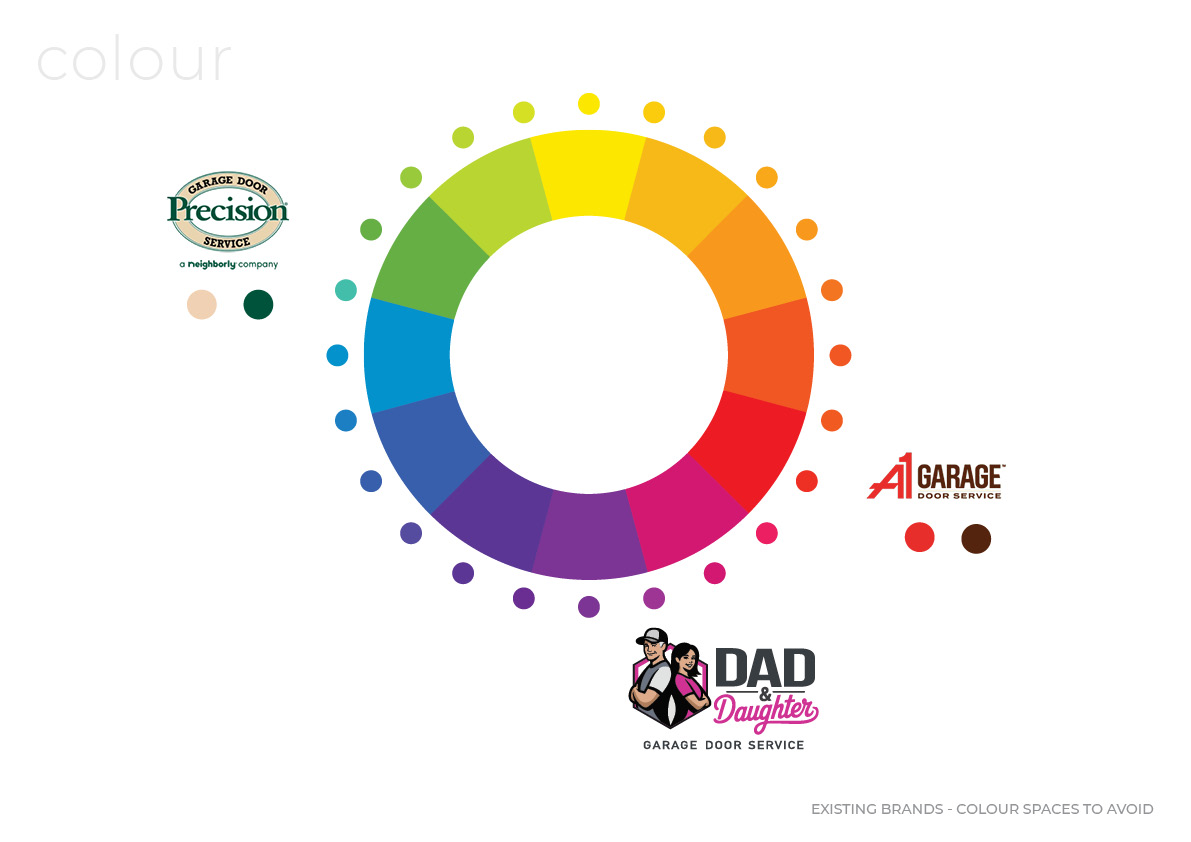
We mapped out the colour territory these competitors already owned and made a deliberate decision to go somewhere else entirely. The result is a palette built around deep graphite and a confident, saturated magenta — a combination that simply doesn't exist anywhere else in this market. It's bold without being garish, premium without losing approachability, and — most importantly — it's instantly recognisable from a distance. In a category where visual space has been very well owned, Dad & Daughter looks like it belongs to a different, better-run business altogether.
Characters worth remembering
At the centre of the new identity are Dad and Elizabeth (Daughter) themselves, illustrated as a mascot pairing that's warm without being cartoonish, and professional without being stiff. We explored dozens of reference points — from classic American mascots to modern tech brand characters — before landing on a style that feels approachable, contemporary, and built to age well as the brand scales.
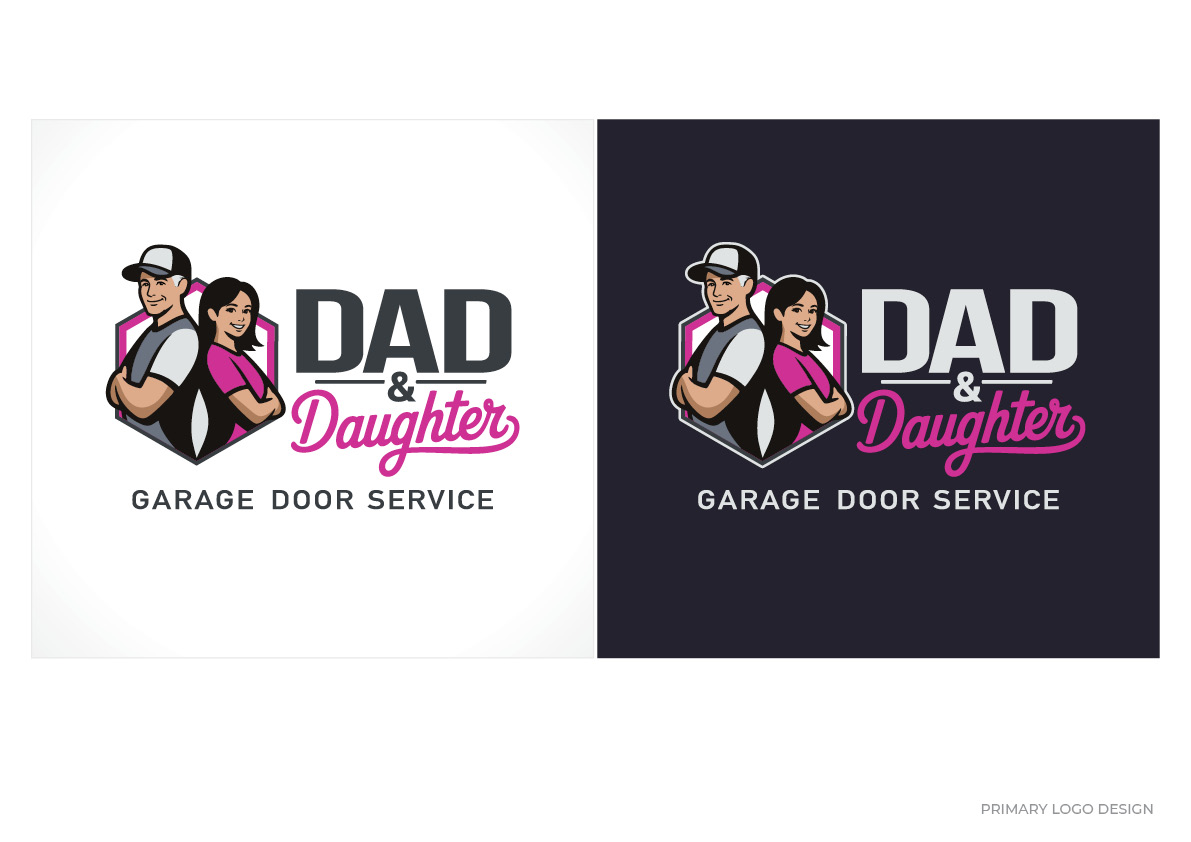
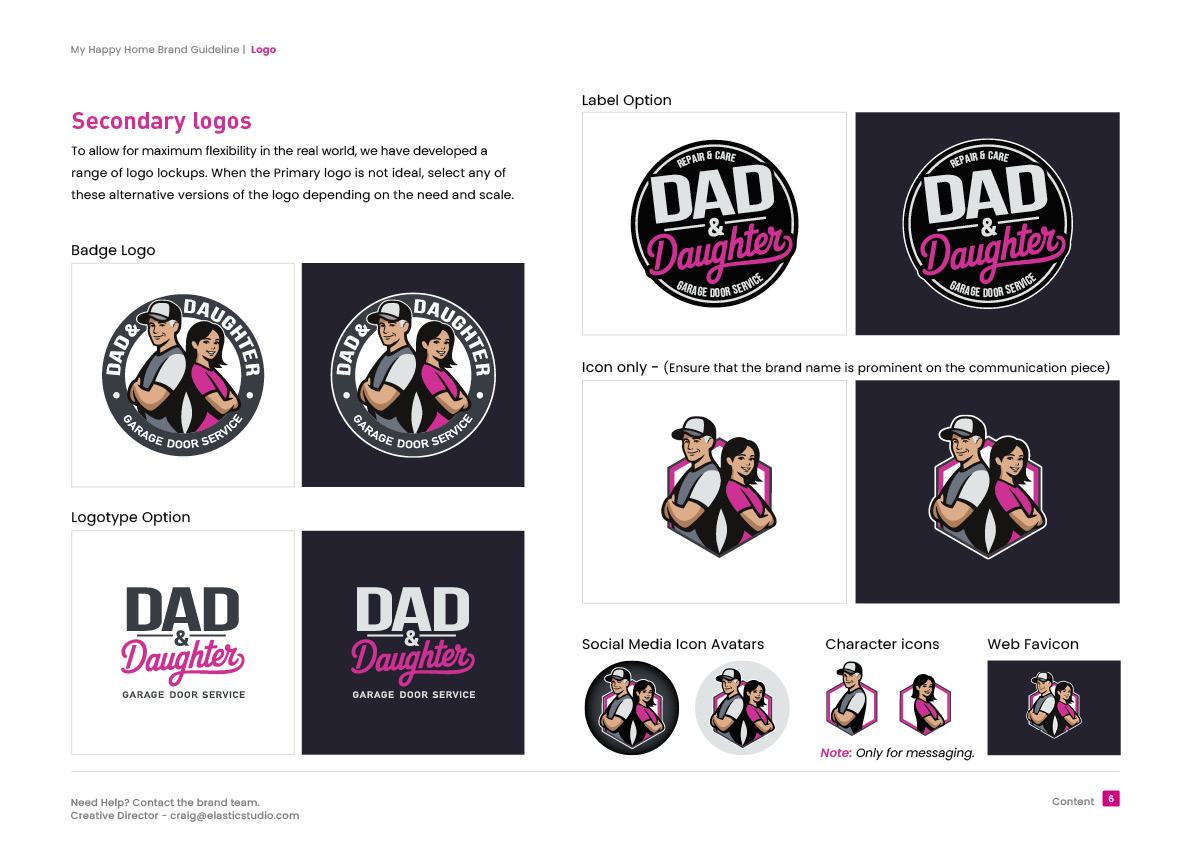
The badge-shaped icon nods to craftsmanship and structure — the kind of mark that feels at home on a uniform patch, a van door, or a hard hat sticker. Bold, uppercase "DAD" typography brings strength and durability, while "Daughter" is rendered in a confident retro script that adds warmth, personality, and a touch of nostalgia. Together, they create a logo that reads instantly, even at a glance from a moving car — which, for a brand whose vans are its biggest billboards, is exactly the point.
A system built to do the heavy lifting
A great logo is only the start. What makes a brand actually work in the real world is the system behind it — and that's where we spent much of our time. We developed a full identity architecture: primary and secondary logo lockups, a badge version, a circular "repair & care" stamp, social media avatars, and standalone character icons for messaging and community communications.
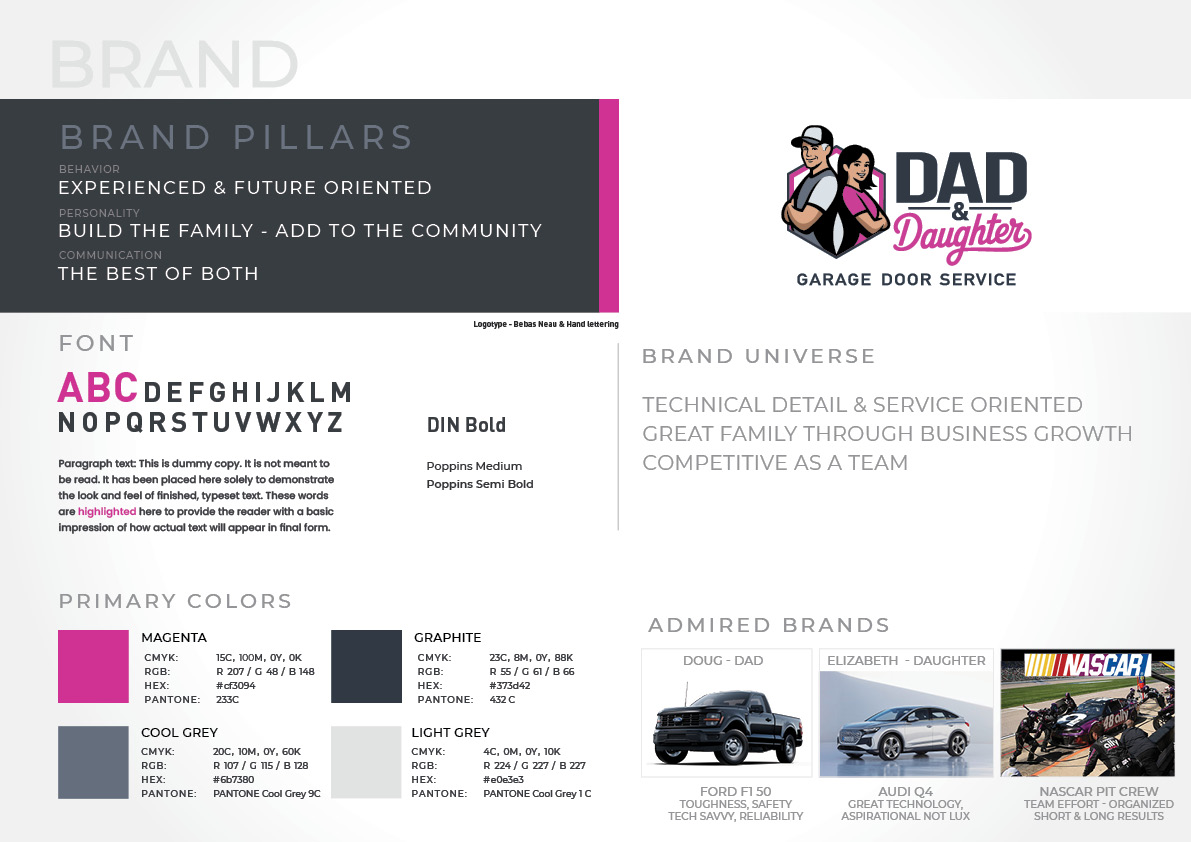
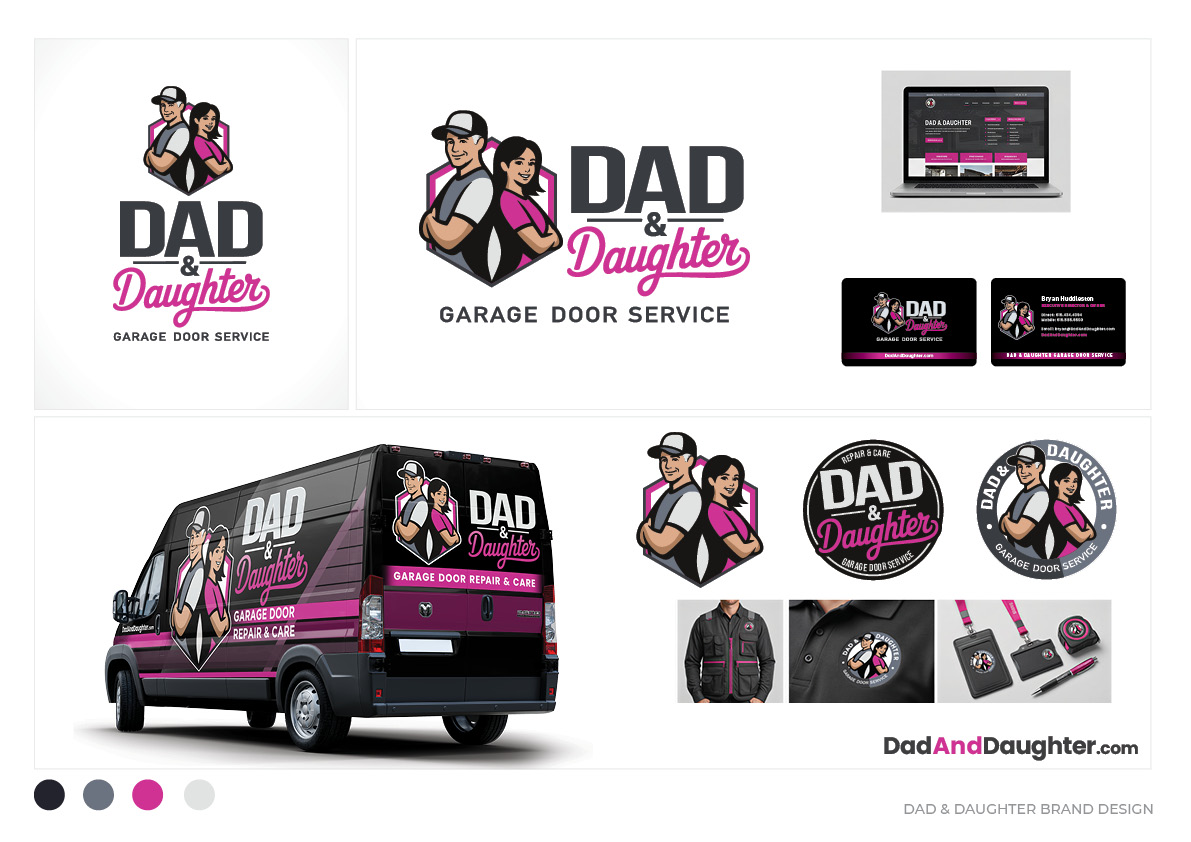
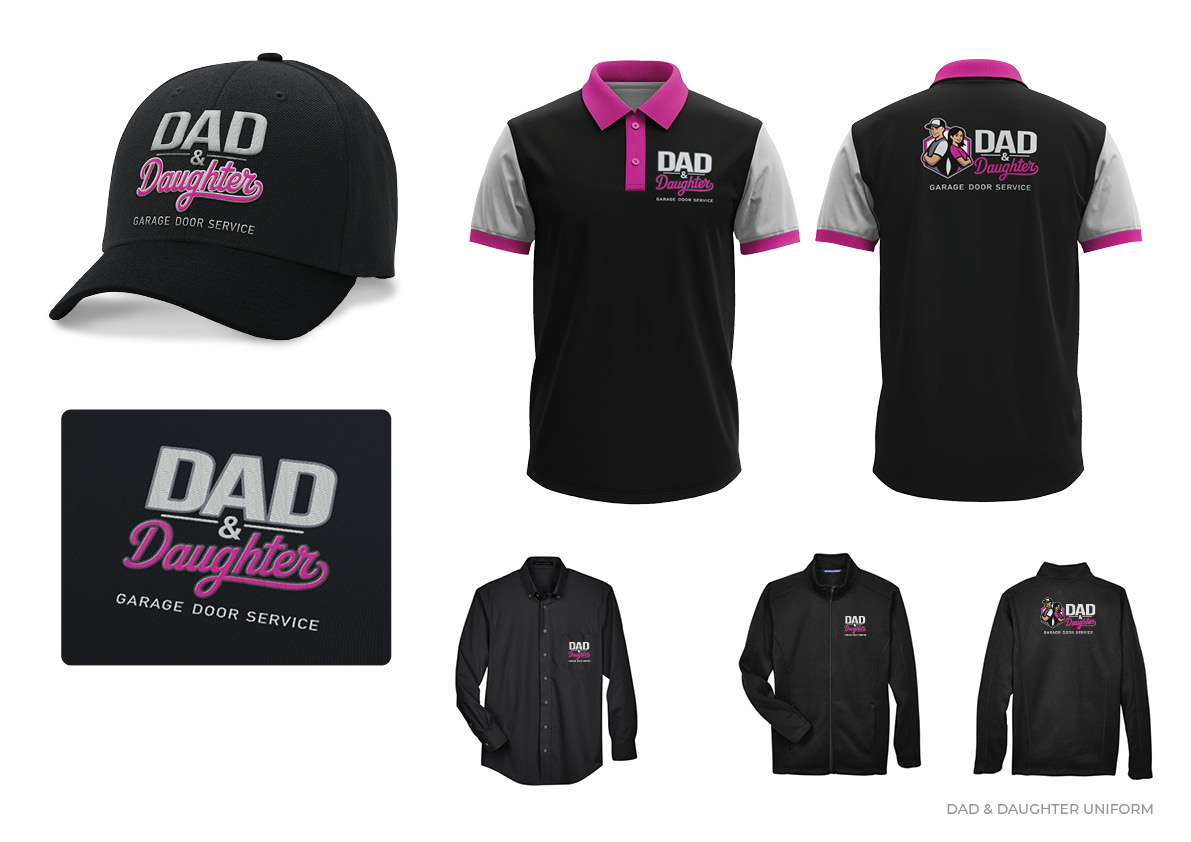
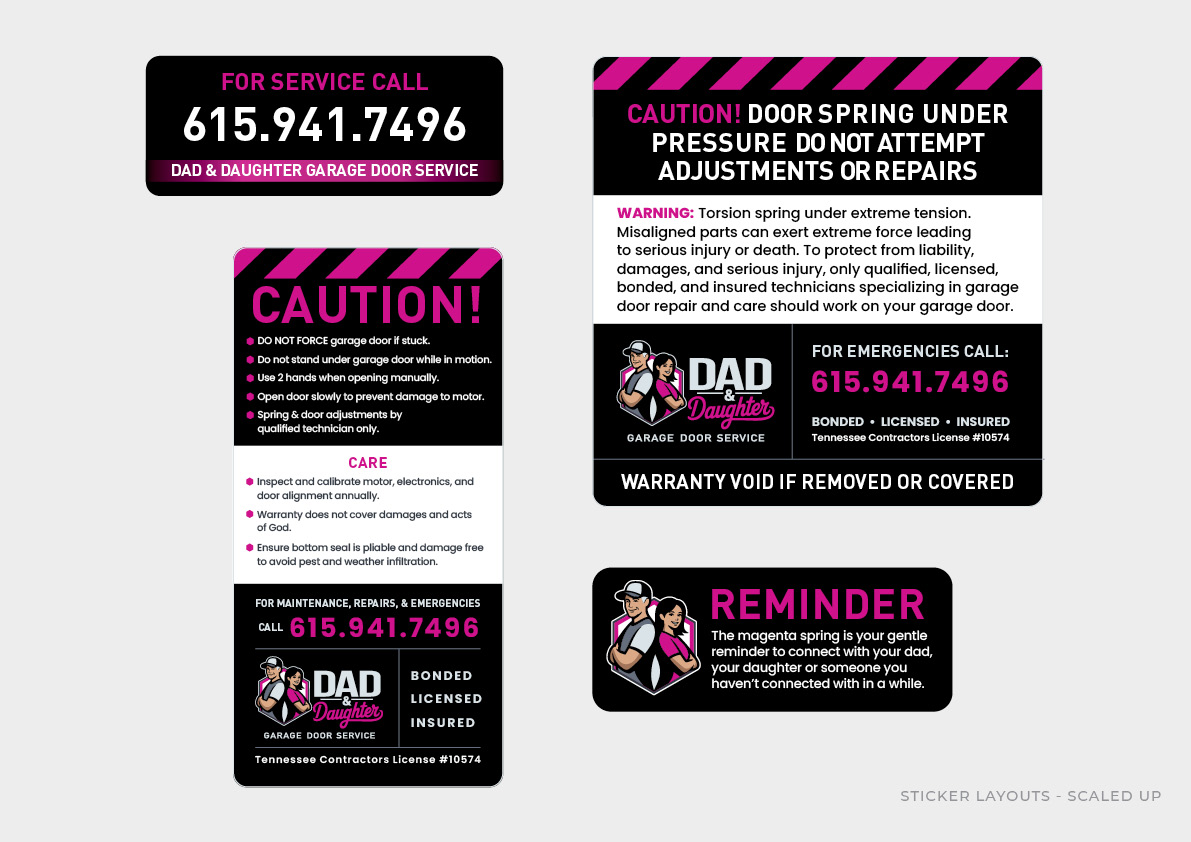
Then we put it to work. Full vehicle livery designs for a Ford Transit van and a RAM 1500 pickup bring the characters and colour palette to life on the road - bold enough to be seen from blocks away, but cohesive enough to feel like one unmistakable brand. Uniform designs carry the magenta-and-graphite palette through polos and caps, with the characters embroidered front and centre. Business cards, letterhead, and a full digital brand guideline round out a toolkit built so that — whether the company adds five vans or fifty - every new touchpoint looks like it was made by the same confident, considered hand.
This is the part of branding that doesn't always make it into the highlight reel, but it's the part that determines whether a rebrand actually sticks: a system robust enough that the brand stays consistent as it grows, scales, and reaches new markets.
A brand built to travel
What started as a local Tennessee garage door company rebrand has turned into something with genuinely national potential - a brand designed from day one to be "elastic" enough to grow, distinctive enough to be remembered, and warm enough to build real community loyalty along the way. That's exactly the kind of project we love: strategy, story, and design system working together, each making the other stronger.
If your business is going through its own evolution - whether that's a full rebrand, a market expansion, or simply a brand that no longer feels like it fits - we'd love to talk. If you're a US-based company thinking about what's next for your brand, get in touch with Elastic Studio.
We'd be glad to show you what's possible.
Branding

Brand Recognition Is Much More than Name Recognition
Unlock the secrets to brand recognition with insights from Wizard of Ads for Essential Services. Learn how effective strategies can elevate your brand and captivate audiences today!
We've all heard the typical phrase "get your name out there" when it comes to enhancing your business' brand awareness. But what's in a name? Nothing, really; unless you have an image, a feeling, or a message attached to it. Your brand's name is what customers will use to identify your company, but brand recognition is so much more than that. It's what people think of when they hear or see your brand's name. Creating brand recognition requires strategic marketing and consistent, creative messaging that resonates with your audience. If you want to create impactful brand recognition for your business, stay tuned. In this article, we'll go over some key principles that will make you a master at building powerful brand recognition for your business.
Understanding Brand Recognition
Brand recognition is the most important aspect of branding. It's what allows customers to truly connect with a brand and understand what it represents. Brand recognition goes far beyond the slogan, logo, and color scheme. It's the intricate mental image that is associated with the brand name. This includes not only sight, but sound, smell, taste, touch, opinion, and emotion as well. For example, when you see the golden arches of McDonald's, you might think of happy childhood memories or the taste of a juicy Big Mac. Or when you see the Nike swoosh, you might think of feeling strong and accomplished. These brand recognition examples show how customers can connect with a brand on an emotional level, which is what creates brand loyalty. When your brand's essence is everything that it stands for in the hearts of your customers, that's when you know you've got brand recognition that will stand the test of time. At Wizard of Ads for Essential Services, we believe that your brand's essence is what makes it recognizable, relatable, and ultimately, unforgettable. We've seen first-hand how important brand recognition is to a business's bottom line. If you're looking to create a brand presence that will last, we can help. Our team of branding experts can work with you to build a brand that truly resonates with your target audience. Book a call with us today to learn more!
Brand Recognition vs. Brand Awareness: Key Differences
When it comes to marketing, there is a lot of talk about brand recognition and brand awareness. But what exactly is the difference between these two concepts? Brand recognition is when consumers can identify a brand based on its features or characteristics. This could be something like a logo, slogan, or the way the brand's products are packaged. And, to go even deeper than that, the way the brand makes consumers feel as well as its values and how it resonates with them. Brand awareness, on the other hand, is when consumers are familiar with a brand but may not be able to identify it based on its features. This is more of a top-of-mind awareness, where the brand is one of the first that comes to mind when thinking about a certain product or service. For example, when you think of motorcycles, Harley-Davidson is likely one of the first brands that come to mind. This is because they have such strong brand awareness. Now, if you saw a motorcycle with the same shape and design as a Harley-Davidson, you would still be able to identify it as a Harley, even if there was no logo or name on it. You might also be able to identify a Harley based on the feeling of freedom and rebelliousness that it gives off or the sound of its engine. This is brand recognition. So which is more important for businesses? Ideally, you want to have both brand awareness and brand recognition as strong as possible, but brand recognition is often seen as more important because it leads to brand loyalty. When customers have brand loyalty, they are much less likely to switch to a competitor, even if the competitor’s product is cheaper or better.
Core Elements That Shape Brand Recognition
The most important aspect of brand recognition is the core value that it represents. A brand should be more than just a name or logo — it should be a representation of what the company stands for. Customers should be able to identify the brand's core values and feel confident that they align with their own personal values. When customers feel confident in a brand's overarching message, they are much more likely to become returning customers and brand evangelists. This is because they know that they can trust the brand to deliver on its promises, and they feel good about supporting a company that shares their values. Furthermore, brand knowledge creates a sense of loyalty among customers, which can lead to long-term relationships and higher levels of customer satisfaction. Many other factors contribute to brand recognition, but some of the most important ones include strong brand identity, consistent exposure and positive brand associations.
- A strong brand identity: This includes elements like a recognizable logo, consistent branding across all touchpoints (including online and offline) and a clear brand message.
- Consistent exposure: If people don't see your brand regularly, they're less likely to remember it. Having consistent brand exposure through advertising, PR and other marketing efforts are crucial to drive awareness and brand recognition.
- Positive brand associations: If people associate your brand with positive experiences and attributes, they're more likely to remember it.
Above all else, your brand should resonate in the heart of your customers by delivering an experience that is unique, memorable and brings about positive emotions.
Defining What Your Brand Means to Your Customers
What does your Brand Stand for in the Heart of your Customer? Your brand is what your customers think of when they see or hear your company name. It's the promise you make to them about the quality of your products or services. And it's the emotional connection they feel when they interact with your company. When you're clear about what your brand stands for, it's easier to connect with customers and create a lasting relationship. After all, people buy from companies they know, like and trust. Here are a few questions to help you get started:
- What are your core values?
- What do you want to be known for?
- How do you want customers to feel when they interact with your company?
- What makes you different from your competitors?
Answering these questions will give you a good foundation for understanding what your brand stands for. From there, you can start to build a strategy for connecting with customers and creating meaningful relationships.
Aligning Your Brand with Core Values
Your brand is linked to a set of values that guide everything you do. These values shape how you interact with customers, what kind of products or services you offer and how you want to be perceived in the marketplace. Some common values that brands are linked to include: quality, innovation, customer service, integrity, social responsibility and community involvement. When customers know what your brand stands for, they are more likely to connect with you on a deeper level and become loyal advocates. So it's important to make sure your values are clear and easily communicated to everyone who comes into contact with your business. Here are a few things to keep in mind as you work on articulating your brand's values:
- Keep it simple. You don't need to list out a laundry of values that your brand represents. In fact, too many values can actually be confusing and make it difficult for customers to understand what you stand for. Stick to one to three core values that you feel best represent your brand.
- Be authentic. Your values should be an accurate reflection of what your brand is all about. Don't try to be something you're not just to appeal to a certain customer base or market segment. This will only backfire in the long run and damage your reputation.
- Be consistent. Once you've settled on a few key values, make sure everyone in your organization is aligned with them and knows how to put them into practice. Consistency is key when it comes to values-based branding.
- Be flexible. While it's important to be consistent, you also need to be flexible enough to adapt your values as your brand evolves over time. As your business grows and changes, so too should your values.
- Be patient. Building a strong values-based brand takes time and commitment. It won't happen overnight, so be patient and stay the course.
Building a Brand That Inspires and Lasts
Brand recognition is the lifeblood of what makes a brand powerful in its influence. Name recognition is important, but without the image and feeling that comes with it, your brand will struggle to stand out. That’s where we come in — at Wizard of Ads for Essential Services , we help businesses build disruptive brands that become not only a household name, but a household philosophy. So if you want to increase brand awareness and create or update your brand image, story and presence, book a call with us today. We can’t wait to get started!
Advertising
OTT Advertising: The Secret to Dominating Your Local Market
OTT advertising has exploded and so has the number of people selling it without knowing what they're talking about.
Everybody and their dog is selling OTT right now.
Radio stations. TV stations. Outdoor companies. Your dry cleaner probably has a deck.
But here's what they're not telling you: most of what's being sold under the OTT banner is overpriced, under-measured, and bought from someone who has absolutely no idea what they're doing and even less incentive to admit it.
In this episode, Ryan Chute sits down with media buyer Beth Radtke and Wizard of Ads partner Ray Seggern to cut through the noise around Over the Top advertising; what it actually is, where it actually works, and how to avoid the traps that are quietly bleeding businesses dry.
The conversation pulls no punches. From Comscore's measurement sleight of hand, to the dangerous gap between impressions and actual people in the room, to the Atlanta case study where one buyer got 5,000 households and another got 25,000 for the exact same $5,000 — this episode is a master class in media buying clarity.
Because the medium isn't the problem. Buying blind is the problem.
Episode Highlights
- Media Agnostic or Media Commission? — The single most important question to ask before taking any media advice.
- What OTT Actually Is — And how connected TV, streaming, and broadcast now all occupy the same living room with different rules.
- The Frequency Minimum — Why OTT sellers push frequency caps and why that's exactly backwards from what works.
- Impressions Are Not People — The measurement gap between IP addresses, households, and actual human beings watching your ad.
- Who's Measuring Who? — Why independently verified data matters and what happens when the seller also owns the measurement tool.
- 78 Steps From the Source — Why buying OTT through the wrong vendor means paying a premium for the bottom of the barrel.
- The Atlanta Case Study — Same budget. Same geography. 5× the reach. The difference was who was doing the buying.
- Live TV Is Back — Why appointment viewing is growing inside streaming and why that changes everything for local advertisers.
🎧 If someone is trying to sell you OTT right now, listen to this episode before you sign anything.
👉 Are you buying media or just buying someone else's commission?
📱 Subscribe wherever you get your podcasts
💥 Brought to you by Wizard of Ads for Essential Services
📞 Book your complimentary 45-minute strategy session with Ryan Chute
Today, we have two special guests with us to talk about OTT.
OTT, even though it ends up a little bit more expensive on a per-person basis, for a business that's not prepared to handle a whole DMA, it's a solution.
What's fascinating now about something, if you're not looking at reliable, objective, disinterested, meaning there's no skin in the game, that the owner of the measuring tool is also the owner of the thing being measured, then it's unreliable.
Be very, just deeply cautious of who you're buying your OTT and streaming from. If you're 78 parts removed from the center, you're going to be paying a small fortune for something that you could have bought for considerably less.
When it comes to OTT, how do we know that the ads that you buy on OTT are actually being played?
Ryan Chute: Welcome to Advertising in America, where today we have two special guests with us to talk about OTT. Yeah, you know me. Okay. Are you down with OTT?
Ray Seggern: I'm not entirely down with OTT, but I hope to be more down with OTT as the show goes on.
Ryan Chute: Let's get into it. We have a wonderful guest, Beth Radke, here, who's going to talk to us about OTT and the pros and cons, the good, the bad, the ugly, and senior correspondent from Austin, Texas, Ray Seggern, who's spent many years.
Ray Seggern: From the great nation of Texas.
Ryan Chute: That's right, the great nation of Texas, who is going to talk to us about some of the challenges that he sees, some of the benefits that he's seen and what the landscape has looked like and how it fits into this landscape. Let's jump into it with you, Beth.
Chris Torbay: What is OTT?
Ryan Chute: What is OTT?
Chris Torbay: Explain it to me like I'm about this old.
Beth Radtke: OTT stands for Over The Top. It refers to anything that's delivered, content that's delivered to you over the internet, as opposed to the traditional way that we knew with the bunny ears and a TV, or cable. There's a difference between OTT and connected TV. Connected TV, of course, is just the delivery of that advertising or content through the TV that's connected to the internet. So that's the differentiation between the two. And of course, it's had a huge growth over a period of time now.
.png)
I think if you look back to 2011, which sounds like a long time ago to those of us who are a little older, but in 2011, about 83% of households were connected to cable TV. So they were primarily getting all of their content through the TV was cable-driven. Today, that number is somewhere in the 30% range. So if you look at cable subscribers going from 83 to 33 from 2011 to the current, that's a pretty dramatic shift.
Chris Torbay: So, just so that I understand it fully, what's the difference in terms of what advertising is in that content compared to cable?
So if you're watching cable and it's 2011, when we go to a commercial break, those ads come from where? How do they come from the station, and so, therefore, they go to everybody in the range of that TV station. Those ads are being run at the station, or I guess they're being run at the network, but local ads are being run at the station, and they're going to everybody in my town who's watching that through cable. Now that we are watching some of those same channels, some of that same content, but we're watching it through our computers or through our connected TVs, which is basically through the internet as well, now, where is that advertising coming from, and so then how does that lead to how we think about it?
Beth Radtke: So that distinction, the cable system, that's one platform of advertising, so those people who are watching through cable or broadcast, regular broadcast, are seeing one set of ads. People who are watching on streaming are seeing a different set of ads, and that set of ads is going to vary. I could be getting a different ad than my next-door neighbor, even if we're watching the same exact thing at the same time, which is really hard for people to understand, and it's the big difference. It's a different break than what we're used to with traditional TV, also, where there would traditionally be a series of spots that would run in blocks of five or so, and that's different on streaming. Usually, on streaming, you only see one or two. Sometimes the content is being matched, so they already have five spots laid in for a typical show, so the streaming live version of that will
Chris Torbay: Puts the commercial breaks in the same spot that they put five, if it's a drama, it's going to be the five commercial breaks.
Beth Radtke: Yeah. And because more and more streaming TV is now live, that's like the biggest growth sector of streaming TV right now, and you'll see more of a transition to that. People are watching more live sports and live news, it's really the fastest growing segment, as opposed to on demand, which is, the way we all got introduced to it, like through Netflix and some of those common places. But most households now have an average of four streaming apps that they use.
Chris Torbay: What's the opportunity for the advertiser now, knowing that people are getting their opportunity for streaming? What's the opportunity for them in terms of targeting, I assume?
Beth Radtke: There are a lot of different businesses that this would work well for, and I think when you look at who it makes sense for, it would be anybody who has a specific area they're trying to target, so a geography. We talk a lot about when you have geography that doesn't align exactly with the DMA. So say you're in a big city like Chicago, but you don't service all of Chicago. Then it makes sense to just place your advertising in the zip codes where you really want to be and talk to just those people, and then that allows you to scale up in a more natural way, rather than stretching yourself thin.
Chris Torbay: So, if you put your ads on broadcast on the major networks, you're talking to everybody. You go everywhere. If you go on OTT, I can just buy Evanston, or I can just buy a neighborhood or a couple of neighborhoods or whatever and only pay for those people.
Beth Radtke: And then you can scale up from there. We love broadcast because from an efficiency standpoint, that's the most efficient; you pay the least amount per person per year when you advertise on broadcast.
It's still one of the best vehicles. Even though viewership is changing, it's still one of the best vehicles for reaching many people frequently over a period of time, which is one of our objectives for building great brands. But I think that OTT, even though it ends up a little bit more expensive on a per-person basis, for a business that's not prepared to handle a whole DMA, it's a solution.
Ray Seggern: Hey, Beth, so I know there's a lot of new opportunities with OTT, but one of the things that we've done with my clients through the years has been cable TV, and cable, obviously, you can't target down to the zip code level. It's just whatever their predetermined zones are, they give you the grid map. And so I've got clients that have, like in Seattle, for example, we don't want to service all of Seattle. We essentially have three of the zones on the grid, of the cable grid, with I think it's Comcast there. So, two of them are perfect hand-in-glove fits, the third not so much. And so I’ve been slow to adopt OTT and connected TV, and I'm curious, as somebody who's studied it a lot more, at what point does it make sense to pull off of cable and either switch entirely to OTT or to mix it up a little bit?
Beth Radtke: I think what I'm seeing and hearing a lot of is not abandoning our successful approach wholesale, but I think some sort of measure of blending, maybe to better address the geographic concerns of the advertiser. So even if it's partially OTT, and then using your cable budget as the basis. And for us, that would be another thing we would do is take a base buy and then augment it or layer it so you have that kind of cross-cumulative approach where we're getting frequency in multiple different ways.
Ryan Chute: This goes back to the tenets of ROI and Wizard of Ads, where we want to dominate a particular medium before we start to look at dominating a second one, where we get to diminishing returns before we start seeing value in a second one, particularly one that's going to be more inefficient than the first one. So we always prioritize the highest efficiency to the lowest efficiency for cost, right? We want to keep the cost as low as possible for clients.
The second thing is, what is it that's creating inefficiency in it? One, it's a smaller market. Now, if you're only serving one-tenth of Chicago, then the inefficiency would be trying to serve all of Chicago, right? The drive times for too few trucks, all of those things would be just as detrimental to the business as spending more on the market that you are able to get to. The key is, let's get repetition in here over and over with that powerhouse message, and we'll win the game. Slow, but surely, we’re always going to be better off and we’re all speaking to the choir here, but to say it to the world at hand, it's far more valuable to reach 10% of the market and convince them 100% of the way than it is to reach 100% of the market and only reach them 10% of the way.
Ray Seggern: So frequency, the way that Wizard of Ads does marketing, that we're all on the, yeah preaching to the choir, we're all on the same page, we never sacrifice frequency. And this again, it's not just OTT. This is also with streaming radio. Nobody has ever really answered for me this idea that we want to reach them three times a week, 52 weeks out of the year, and I'm always getting pulled this way to “Just look at my gross impressions," and this and that.
How do you, what are you doing in your research, Beth, to get us to, because I know that you wouldn't be doing this if you weren't making some headway in frequency. So how are we dealing with the main thing, staying the main thing, which is, of course, frequency?
Ryan Chute: Repetition. When we speak of frequency, we're not talking about where we're tuning into, but we're talking about how often they see it a week. How often do you hear that message?
.png)
Ray Seggern: We want to do this ideally, it's at least three times on seven nights' sleep, which is the way that we like to do it.
Beth Radtke: Yeah, and we talk, I’ve talked to so many people about this over the last couple of years. It's interesting, whenever you talk about frequency, they go right away to frequency cap because that's really a standard in that OTT world. It keeps you from seeing that awkward pharmaceutical ad 50 times during one movie. So some advertisers want a cap, so that's a conversation they're comfortable with, and I'm always saying, "No, we have a frequency minimum. So don't serve me the ad if you don't think you can get me three times this week."
And the answer is the currency that all the digital platforms use really is impressions. And we're not. That's not us. That's like a bunch of reach without frequency. So having that conversation is a really important part of what we do because we have to find a way to tool the campaign so we make sure that people are getting that, and the answer is you can't do that immediately from the beginning. We have to optimize for that. So we discover over a period of time how to make sure that we're getting that certain frequency a week, and then we also want to cap at a reasonable limit, too, because we don't want to irritate people that much.
Chris Torbay: I think we've all had that situation where we're streaming something. We missed an episode, and so we go and find it on the app, and you find out that the only sponsor of that program is the same thing, and you just see that same detergent ad literally in every break all the way through the show. And you think, "I can't believe the advertiser wanted this to happen." I'm sure they love to have frequency, but in their desire for frequency, this is not what they wanted. This is definitely not what they wanted. How can you let this happen?
Ryan Chute: That's right, and we have to recognize these things as strategists when we're putting this together. If we know that we're getting an overabundance of repetition, even within a show, let alone a week.
Chris Torbay: Yeah, exactly. I don't want it to happen tomorrow when I'm streaming the next episode. Oh, my God, it’s another five airings of the same commercial.
Ryan Chute: Then what we have to be cognizant of is if that's happening, we have to be ready to swap that ad, which then goes towards the cost of production of those ads. So now we're looking at, not just the cost of getting the thing produced, but the actual purchasing of those products. So, we're not advocates of any particular channel. We're media-agnostic people. We do not care about which media channels we use. We care that the right strategy and the right messaging is used for the channel that's being deployed.
And that's a fundamental break because we're talking about repetition where everyone's capping it. We're saying, "No, we need to have at least three hits a week in a healthy environment." So there are ways that we can cheat with this.
And a few of them come up, like on streaming, you have very little control of that one after the other kind of scenario on OTT, that's mildly mitigated through, for example, the news. Not all OTT is created equal. I think that's one of the things that you and I have spoken about, Beth, is the smart TVs? So you can get your local news on your smart TV directly, almost like it used to be broadcast, right? Like it used to be, the antennas. Now it's just right there, and you can pick the news and watch the six o'clock news live, which is what you're going to do. That's a great option for clients. And then you can cycle those out. So, it's not just that we're only servicing a certain market. It might be, say, I want greater reach, and this is a relatively low-cost, low-efficiency, but still lower-cost access point to just reach people on the news.
Beth and I talk about Nashville and getting a $12,000 spend on TV ads for just running news in Nashville for the week for a month is the cost. So $3,000 or $4,000 a week. Was that worth it? Yes, because we're getting in front of the same consistent group of people. Now, if we run it on two different OTT platforms, one is the smart TV, but then Beth gets it on another OTT set of premium channels, be it specific shows or news, but different broadcasts. Now, all of a sudden, we've got two markets and we, we're not getting maybe a 10%, 20% overlap.
We’re guessing, no one knows. But now we're talking to two distinct markets, but they're consistently seeing the thing. So it, it is about being hyper strategic about it and figuring out, yes, if this is what we're dealing with, and yes, if people are cutting cords, and a way to get additional viewers consistently is to use this channel medium, then great. We go forth and figure that out.
One of the big challenges in California right now is with a client that's not in the LA market, and we have to solve for that problem. So it's what's the problem we're solving, and then how do we solve it in a way that's not going to mess with the game?
Ray Seggern: So, we're at the game has gotten way fiercer than it used to be. It's more ferocious. And as a guy who came up through radio, I knew radio enough to buy my own radio when I went out as a Wizard partner in 2006. And it was easy enough to morph that into a strategy to buy television, right?
So in a town like Sacramento, you've got ABC, CBS, NBC, and here comes Fox. You got the cable company, you got all the radio stations. There is a closed ecosystem of about 17 people I can go to, and I can buy any radio or any TV I want.
What I still don’t understand is how it works, and why we need the Beth Radtkes of the world who are going to devote the time to really stay on top of this. And this would be my cautionary tale for owner-operated businesses that think they're going to go it alone. Buyer beware, because I'm reasonable, I'm sophisticated enough to know that I'm getting out of my depth here at this point, right? Because I look at, okay, so you've got three, I'm not sure what Fox is doing, but obviously got Paramount Plus, and you got Peacock, and you got ABC, through Hulu, and Disney+, so those are the three networks.
.png)
Ryan Chute: You’ve got Prime.
Chris Torbay: You’ve got Netflix
Ray Seggern: We’re going to keep going. You've got Prime, but you've also, before you even get to Prime, you've got access to a lot of those same programs via YouTube TV, via Sling, and all of the cable alternatives, right? So now it's oh, and by the way, iHeart and Cumulus Radio groups, they both want to sell you OTT TV now, too. So it's like all of a sudden my neat, nice, Pleasantville kind of world where I had 12 people to go to, now it feels like it's 37, or is it 137? I honestly don't know if it's 37 or 137.
Ryan Chute: It's both, and I'm going to have to defer to Beth here, but there's, you're talking about two separate things.
It's valuable for the listeners to divide it. One is that everybody and their dog is selling OTT, and not all OTT or streaming is equal, and you may be buying it way downstream of the actual seller, and you may not be. So knowing that and then knowing how you can affect repetition, all deeply crucial to the actual strategy working or not. The second is that yes, there are just an infinite amount of actual real media channels because as the media landscape is shifting and people are either diversifying or trying to bundle, you end up having to deal with so many different players to view the landscape.
And measurement becomes damn near impossible because there is no cross-cumulative measurement of if they watch Prime, they also watch Paramount at its exact levels. In the good old days of radio, and today, even today, we can say without a shadow of a doubt exactly how many human beings in Sacramento will watch it.
So, Sacramento is an interesting city compared to Orange County. Where Sacramento is a city, and we can run strategy in a city way different from how we'd run in Orange County, which basically is getting all of the media coming in from LA. So the layers of where media lands is very complicated. Another complicated one, Jersey, New York markets are the same.
Ray Seggern: Any of those top 20 markets, really, if you think about it, and especially for, we have so many clients that are home service companies, right? So, especially where traffic becomes a thing, too. There is definitely value in geographic targeting. If you can't fish in the bigger pond, you have to create a scalable universe to be able to air your message in.
Beth Radtke: Like, we have somebody in Chicago, they have 10 trucks.
They can't service all of Chicago. They'd be using all their time on windshield time. So, the most efficient use of his media budget, even though he could afford, we could buy some radio for him, but he would be using all of his time, having people all over that city.
Ryan Chute: The flip side is that they'd be saying, "No, we don't service there," which burns you for when you want to service there.
Chris Torbay: When you grow beyond 20 trucks and with a second warehouse, you can suddenly service the South Side. And now people go, “Oh, yeah, I tried them once.”
Ryan Chute: And that’s the kiss of death as much as anything else. So the strategy is specific to the client's exact need. Even in the same city, we could have five different strategies going on with five different clients, all with different needs, at different sizes, and growth, and capacity to service a city.
In LA, if you don't have five distribution points, you don't do LA. You wait until such time as you can handle the city because drive times are disproportionately bad in that city. For sure. Boston's not uncommon to that, as well as New York in the boroughs.
Chris Torbay: There are a number of cities that have a choke point in terms of commuting, and if Boston, if you want to do the south suburbs, there is one bridge, and so to get in or out of there, you have to choose to be on one side or the other, and we have the same thing in Mobile (Alabama). If you want to go east of the city, there is one.
Ryan Chute: It's like you're going into a different universe to do that. It’s like you have to be prepared operationally to do that, and sometimes that's where even our messaging strategy will shift, as it's allowable, when we can actually play the game that's meant to be played, that was always meant to be played, but not until we're at that spot. So all of this is so deeply interconnected and deeply valuable
Ryan Chute: Why do we focus on OTT in this? But because, one, we like to have a single topic per conversation, but it's a fascinating conversation because so many people are being hit with OTT because there's so many sellers of OTT.
Beth Radtke: Everybody's selling OTT now. Pretty much anybody I would talk to about buying media fm, so that's radio, TV, outdoor and then, pretty much anything else in between, everybody's selling OTT and some other digital services. It's at least worth a conversation to look at and just help figure out and make sure that you're getting the best sourcing for whatever you're buying or interested in buying and, just looking at that because when you have people who that's not their main area of expertise, it gets harder to know if you're really getting the right thing.
Ryan Chute: I recall two within the last four months of having them send me over a client who had been presented without our media buyer being on hand, and was presented OTT options. It wasn't 10 seconds that you could see the massively glaring misconceptions that were being portrayed from broad rotators, to timings, to total amount of access, or ad points that were being put out into the marketplace, where they were going to be done. The amount of absolute nonsense that lives out there that we can now reinforce with Comscore, right? Comscore is the biggest scam on the internet in the universe right now. The Comscore is the company that will make up any number in the world that the media channel wants to convince you of the dumb bullshit that they're up to.
Mick Torbay: And we're going to get sued.
Ray Seggern: The opinions expressed by Ryan Chute, may or may not…
Beth Radtke: The views expressed here….
Ryan Chute: These are opinions only. But this opinion is derived off of the absolutely deviously misleading information and terminology being used to convince people that they're getting something that they're not.
Ray Seggern: Here’s the thing. What you've got is you've got companies that are developing their, “We will measure ourselves, and we will share..." And then they start to do this thing where they spread the glitter and the fairy dust on it, and before you know it, you've bought into looking at what…
Chris Torbay: But that's always happened. Radio stations have done that, TV stations have done that. It's a new area, and they’re doing it too.
Ray Seggern: For sure. But Nielsen has always been measuring TV. Arbitron always did a good job with radio, and then Nielsen bought Arbitron. That's a whole other conversation. But still, generally speaking, reliable metrics that we could count on through the decades of the history of broadcasting, there was obviously an evolution in measurement. Radio went away from a diary system, but there's still a lot of diary markets in America. And you have to look at their data differently. But what's fascinating now about something, I'm not going to single out come, but ComScore's not the only flagrant offender in this deal.
Ryna Chute: It's not. No.
Ray Seggern: And the thing that I will say is if you're not looking at reliable, objective, disinterested, meaning there's no skin in the game, that the owner of the measuring tool is not the, also the owner of the thing being measured, then it's unreliable. It's fundamentally, systemically unreliable.
Mick Torbay: In the past, when you were buying a radio campaign or buying a TV campaign, you didn't just have to take the TV station's word for it that this many people saw your ad. There was an independent organization that was actually measuring it, and they could do it to a mathematical certainty, within one or two percentage points, 19 out of 20 times. They actually know how many people are watching this channel, and how many of those same people are watching later that week, so that they could calculate how often they see it. So when it comes to OTT, how do we know that? How can you prove, or how can we independently verify? Explain to our audience, who's independently verifying that the ads that you buy on OTT are actually being played to an audience?
Beth Radtke: There are standards that are held throughout the digital industry that help measure, and there are standards that they hold up.
Mick Torbay: Because, for example, I know when it comes to pay-per-click on Google, the way you know how many people have seen your ads is that Google tells you. How does it work on OTT?
Beth Radtke: It's the same. The platform is measuring it for you. But it is an audited, and they have to. There’s a standardizing industry that measures OTT.
Ryan Chute: And they're measuring the IP. They're not measuring people. They're not measuring a person in the presence like Nielsen, or any people meter subset.
Beth Radtke: Yeah. And that it’s measured individually.
Ryan Chute: And that it's not fluffy.
Beth Radtke: It's by household.
Ryan Chute: That the dog's not being kept company by the TV rather than Mrs. Jones watching your ad. And the definition of people, for example, is within question when you actually say, “Should I even have to ask what the definition of people is?"
Ray Seggern: What are we doing here? Come on.
Ryan Chute: But apparently, that's a definition that you have to ask when you're being served up this information. Which is very true to what you said earlier about impression. An impression is not people, and impression is total potential reach, and they're not telling you, "Oh, here's how long they watched it for," and they have all this information, whether or not there was somebody in the room, whether or not there was somebody paying attention, whether or not all of these things that actually matter in the measurement are true.
We have to find ways of cheating the system based on what we know about human behaviour and the system.
Like the propensity to fast-forward through a thing or skip, or to watch the ads. It's funny. I was sitting in my in-laws' place, and they had the curling on, and they were watching the stuff, and the ads just played. They didn't fast-forward through the ads and stuff. They were just like, "Whatever." Just like, "Let them all play."
Beth Radtke: And that's what we're seeing is the level of engagement and even response to advertisers is different during live TV. People consume it differently than if you're watching your 30th episode of Game of Thrones or whatever it is.
Ryan Chute: The binging.
Beth Radtke: So it's just a different type of viewing. It's more, it takes us almost back to traditional TV viewing where it's appointment TV, like the news comes on at 6:00.
Ryan Chute: In a world where you wouldn't think that was still a thing, it's still a thing.
Ray Seggern: It is. And it makes it interesting, and Beth, by the way, I just want to say, because we're all here going, "But Beth, what about this?"
Mick Torbay: It's because we don't know stuff.
Ray Seggern: And I'm very much picking up from you that this is still very fluid and it's still developing? And I think, I look back on one of the fundamental things that I've, that has been, like, hardest to wrap my head around is if I buy a spot on the 6:00 news on KXAN in Austin, I can go plant myself in front of the TV, get my rabbit ears out, and see if the spot ran.
Chris Torbay: Bring the family around. “Hey, Daddy’s spots are about to run. Come on, everyone."
Ray Seggern: And now it's like I bought 1,000 gross impressions, or did I?
Chris Torbay: And you might not be any of them.
Ray Seggern: Did they play?
And so I know that, and through the years, on some level, radio groups like we used to work at, or TV groups, they deliver an affidavit that's a proof of performance that says, "We ran this spot here," and it's got a little stamp on it, and somebody is saying legally, "No, we guarantee that this is what we did." But you could have a trust but verify when you could go watch the spot. Now you can't do that anymore.
Beth Radtke: And when you buy a campaign, like I could be served the ad, my next door neighbor, even if they're watching the same streaming show at the same time, may not get that same ad. So, for any number of reasons, in that way, I think it's confusing for people because if you knew it only as one way, you're trying to make those two worlds make sense.
Ryan Chute: Let's talk about some of those OTT and streaming buying best practices. One of them being, is to be very deeply cautious of who you're buying your OTT and streaming from, because not all sellers are created equal. If you're 78 parts removed from the center, you're going to be paying a small fortune for something that you could have bought for considerably less. You're going to get showing up in one of the three kind of common areas of OTT:
- the local OTT,
- the premium channel OTT, and
- the garbage channel OTT.
And we know this is true from television statements, as certainly in cable programs, where if you're on the animal channel at 3:00 in the morning, is that as premium a spot as the news at 5:00? No. There's a reason why you're paying premiums for certain things. The other is having a provider who is providing you with some semblance of the ability to drive repetition in the appropriate manner through the strategy or through the actual systemization.
What other best practices should we be paying attention to when we're looking at buying OTT?
Beth Radtke: What you were talking about, making sure that whoever you're dealing with has access to those publishers, at least, some sort of decent connection with them. Some of the larger providers will have that. It shows that they get better inventory. Otherwise, you end up with a campaign that's running in just a bunch of junk places. And even the fast channels like the free ad-supported channels, which a lot of people are familiar with, you don't want all of your campaign showing there. That tends to be a lot of younger people; it's like reruns of whatever. Those just aren't as good at capturing people the way we want to. And some of the things that we do about how to reach people with frequency, so those are the main questions that we focus on are how to make sure that you're getting in the right programming, where you're engaging people, where they're going to be paying attention to our clients and, that they're being seen and remembered, and that has to do with content. That's why you see more of the live content growing currently than any other type of OTT.
Ryan Chute: So there's a part of it that I'm hearing that is emotional environment and surroundings, or putting yourself in a place that's surrounded by other high-value kind of emotional impact trust factor, and everything else.
Live news compared to the 78th rerun of MASH. A different emotional environment. Not to say MASH is bad, MASH is amazing, but at the end of the day you're showing up at a time and a place that's not going to have the same level of impact not necessarily the same type of people watching that are going to be most likely to buy your thing, particularly in home services or higher average tickets, longer purchase cycled items where people have the means to buy your thing.
.png)
Beth Radtke: I think context is important. Seeing advertisers in the environment seems to make sense for them. I expect to see certain national brands on the big, like on Netflix. I expect that. I like the idea of a local advertiser in local content. That makes sense. It's just in the right place with something that's related to their business. The right environment, definitely, I think, makes sense. Finding the places where we think that people are going to be actively consuming. News, for example, is something that more than one person tends to watch. If a household's watching, they're watching. That's News, but otherwise, a lot of TV, OTT has become like a solo sport. People are watching on different screens in different parts of the house.
Ryan Chute: Different rooms, and each TV now has your local news, like if you're showing up on the local news on your smart TV device, that person is less likely to be watching the news on another type of service as well. They've got their favorite when it comes to the News. Be it both the channel and the time of day that they're watching it. But that's a bit of a cheat. If we think about it, that's a way that we can get in front of the same person consistently, which is the most important part here.
Chris Torbay: I go to say, I feel generally encouraged by this whole thing. There are all the caveats that we've all been talking about, whether the numbers are right or how we get the numbers that we actually want not the numbers they're giving us. But in the context of an episode we’ve done before, on whether or not the TV-30 is dead, we talk about this all the time. "Oh, nobody listens to the radio anymore." And we always counter it with Nielsen, which will tell you who is still listening to the radio. So yes, just because you have Spotify doesn't mean that there's nobody listening to the radio. Just because you watch streaming doesn't mean nobody's watching broadcast.
But at the same time, yes, broadcast television is declining and broadcast radio is declining, and so people wonder whether they should still be doing radio ads and TV ads. If this OTT thing is the new way, and if we get those numbers right, we get the data that we need, and we can prove it. What it also shows is creating radio campaigns, if sometimes those ads are going to be on regular radio and sometimes, they're going to be streamed into your podcast and doing TV campaigns, again, some of them are going to be on broadcast and some of them will be on OTT, is still a great way to build the brand for your business in two media that we know are great for building brands.
Ryan Chute: Yes. And can be repurposed too, right?
Chris Torbay: While some of its origins have atrophied, it looks like this is growing in that place. And now we, yes, we've all switched to Netflix, but unless you're paying the premium price, it's got TV ads. Just like TV did.
Ryan Chute: In an early episode of Advertising in America, Mick had alluded to the fact that TV is still TV. That the place where one watches TV may have changed, but TV hasn't gone anywhere. Radio is still radio. A podcast is just another version of long-form radio. It hasn't gone anywhere. Strategically, is there a place for all of these things, depending on what it is that we're trying to achieve? The answer's absolutely yes.
But there are also places where you're just wasting your money. If we're going to take care of your money from a consulting and then in a strategic standpoint and say, "Hey, if we're treating your money like it's grandma's, I'm going to put it in the most efficient stuff first, and then I'm going to drive it down to the least efficient stuff based on what you have for budget as soon as I've optimized at each level."
And that's as simple as that sounds, there are 37 of these different options now, where there used to be 12. And you could talk to six people, or five people or three people. You're talking to 20 now. The job is astoundingly difficult, and then to get it all mixed together.
Ray Seggern: I think also in simpler times, Beth, one of the things where we just keep it simple is let's treat these people as commodities traders. This radio, very few radio stations I wouldn't advertise on, and obviously, it depends on the product or the category that we're in. But for the most part, you can reach good customers just about anywhere. But there was a finite number of radio options. There was a handful of TV options. You figured out how to triangulate cable as being kinda like broadcast but a little less, and now it just feels like the thing that's frustrating for me is I can get access to the six o'clock News six or 16 different ways. Is there an advantage, maybe, to just go into the source and just buy your OTT from you, keep saying get as close as you can to the source? So in Austin, Texas, would I not just go to KVUE, KXAN or KBVO and just get my OTT from them?
Beth Radtke: Yeah, absolutely. I think the other thing, though, that we were talking about earlier is, remember that your salesperson is incentivized to, and so you just have to weigh what all those things are. And that's what we try to do, just look at things. We call ourselves media agnostic. I don't have any dog in that hunt. I don't need to make a commission from a specific growth of a digital product. So it's just making sure that's balanced in the way that makes the most sense and that we think it's going to perform.
Ryan Chute: And having that negotiator on your side, I can think of two recent experiences with Beth in these really weird markets where we're not servicing a full spectrum market in any particular way, and had to use one platform or another to make these buys.
Ray Seggern: So shrink in the universe, so that you don't have the whole metro area of a larger city?
Ryan Chute: So we're creating trade area efficiency over, over reach efficiency. And ultimately, one example comes to mind quite quickly, Atlanta, Georgia, and where the last OTT guy had set up a like, "Let's just get in the house anyway we can," he managed to spend $5,000 a month on 5,000 households with about a one-and-a-half frequency a week. Which is really at the worst edge of bare bones that you could possibly get.
Where Beth comes in that exact same footprint and gets 25,000 homes at the exact same $5,000 at a 3.0 frequency. So when you start to look at when you have someone who knows what they're doing, you can pay them the money, you're going to get five times the result, right?
Yes, you had the same budget. But one, you spent $5,000, and it did nothing and two, you spent $5,000, and it did the thing. The whole point here is if you don't have repetition with a salient, strong, powerful, emotional driven message, and you don't have enough households, you've missed it three times.
We have to shift all of those problems. Buying it and just buying it for the sake of buying it doesn't solve the problem. It can, in fact, just be a burden on your business; you're in a small market, you're already inefficient, and you're already only talking to 25,000 homes. You're making it worse by talking to 5,000 of them so infrequently that they don't even remember you from the next week, one week to the next,
Mick Torbay: See, I'm a little concerned because we keep using a word that we use a certain way, and it's an inside baseball thing, efficiency. We've all said efficiency and/or inefficiency. Beth, can you define an inefficient buy so that we all understand what it is that we're talking about, media buy efficiency? What is an inefficient buy?

Beth Radtke: For our purposes, what we're trying to do is get the lowest cost per person per year. That is one of the ways that we look at it. That’s a way that a business owner can understand it.
Mick Torbay: How does a business owner know that when he goes to a radio station or a TV station, or an OTT salesperson, how does the business owner know that this is an efficient buy versus an inefficient buy?
Beth Radtke: We'll tell him or her.
Mick Torbay: So this is not something that's easily calculated.
Beth Radtke: It’s hard to understand the salesperson, and that's the other thing is I think media sellers haven't been all that good at breaking it down for clients. I feel like we do a pretty decent job of trying to just keep it on one sheet and explain it in a way that people can understand. But our objective is to buy the most cost-effective way, so the least cost per person per year first, and make that your base layer till we get to 50% of the market.
We're trying to reach as many people as we can with that frequency of three or better a week, and then layer on top of that. I'll buy more expensive people later on, but for my base layer, I want to buy it the most cost-effectively that allows us to reach the most people.
When I'm buying something like this, it ends up being more expensive, less effective…
Chris Torbay: Per person. Per year, it's more expensive.
Beth Radtke: Yes. It's more expensive.
Chris Torbay: But also without the wastage. If you have to buy all of Chicago and you can only serve one-fifth of that pie, then the math would be the wrong way, which it would be cheaper per person, except you have to throw out four-fifths of those people.
Ryan Chute: Just look at the Atlanta example. $5,000, at 5,000 people, is effectively 52 bucks to talk to that person for the year. At $5,000, but it's only $2.40 for the other person. So I can talk to you for $2.40 times by, right? All of a sudden, and now I'm talking to 25,000 people, I'm not talking to 5,000 people. Those are the two efficiencies we see. One is almost double, over double, and it's 1/5 of the people.
Mick Torbay: Will the salesperson who's selling me this break it down as clearly as this?
Ray Seggern: Probably not.
Ryan Chute: Maybe just an independent person could. Almost certainly not. They’re going to break it into a gross
Mick Torbay: So, how would I protect myself from that?
Ryan Chute: Hire Beth.
Mick Torbay: She's not the only media buyer at the Wizard of Ads organization, but someone who’s independent of the media providers. Whose business card doesn't say a “media company” on it.
Ryan Chute: 100%. And somebody who has had the opportunity to dig into it and understand it. It's probably taken you quite some time to just sift through this as an experienced media negotiator on both the selling and buying side. What did it take for you to get where you are today? It can only possibly be 10 years of experience, because you're only 30 years old.
Beth Radtke: It's been really surprising because I'm talking with other media professionals and people who I think know what they're doing, and I feel like I am constantly asking 100 questions. I feel like I'm asking the same questions over and over, not really ever understanding what the answer is, because they're, again, living in their world where their currency is impressions.
Our currency is frequency.
I need to find a way to convert that in a way that makes sense with the way that things are changing, and I want to be able to do that and find the most effective way for the clients we work with to do that. But because of the changing industry, I think they're all trying to figure out their sales mojo and sure, some people are happy to buy on impressions. It doesn't matter to them.
Ray Seggern: I think there's another important thing that, and I don't want this to be, "Wizard of Ads is the best media buyers ever. Come buy,” and “If you don’t believe me, ask me again.” Trust me, we are.
Ryan Chute: Sounds like we're the salespeople that are trying to sell it there.
Ray Seggern: So here’s the check, this out, and that's exactly where I'm going. There's a much deeper truth here that I want to make sure we connect to the important thing that Beth just said, which is we really pride the way that we approach things, which is we're never making a commission on any advice we give you.
Ryan Chute: None.
Ray Seggern: We don't benefit ever that you spent this amount of money here, there, or elsewhere, and it profited me or Beth or Ryan or anybody more because a specific channel was recommended. Our only care is what is the highest and best use of the client's money because we're in it for the long haul, and every year, every 52 weeks, we measure the last 12 months of sales.
And if you're up, if you do better, we do better. That's how we make more money, by growing your company. You cannot say that about any direct seller of media that is making a commission off the thing they're advising you to buy.
Ryan Chute: And that's, I think, alludes to Mick's point about efficiency. They're motivated to sell you an inefficient buy because they make more money when they sell more
Ray Seggern: Now you're stoking my trust issues even more now. Beth was getting me closer to wanting to buy more.
Ryan Chute: But navigating that is a challenge. It is a real bear to get your head around, and there are so many people selling something, they don't know what they're selling. And some of them are just so far downstream that they've, everyone's getting their piece along the way. And we have to sift through that. Cutting past a lot of that, like just cutting a lot of the fat off, is a big piece of this. And, being curious, I think the biggest takeaway from today's conversation around OTT is, is this an efficient buy? Are we talking to a heap of people with the right repetition every single week with a message that matters?
If we're not, let's reassess what the message is first, and then figure out the best channel to deliver that on that keeps our budget in line and gets the results we're looking for at meeting or exceeding expectations. And then stack those as we start to get past diminishing returns.
I don't know that there's more to the story than that when it comes down to it, because there are so many little nuances we could just get down the rabbit holes again so easily as a sum up. But that really does, I think, encapsulate what we've explored here today.
Thank you so much for watching Advertising in America. We'll see you next time.
Thank you for joining us on Advertising in America. We hope you enjoyed the show and captured a nugget of marketing magic. Wanna hear more? Subscribe, leave a review and share this podcast with your friends.
Do you have questions or topics you want us to cover? Join us on our socials @advertisinginamerica.
Wanna spend your marketing budget better? Visit us at wizardofads.services to book your free strategy session with Ryan Chute today.
Until next time, keep your ads enchanting and your audience captivated.
Sales
Powerful Sales Words for Your Sales Success
Unlock your potential in sales with powerful adjectives and persuasive techniques. Learn how to craft convincing messages that drive results and boost success.
"The best word shakers were the ones who understood the true power of words. They were the ones who could climb the highest." -Markus Zusak
The magic of words wields power like no other in the sales realm. They create a significant impact on how sales reps convey their messages and communicate with customers. If you're finding that your sales are struggling, it might be time to take a look at the sales words you're using. The right persuasive sales words can lead to a boost in sales, and the wrong words can do just the opposite. To become a word wizard in your sales process, you need to know which words have your prospective customers reaching for their wallets and which words have them booking it in the opposite direction.
Why Do the Right Words Matter in Sales?
The words you use in your sales process can have a significant impact on your success. Sales experts know that sales words make or break a deal. This is because the right sales words can create rapport, build trust, and establish authority. They can also help to remove any objections that the prospect may have. Unfortunately, many salespeople don't realize the power of sales words. They either use too much industry jargon or they try to be too salesy. This often turns off potential customers and can damage the sales process. When you use the right sales words, you can create a powerful sales message that will resonate with your prospects and help you close more deals. At Wizard of Ads for Essential Services, our talented wordsmiths specialize in the art of alluring prospects through the use of powerful selling words. Contact us today, and we'll help you find the most convincing words for your business marketing.
Power Sales Words That Can Make Deals
Good business words can make a big difference in how many deals you close. Here are some of the best marketing and advertising words that sell and how you can use them.
You
When you use the word "you" in your sales pitch, you are much more likely to close the deal. You can use the word "you" to focus on the customer and their needs. For example, instead of saying "our product is the best," try saying "our product will help you achieve your goals." By using the word "you," you show that you understand what the customer wants and that you can provide a solution.
The Client’s Name
Using the client’s name in your sales copy helps create a personal connection with them and makes them feel more invested in the purchase. As a result, they will be more likely to buy what you’re selling. You can use your client's name when you’re introducing them to a new product or service, in the body of your sales copy, or as a call to action.
Together
"Together" is a power word in sales that help close deals because, as the title suggests, it brings people together. When people come together, they want to work as a team to achieve their goals. Using "together" in your sales pitch can create a sense of unity and camaraderie that will persuade potential customers to invest in your product or service.
Value
Everyone loves getting value out of a product or service, which is why the word "value" is so effective. Some examples of using "value" in your sales pitch are:
- "Here's why you're getting a lot of value for your money..."
- "This is a great value for the price, because..."
- "Based on a comprehensive study of local suppliers, you won't find a better value anywhere else."
By incorporating the word "value" into your sales pitch, you're emphasizing the importance of what you're offering and why the customer should buy it. People want to feel like they're getting a good deal, so using "value" is a great way to show them that your product or service is worth their money.
Imagine
The word "imagine" is one of the best words that sell. Why? Because it captures your prospect's imagination. And when you can do that, you're well on your way to convincing them to buy from you. So how can you use this power word in your sales copy? One way is to use it as a headline. For example, "Imagine the ice-cold air kissing your skin." Or "Imagine, for a moment, the warmth radiating your soul like a bear hug dad used to give." You can also use it in the opening sentence of your sales letter. "Waking up tomorrow morning, you feel more refreshed and energized than you have in a solid decade. Imagine how great your back feels. How perky you are..." Whichever way you use it, make sure it causes your customer to visualize their life with your product. Because when you do, they'll feel even more motivated to make the purchase.
Successful
When you use the word "successful" in your sales writing, you create an aura of quality and trustworthiness. This positive sales word drives customers to associate your product or service with success. Making them more likely to buy from you. Use this word in your headlines, web copy, and sales letters to create a positive association in the mind of your customer. When they think of success, they'll think of you!
Results
People are always looking for easy to comprehend measuring sticks. Results are those measuring sticks. When it comes to sales, the word "results" can make all the difference. Just by using this word, you can increase your sales significantly. This is because the word "results" signals to the customer that you are an expert in what you do, and it will deliver a desirable outcome. When customers feel confident in your abilities, they are more likely to purchase from you.
Proven
The word "proven" has a track record of helping businesses increase their sales, and it can do the same for you. Using "proven" when selling will show customers your product is backed by experts. When customers see that a product or service is proven, they're more likely to trust it. They know that it's been tested and that it works. And when they trust a product or service, they're more likely to buy it.

Safe
People want to feel safe when they make a purchase, which is why the word "safe" is great for sales. It's a word that makes people feel comfortable and confident in what they're buying. For instance, you might see a sign that says "This car is safe for your family." This makes the car seem like a good investment, something that will protect your loved ones. When you use the word "safe" on your product or sales page, it subconsciously makes people more likely to buy from you.
Risk-free
Making a purchase takes a good deal of risk. When people spend their hard-earned money, they want to be sure that what they are buying is worth it. No one wants to feel as though they have wasted their time and money on something that was not worth it in the end. This is where the term "risk-free" comes in handy. When people know that they will not have to worry about wasting their money, they are more likely to make a purchase. "Risk-free" tells customers that if they are not happy with the product, they can return it and get their money back. This gives people the peace of mind they need to make a purchase.
Some Words to Avoid on a Sales Call or Deal
Just as there are effective sales words to use to boost sales success, there are other words that can completely tank sales results. As long as you avoid the following words like the plague, you’ll be just fine.
Cheap
The word "cheap" has a negative connotation and can make your potential customer feel like they're getting a bad deal. This is because it implies that you're trying to save money by cutting corners. Instead, try using words like "inexpensive" or "affordable." This will make your potential customer feel like they're getting a good deal without feeling like they're being taken advantage of.
Quota
Another sales word to avoid is "quota." Salespeople often use this word to try to increase their sales, but in reality, it can have the opposite effect. "Quota" is sales jargon that customers don't want to hear. It's a term that salespeople use to add pressure and make the customer feel like they need to buy something. Instead of using sales jargon, salespeople should focus on using language that their customers will understand and appreciate. This will help build trust and rapport with the customer, which is essential for making a sale.

Obviously
The word "obviously" is a sales no-no. It makes the customer feel like you're trying to pressure them into a decision, and it comes across as arrogant. You may also think something you're saying is obvious, but to the customer, it may not be. So avoid using this word in sales situations. A better sales strategy is to use words that build rapport and trust, such as "I understand" or "It sounds like."
Discount
Using the word "discount" can give off the impression that you're not confident in your product or service, or that you're desperate to make a sale. It can also make the buyer think that they're getting a bad deal. There are better words to use when negotiating a sale. "Special" or "exclusive" are two good options. They convey the idea that the buyer is getting something special, and that they're not going to find the same deal anywhere else.
Problem
If you're making a sales call or working on a deal, avoid using the word "problem." It's not likely to help you close the sale. When sales reps use the word "problem," it can sabotage the sale by making the prospect feel like there's an issue that needs to be fixed. Instead of using "problem," salespeople should focus on finding a solution to the customer's needs. Using words like "challenge" or "opportunity" is more likely to help you build rapport with your potential customer and ultimately close the sale.
Hopefully/Maybe
When you're on a sales call or dealing with a potential customer, it's important to sound confident in your product or service. Using words like "hopefully" or "maybe" conveys a sense of uncertainty that can undermine your sales pitch. Instead, try using sales words that convey confidence and certainty, such as "guaranteed," "you'll love it," or "it's the best choice." By using language that exudes confidence, you'll be more likely to close the deal. Sales reps are the lifeblood of any company. They are the ones who interact with customers and sell products one-on-one. That’s why it’s so important to arm them with an arsenal of powerful sales words that will help them not only sell your products but sell them to their fullest potential. At Wizard of Ads for Essential Services, we specialize in helping your company do just that. Contact us today, and our team of Sales Operations Strategists can help you curate a list of the best sales words for your business.
Corporate Culture
.webp)
Why 80% of Businesses Are Running on Broken
Why do some brands earn loyalty while others just earn transactions? Ray Seggern breaks down Story, Culture & Experience on Advertising in America.
Your brand has a story. The question is whether it's true.
Most businesses think they have a culture. They have a summer picnic. They have a mission statement on the wall. They have a boss who reads leadership books and then shows up late on Mondays. That's not culture. That's a fairy tale with fluorescent lighting.
In this episode, Ryan Chute and the Torbay brothers sit down with Wizard of Ads partner Ray Seggern, author of the forthcoming book Story & Culture & Experience: A Field Guide for Finding Your Awesome, to break down the three forces that determine whether a business becomes iconic or invisible.
Story is what the market believes about you. Culture is who your people actually are. Experience is what your customers actually feel.
When all three align, you don't have customers, you have champions. When they don't, no ad budget in the world will save you.
This conversation goes deep on why advertising is secretly also a recruiting tool, how the boss's behavior predicts the team's behavior, and why the organizations that are hardest to fix are often the ones who most need fixing… starting at the top.
Ray doesn't sugarcoat it. Neither do Ryan, Mick, or Chris.
Episode Highlights
- The Three Circles: Why story, culture, and experience are inseparable and what happens when any one of them is missing.
- Culture on Accident: The businesses that are quietly brilliant but invisible and why that's a fixable problem with a powerful upside.
- What You Emanate, They Will Emulate: How leadership behavior sets the behavioral standard for everyone below it — for better or worse.
- Every Consumer Ad Is a Secret Recruiting Ad: How the story you tell the market is simultaneously shaping who wants to work for you.
- The 80% Problem: The uncomfortable reality about how many businesses conspire to bend the truth — and what that does to culture from the inside out.
- Assholeism: Ray's favorite chapter. The uncomfortable self-inventory that most bosses will never take.
- Does Your Business Have a Soul? The final question in Ray's book and the most important one in this conversation.
🎧If you've ever wondered why your culture keeps breaking down, why your best people keep leaving, or why your story doesn't match what actually happens inside your walls this is the episode.
📱 Subscribe wherever you get your podcasts
💬 If your story disappeared tomorrow, would your culture still tell it, or would no one notice the difference?
💥 Brought to you by Wizard of Ads for Essential Services
On today's episode of Advertising in America, we have a special guest today, Ray Seggern.
The thing I love about Wizard of Ads is we're empowered to select those kind of people. We're taught early on from our founding partner, Roy Williams, that you should sniff out what a client's all about, and it's not just about whether they're going to be astronauts when they grow up financially. It's also whether or not they're going to walk the walk, and be reputable and all those things.
Mick and I like to say this in a lot of the brands that we work on, where when we're doing advertising, the advertising is aimed at consumers, but it is secretly also saying something.
What would you, as a culture expert, how do you say to the boss, "Hey, maybe the problem's you?"
And it's not, maybe not even a nice one-day thing, because if you don't like the people you work with, now you're being forced to come to. I don't know what story I'm on.
And that boss that you're about to quit from is drunk.
Ryan Chute: On today's episode of Advertising in America, we have a special guest today, Ray Seggern, one of the Wizard of Ads partners, who's going to talk to us about story, culture, and experience. This is the thing that got me to join the Wizard of Ads, and I'm excited to talk about this today, so welcome, Ray.
Ray Seggern: Thanks. It's really good to be here. And Ryan, thank you for all the support, man. That's some pretty tall praise. You've made quite an impact, moved a lot of mountains in the Wizard of Ads world, in the almost decade now. Eight years? Nine years? So, to acknowledge this little bit of mind craft to be what got you involved, or wanting to get involved, it’s pretty tall praise. Thank you.
Ryan Chute: It is. It's exciting times, and the reason why it did, and before I say that, Mick, why don't you come in? Welcome in. Come on in.
Ray Seggern: Mick does like a little Madonna wardrobe change, I'm noting. It's like between songs- yes... he runs backstage
Mick Torbay: Once every two weeks, I change my shirt ...
Ray Seggern: Gets the pointed brassiere on and then comes back out. Every two weeks ... and then comes back out and
Ryan Chute: It is amazing how he always still has the same socks on. Every time.
Mick Torbay: If you knew me, that wouldn't surprise you at all.
Ryan Chute: So yeah, he's got 78 pairs of red socks.
So the reason why story, and culture, and experience was so impactful for me when I first heard it from Roy, who referenced you in the first Wizard of Ads Magical Worlds class at the Wizard Academy in Austin, Texas, was that it spoke to me because I'm a sales guy, I'm an operations guy. I'm a person who builds systems and processes and strategizes from a business standpoint. I wasn't a writer; I wasn't a media buyer. And I was looking at it, going, if there was something that I was missing, it was probably more of the story at that time. What I came to find out was that what I could contribute to the Wizard of Ads more than anything else was the culture and experience side, and that I've grown to believe in David Packard's quote from Hewlett-Packard, “that marketing is far too important to be left to the marketing department.” And this is the epitome of that, with story and culture and experience. There's a book coming out next month. Next month, we're excited to read this in depth. But take us through the Coles Notes, the high-level version of what this is all about.
Ray Seggern: It's Story and Culture and Experience dropping it next month, A Field Guide for Finding Your Awesome, and it is about business owners who know something's amiss, right? What are the KPI? What are the measureables that might be amiss?
Maybe you can't hire people and keep them. Maybe you know your marketing kinda sucks. Maybe you should be making more money. And I believe that just about any- and not just businesses, but a nonprofit, a sports team, a family unit could take this lens and apply it to what's going on, and you could figure out what's right, what's wrong, and what's missing. And therefore, use that to affect change that would allow you to get better. It all started when I was hired by Roy Williams, founder of the Wizard of Ads group back in 2004. I was one of his in-house writers. And a lot of people think Roy must have mentored you. You were mentored at the knee of the master there." It's like, "No, here's the three books, and it helps you figure it out. And, if not, Tom Walters is next door, Corrine Taylor's up the hall.” So I devoured the books, and in particular, I devoured the advertising performance equation, which says that the components that we usually think of, the salience of the ad, which Roy calls the impact quotient, the share of voice, how good is the buy, and then the market potential, would kinda be the three things.
But there's this, there's a fourth factor in there called the personal experience factor. And it is not the experience you deliver, but the experience that your organization delivers relative to the expectations. I’m absorbing all of that. It was several years later, and it was the first day of the year, the second day of the year, I'm on the way to the gym, and I hear a story on NPR, on Morning Edition, called, or the theme of the story is, does expensive wine taste better? And that brings up for me that. So that ended up being the jumping-off point for my TEDx talk that I gave back in 2012 in San Antonio.
But somewhere along the way in developing that, I was like, “Wait, there's a, there's something missing here," because a lot of my clients, home service companies at the time, but also jewellers, car dealers, and everybody were having a really difficult time attracting and retaining quality employees, and a lot was made of that. The brain drain, the mind flight, the whole gig economy was coming on at the time. And what I realized was, and this is where I kinda had my Archimedes moment. I jumped out of the bathtub and went running down the street. Eureka! There was a missing factor there. The personal experience factor applies to customers, sure, but you can also point it inward. The personal experience factor of your team is the predictor of culture.
So that's how it all got started, and then I came up with the overlapping circles in the Venn diagram to see what happens when story and culture are aligned, what happens when story and experience are aligned. So that's how I started exploring it. And then, a very lengthy decade on, it's ready to go into a book now.
Ryan Chute: But tell us about the three buckets. Tell us about these three independently, and then how they overlap.
Ray Seggern: Okay. So, story is a combination of everything that is being said about you by you and by the marketplace. So it would include your advertising and your marketing, but it would also include reviews. It would start with what people could read on your website. But in an era of social media, and where review sites are so prevalent, what's changed, maybe since those original Wizard of Ads books, is that the story is no longer a linear one-way offering from you to the market. It's now very much three-dimensional. All communication is a feedback loop anyway, and that's probably more indicative of what's really gone. Now, along the way, it has become so much more exponentially powerful to the degree to which you can't control your own narrative. So that's story.
The experience, depending upon what it is that you do. It is the level of service that you provide. If you're in the ice cream business, it's the quality of the ice cream. If you're in a restaurant, it's the quality of the food. If you're a car dealer, it's not only the experience that you deliver on the lot, but it's also the quality of the car, it's tangled up in there as well.
Culture, I think, is where the magic happens, and it's also the slipperiest part of the slope because it's harder to define. It's like we know where we've observed or been inside an organization that has really good culture, and we know what it's like when we've been in one of those toxic environments, regardless of what the mission statement on the wall says, we know what the real story is there, right? Exactly right. And that's harder to pin down. And I'm going to be honest, in the time that I've been developing this, I sometimes cringe when people talk about culture anymore. It's almost like it's getting to be overused. So, I don't claim to have all the answers for how to make you whole or solve the world's problems around culture. My only contribution, hopefully, is to explore the relationship between that and the story and the experience you deliver.
And along the way in writing the book, obviously, I've absorbed a lot of materials and observed those really positive and really negative instances of culture. What I've observed, hopefully, it's the where we observe the best, let's do more of this. And then we observe the worst, let's do less of that. The headline, I think culture's an inside job. For a long time, people made it all about “You gotta get a ping-pong table, and it's work-life balance," all this. It's not necessarily that. It's about consistency, and we've all heard that saying that people don't quit jobs, they quit bosses. So, fixing our bosses, fixing our leaders, and fixing our managers.
Chris Torbay: There's a lot of places that think that culture is that we have a summer picnic, or we bring the kids in at Christmastime, and you know, we bring in Santa. And it's like that's a nice one-day thing, but if that's not how you operate the other 364 days.
Ray Seggern: And maybe not even a nice one-day thing, because if you don't like the people you work with, now you're being forced to come to, oh my goodness.
Chris Torbay: And that boss that you're about to quit from is drunk.
Ray Seggern: Yeah, for sure. One of the things that I like to say, recently about culture is there's a relationship between what leadership emanates, the team will emulate. So if you're showing up hungover to work three or four times a week and you're the boss, you shouldn't expect different from your staff. If you're cutting out early.
Chris Torbay: To have their nose to the grindstone and care about every penny and all that kind of stuff.
Ray Seggern: Exactly.
Chris Torbay: So are there good examples? The one that jumps out for me, and that marketing people, we all love to cite Apple. But there's a brand where if you look at their outward story their marketing, it's all seamless and pretty and classy and sophisticated looking and things like that, and then your experience in an Apple Store is seamless in the way that the receipt comes out of a table behind you and you didn't even see it, or the people can help you with, the unboxing experience and all the stuff like that. And my understanding from the few people that I know who've worked in those organizations is that they are, they feel very well taken care of, very well supported, very well educated, and all three of those circles are aligned in those things. Are there others in your mind that stand out as a good example of where it's firing on all three cylinders?
Ray Seggern: Yeah, for sure. There's so many. And I think, as I hear you talk about Apple, obviously
Chris Torbay: That's an easy one.
Ray Seggern: It's an iconic example, and I think we've all seen the lines around the block at the Apple Store. We've seen people tattooing the Apple logo and all that stuff. And fundamentally, I think, they had a great marketing campaign. I'm a Mac, I'm a PC. But, fundamentally, the thing that starts with Apple is its experience.
You could be Dell guy, you could be the Microsoft guy. You can be all that. Acer guy, whatever. And if I ask you to trade your Acer computer for a Dell computer, you might have a little bit of preference, but fundamentally, it's the same functionality. People will fight or die. You will have to pry my Mac out of cold, dead hands.
But to your question about other examples, it's not always that it has to be the thing that's good about Apple is that it's, it all seems to fit.
The story seems to fit with the experience you get, and to the outside looking in, it seems to fit with the culture you've got there. But there's also the United States Marine Corps. There's the culture of Vince Lombardi's grizzled, hardened Green Bay Packers back in the day. It doesn't have to be that everything is all sunshine and rainbows. It's just that, I think more than anything, that it's consistent. So I think that is the commonality is really unity, clarity, and alignment across all three of the channels.
Ryan Chute: The research that I've done, which is fairly extensive because of the pathway in, has taken me down a tremendous amount of rabbit holes, and one of the things that stood out to me today in this conversation for the first time was the power of one of the most powerful brands on Earth, Apple, arguably in the top 1% has got such a prolific culture that it has leaked outside of the company and into the marketplace as a cult following, or other iterations of whatever you want to frame that out as. But the brand is an extension. For me, brand is culture and culture is the brand.
Ray Seggern: So when I explain story and culture and experience, and then, so there's really eight, it's an eight-step progression. You look at story, then you look at culture, then you look at experience, then you look at the pairs, like what happens when you have story, and culture together? What happens when you have culture and experience? What happens when you have experience and story? And then there is a scenario where none of them are there. But really, the magic happens when all three of them are occurring because what happens is you could call it a flywheel if you want, but it doesn't necessarily go in one direction because they're constantly feeding back and forth in every direction. But what you ultimately have to your point is that rare phenomenon, and you know it when you see it, where the fans of the brands do the marketing. They carry the message. They become the vocal. Again, I don't want to upchuck, brand ambassador is a phrase that got distorted a lot through the years, but they really are true brand ambassadors.
Ryan Chute: Yes, sure they are. They are champions of the brand and are defending it at that point in time, which is arguably the extreme case of us being able to put a lens on what does that mean at a home service business? What does that mean at a jewelry store? What does that mean at a furniture store, or car dealership, or a law firm. And to me, like the answer is, like you said, emulating.
Ray Seggern: If you emanate, they will emulate.
Ryan Chute: For what you emanate, they will emulate. And you think about what leaders are doing, not all leaders were considered kind leaders. Jobs was not considered a kind leader, Lombardi and some of these other folks that were strong, stoic and hard-lined. But they had a set of rules. They had standards. They had a North Star. They had things that they were willing to compromise, to lose, to sacrifice. And that's where true value lies. And one of our partners Manley Miller one of the just absolutely brilliant minds in the Wizard of Ads partnership, came up and said to me one day when we were having dinner together with Roy and Penny, and said, "Ryan, your beliefs are worthless."
I'm like, “That's an interesting way to start the conversation." And I go, “Tell me what you mean." And he goes, “Think about beliefs. Beliefs are like for every proverb, there's an equal and opposite proverb." "For every truth, there can be an equal and opposite profound truth."
Ray Seggern: We should bear in mind that Manley it is a Metairie, Louisiana, with that good kickass New Orleans accent, preacher.
Ryan Chute: Preacher.
Ray Seggern: In addition to being a Wizard of Ads partner.
Ryan Chute: Yes, he is. He is all of that and so much more. He’s an onion. He's got layers.
Ray Seggern: The proverbs, the equal but opposite, so-
Ryan Chute: Those are your beliefs, right? If you believe in justice, you equally as much believe in mercy. And it really just depends on which side of the table you're sitting on as to which one you believe. And if the accused murderer wanted mercy, that's pretty normal. But if the accused murderer wanted justice, that's a sacrifice. What happens when the victim's family murders the murderer? Now what do they want? They want justice, and now they want mercy. So you end up having this dichotomy of it suits me best, so I'm willing to change because there's no consequence. I'm going to go on the side that serves me best. Values live in the world of I'm going to take the sacrifice, right?
Ray Seggern: Okay, so you've got a lot of experience in and around sales. You, as much as anybody in the Wizard of Ads tribe. You can sell some shit, and you've grown up steeped in that culture. So, of all of the different sales organizations you've been in and around, how many would you say are rigorously honest, objectively rigorously honest? We're not going to tell any little white lies on one end of the spectrum, and on the other, far end of the spectrum would be what I've observed a lot, which is we're fine conspiring to sometimes borderline lie to the client to get the sales.
Ryan Chute: Over 80% conspiring to be evil. A very small percentage of those have a code of honor and a sense of duty. No one who never lies, because sometimes the imperfect truth is the best way to get a sale without hurting anybody.
Ray Seggern: So we'll call it a continuum, a spectrum, whatever you want, right? So one of the things that I have observed in looking at hundreds of companies is where we're falling more to what you're calling 80% of organizations in the world are skewing a little more towards, we can bend the truth a little bit to get money on the books, right?
Ryan Chute: Self-serving.
Ray Seggern: Here's the problem with that. So that's part of the experience, right? If the experience is that's what we're doing, how does that affect culture? And why would we expect anything other than what I'm about to say? If we will conspire to lie to them, we're perfectly fine lying to each other.
Chris Torbay: To our bosses and to our customers.
Ryan Chute: And the truth is that I've seen huge successes on both sides. The very small few that are willing to take the consequences and the sacrifice are some of the best operators in the world. And I've been around the world. I've seen the world. It’s extraordinary. But so many people get bogged down in survival mode and think they have to do these things to put food on the table and meet payroll and all the things.
Ray Seggern: I started suggesting to my clients, my Wizard of Ads clients, what it would look like, what would have to happen, what if you just implemented a no little white lie policy? We don't lie to each other, and we don't lie to the customers. And if I catch you doing it the first time, you get a warning. The second time, you get fired. I have not been able to convince one client to do this. And I've got fabulous clients.
Mick Torbay: Wow, you can't talk them into a don't lie to your customers policy. That is amazing.
Ray Seggern: No. Hold on a sec. Hold on. I'm going to get in trouble on this now. Well, a zero tolerance policy towards no little white lies.
Mick Torbay: And I simplify everything and draw attention to it.
Ray Seggern: My reason for making the point is that it's a very hard hill to defend and agree to fight and die in the world we live in now.
Ryan Chute: But it's also so all-encompassing that we start getting into the gray areas of how much of a lie is this? And measuring what a lie is.
Mick Torbay: Does my new haircut look good?
Chris Torbay: This is the problem where you... Yeah, because you have to define what a white lie is. Because the white lies, by one definition, are the ones that you do to save someone's feelings. And say, "Okay, that's not a lie, it's just I'm not going to say it looks weird, man."
Ray Seggern: And in talking to people at events, and talking to my clients, a very common refrain is “we're an honest organization," and I believe in the core to go out that far on the branch and say, "We're going to fight and die on this," is hard to do.
Ryan Chute: Here's what I've discovered from the research that I've done, and it breaks down into three buckets which has become my mission statement, which are, is then backfilled in by the components of actual mission statements, which is objectives on one end commander's intent, which is the mission statement, and then the rules of engagement. Just to speak about the actual commander's intent, when I researched all companies that I could get my hands on, hundreds and thousands of them, just if I saw a value statement, a bunch of core values, a bunch of mission statements, I'm reading them, I'm dumping them into a bucket and saying, "What do these all mean?" And I broke them out into different themes, and they all lived in these little buckets. Eventually, those buckets got paired down into this, which means this, and it gets down to three buckets.
There's three things that matter in every business to operate in virtue. And it's to help people win, to be the helper, to have that servant mindset of people, including yourself, your inner circle, and your outer circles. All of them.
The second is trustworthiness, to do things worthy of trust. The optics, the aesthetics, the intentionality with yourself. Am I betraying myself to say these things, do these things? Am I betraying my customers, the people I care about, my coworkers, my employees? Am I betraying the greater communities, the outer circles?
And the third one being gratitude and living in humility and grace, and abundance and curiosity and growth, and ambitiousness, and all of the things that live in gratitude. That allows us to expand, in nature. And when you take literally anything that you get from any company anywhere, it will live in one of those three buckets, and sometimes a couple of those buckets for different reasons.
And that gave me a lot of peace. It gave me a lot of peace because it allowed me to allow something to happen in the organizations that I run, and that's to empower them to go forth and prosper. I trust your decisions. And that has given those organizations more power in having enough autonomy to do the job that they need to do without feeling as though they're boxed into catching themselves in every little moment.
Ray Seggern: What's interesting, so those are very noble concepts. And I think the best operators, and I think the thing I love about Wizard of Ads is we're empowered to select those kinds of people. We're taught early on from our founding partner, Roy Williams, that you should sniff out what a client's all about. And it's not just about whether they're going to be astronauts when they grow up financially, it's also whether or not they're going to walk the walk and be reputable and all this other stuff.
What's fascinating to me in my study of experience and culture as they relate to a fabulous story is a couple of things. The degree to which it evolves a certain amount of success requires a lot of new people coming in to sustain the growth. So maintaining the culture with a lot of new people coming in can be hard to do, which is why you would find one of my clients who went from this amazing growth spurt from 2007 to 2010, $5 million, $7.2 million, $16.1 million, $22.3 million, okay? Bip, bip bip, okay? In that third year, was when they hired somebody who then hired his wife to work at the company, and then had an affair with somebody else in the company. Is it a surprise that's also the year that channel whatever was hiding around the corner when one of our comfort advisors lied about heat, cracked heat exchangers? It's not. It's because it's hard to sustain that. So you talk about, I often say that a story is either a mirror or it's a fairy tale. And in the beginning, it was that the story will hold up the mirror to culture or experience, but in a lot of ways, experience and culture in particular are now holding up the mirror to the story as well, or not in some cases. And, so the degree to which it's this very dynamic flow and the components feed off each other.
Chris Torbay: You would think story can also contribute to the establishment and perpetuation of culture as well. Mick and I like to say this in a lot of the brands that we work on, where when we're doing advertising, the advertising is aimed at consumers, but it is secretly also saying something. So we say every consumer ad is also secretly a recruiting ad. And, especially if it's one where you put the client, we've got a couple of clients that we share and, if you're putting a client on the air and you're establishing him as a person that you know and trust and all these sorts of things that secretly people who are maybe not happy where they are go, “that guy seems like..." to your point about quitting bosses. They think, "That is an organization, if that's the way he thinks, if that's the way they operate there, that seems like a place that's a better fit for me."
Then when that person arrives, you would think it reduces the burden of incorporating them into that culture because the story kind of established, to go back to Apple, I think if I were to go get a job at the Apple Store. I'm already 50% to understanding how they are going to teach me the culture of how you are a staff member, because the story is “I already know what Apple's about.”
It's I betcha this is probably true here. I bet. So I wonder how to your point of overlapping.
Ray Seggern: So let's talk about what would happen if Apple is so iconic, it's hard to apply this. But what if Apple didn't have a story? What if Apple, and what's odd is it's more common and more prevalent than you would think, that there are companies with basically decent culture, and they're okay at what they do. So let's call them C+ B- B that we would give them on culture and/or experience. Basically good at what they do, right? Decent people work there. Boss maybe goes to church on Sunday. He's a good guy. Maybe he's a little bit of a pushover, doesn't fire people or whatever. But never marketed, never told the story. So, what you've got is culture by accident? And so none of that is scalable without story, for a few reasons. One, is you can't get the horsepower to attract people to want to come be part of this culture.
Chris Torbay: It's an impromptu culture. There's no structure to teach.
Ray Seggern: By the way, in our world, that's the perfect Wizard of Ads client. It's a guy who's really good at what they do, and has good moral fibre, and attracts people to want to work there and stay there. And if all we go to do is come in and insert a story, need story…man, this is the kinda clients that.
If you look at some of the biggest Wizard of Ads success stories, I believe that's what's going on, where you've got a guy, or gal, that are primed for an organization that's primed for growth because of those two things. We just have to bring the help, help distill the story. And the way you do that is not by making up some bullshit. It's by holding the mirror what is up to there. And then doing what we're good at.
Mick Torbay: I told a story on this program a couple of weeks ago about a company that was a former client of mine. And the owner of the company was telling us that in that community, you just couldn't get anybody, it was an air conditioning company, a heating and air conditioning company. And he basically said, "In this community, you can't get anybody to stay at a heating and air conditioning company for more than 18 months." After 18 months, they leave.
Chris Torbay: Nobody's loyal around here.
Mick Torbay: Nobody, nobody's loyal around here. There's no loyalty whatsoever, and I was looking at going in this city, as if to say there's something wrong with the city. Because boy, “I've got a lot of clients in this space, and they don't lose people for every 18 months, they're not turning over their entire staff every 18 months.” And just to further complicate it, it was a military town, so it made no sense whatsoever. Because this is a place where your base of potential hires is all literally the most loyal humans on the planet. And I was just looking at that, going, "Huh, the only common denominator here that I can see is you." So, what would you, as a culture expert, do in a situation like that? Like, how do you, oh, how do you say to the boss, "Hey, maybe the problem's you?"
Ray Seggern: Oh. Yeah. And maybe I'm wrong.
Mick Torbay: Maybe it's not the boss, but who knows?
Ray Seggern: So when the book comes out, the emotional intelligence, I think everybody should be in therapy and do some sort of exercises like that to get more self-aware. And man, self-awareness at the personal level, it cannot be hoisted upon you. All right? It's only when, and my highest hope for Story and Culture and Experience would be that people will read the book and go, "Oh, okay." And, because I think sometimes there's a macho thing about therapy and self-improvement, an ego thing that limits a lot of people. An ego thing. There's a lot of self-limiting beliefs. If you just think about, Mick, the thing you were just talking about, everybody here is dishonest, right? Think about how often we've heard some different stripe of that as consultants coming in, "Oh, it's just different here in San Antonio." "It's just different here."
Mick Torbay: Oh, good heavens.
Ray Seggern: No, it's not. It's really not. It's really not that different there. And I also think that it's much easier for people with big egos. And I didn't mean you, Ryan. You just sit, you observe people.
Mick Torbay: A large beards, and large egos, assholes.
Ray Seggern: My favorite chapter in the book actually is Assholeism, which, you know, we have an asshole problem. Excellent. We need Asshole Anonymous to go to.
Chris Torbay: Is there a picture of me in that, or is it just a group?
Ray Seggern: We just need a group. We need a recovery group for assholes.
Ryan Chute: Yeah, 12 steps.
Mick Torbay: Is it just the first step is what?
Ray Seggern: It is acknowledging our powerlessness over our own assholedom.
Chris Torbay: Oh, there we go. Yes. That's a good one.
Mick Torbay: But it seems to me there's a slightly challenging aspect to your goal of trying to fix these problems, because that's actually what you do. You wrote the book to prove that you're an expert in this, which you are.
Ray Seggern: I'm a curious student. I don't want to claim I got all the answers. I just make observations and put them out there.
Mick Torbay: No, that's not what I meant. What I meant is that if your business had a culture problem, you would be a good person to call to come in and maybe help with that.
Ray Seggern: I think any Wizard of Ads partner would be a good person to call in because we're not going to candy coat or bullshit anything fair enough.
Mick Torbay: But I would never dream of doing that myself because it's just not something I've studied the way you have. What I'm getting at, though, is that one thing you mentioned right near the beginning, you were talking about how part of the problem is fixing bosses, if the boss is not leading well and people are therefore not following well and that the problem very often starts at the top. The challenge with bringing in someone who might help or improve this is that ultimately, that decision has to be made by the boss. And how do you convince a boss to maybe come in and bring someone in who might fix the boss? They might be better. So think about that.
Ray Seggern: Just interpersonal connections with family members, with spouses and loved ones through the years, how often does it work when you set out to fix somebody?
Ryan Chute: Fair enough. It never works. The person has to be ready to fix themselves. And that usually happens with some sort of catastrophic moment in their lives, be it that their business is struggling, their marriage is struggling, or their staff is leaving them in droves.
Mick Torbay: Like every 18 months, for example.
Chris Torbay: Still hasn't got the message, has he?
Ryan Chute: If you look at any of the training of any of the major players, Tony Robbins and Lisa Nichols and then these folks who are really dialled into motivation and interpersonal work. That self-work, it all starts with mindset. It's always mindset first. And the mindset starts with the self, and then it works to the inner circle, and then it works to the outer circle. And this is what I call the leadership trifecta. If you don't have the wherewithal to work on yourself first and recognize that if you're an overachiever, there's a very high chance that you've got some daddy issues.
Ray Seggern: May I? There is a lot of, I probably the single most common problem, I believe, I would hypothesize, is that there's just a lot of trauma in the world. And this is not, Story and Culture and Experience is not about let's all get in a circle and complain about our feelings, okay? But it does flow from emotional intelligence for sure, and there's just an awful lot of situations where employees bring their trauma into the workplace, of what they didn't get when they were kids, and it is just triggered by that boss.
Ryan Chute: Sure, it is. And the boss too. And I'm included in this daddy issues mix. It's like I had things that made me the person I am. And I'm an overachiever, and those issues are one of the biggest fears I had in doing the group work, and the personal work in the last year for me was, what if I come to terms with this, and no longer have that fire in my belly. That thing that made me what I am. And what I've come to discover, almost through fear, because it was terrifying, really to go through it, was that it makes you stronger, and it makes you more vulnerable. It makes you more courageous. It makes you clearer on boundaries and all the things that your employees are looking for in that great culture. All the things that your wife is looking for in a great relationship, and your kids looking for in a good father-son relationship. And frankly, how you show up in your community, the man you want to be or the woman you want to be. You don't want to be the asshole. You want to be a strong person and show up with intent. And I think everybody who's operating at an extraordinary level is putting in that work or at least being willing to be vulnerable.
Ray Seggern: By definition, extraordinary means that all the ordinary is over here. And so to do great things sometimes pushes us outside our comfort zones, a little or a lot. And great is itself a spectrum and relative. I think when people start to, the metaphor might be outkick the coverage of their experience. For me personally, I came into the Wizard of Ads group because this looked like a late-night heavy metal DJ; there's not a lot of exit strategy to get to here's how we make some money on this deal, right? That's right. Okay? There's just not.
Ryan Chute: You die young and beautiful. So that's the way out.
Ray Seggern: But what I liked about what Roy offered in the beginning for me is, “Wow, I could have 12 clients, and they could pay me a little bit, and I'm basically just working from home. I can do the media buys, I can write the ads. I learned how to do all that, and I'm making a living now, and I don't have a boss,” right?
Then, very accidentally, I got an opportunity, and we had 17 new clients in one week. I don't have any experience; nobody ever taught me how to be an effective leader. And really observing my dad run his dump truck company and all the radio stations. Radio, by the way, through the '80s and '90s was not necessarily the hallmark of enlightenment, let's just say the hallmark of enlightened leadership. It was a lot of fun.
But let's just say it could be really inconsistent, and a lot of fevered egos, a lot of ruthless management, actually is what I saw in there in some cases. So, as the entrepreneur, the founder, the leader, the managers, whatever, as we ascend, we get to a point where we've out-kicked our coverage here. We don't know how to do this. And I look back on a lot of those relationships that I had from 2012 through 2017 or so, those first five years of just meteoric growth inside my Wizard of Ads business, where, man, I just did some things so poorly. A lot of what became Story and Culture and Experience was, boy, nobody taught me how to do any of this, and I sure learned the wrong way to do it.
Chris Torbay: Let me write it down.
Ray Seggern: So let's write it down.
Ryan Chute: Isn’t it like you're trying to become the person you needed? That was me. I needed that when I had what I know now back then, that would've been a gift, such a gift.
Ray Seggern: And me in those years, this is before, I really had an epiphany along the way, which is the ability to own our own shit and say I'm sorry is huge. And a lot of bosses and a lot of leaders just suck at it. They just have a whole blind spot about it, because they think it makes them weak if they show that kind of vulnerability.
Ryan Chute: And one of the people they feel that they're weak to is themselves. Me included, struggle with that vulnerability, it takes courage. And ultimately, those are things that you have to work on as a man trying to define his masculine through his femininity.
Ray Seggern: So we use the word vulnerability. It makes me think of Brené Brown, obviously, right? Love Brené. She, so she built a whole cottage industry around that. And one of the chapters in Story and Culture and Experience is Boss' First Emojis, and I'm literally repurposing Baby's First Emojis, which there are eight emojis in the book. So just think of mad, sad, and glad are the first three, all right? Five more emojis would be in that, think of it like Crayolas, right? You've got the box of eight. But, and you've got the three that they just wrap up and give you, the kids at the restaurant? Red, green, blue. That's mad, sad, and glad, okay? If you read Story and Culture and Experience, I'll walk you through the eight emojis. But what you really want to do is evolve to the point where you get Atlas of the Heart by Brené Brown, and you want the full spectrum and get good on emotions, because then if we can identify them first, then we can exhibit them, and show up better.
Ryan Chute: I think that's really the exercise of leadership, of your brand, of your culture, is one reconcile yourself. How do you want to show up? And how are you expecting your people to show up? And set a standard and build a vision that's big enough to incorporate their visions as well, and to inspire them into this.
One of the exercises I went through is simplifying motivation, both externally and internally, both positive and negative, and how it all reconciles to identity. And why that matters so much in how we sell, how we market, how we lead, how we pay our people, not just in the externalities, but in the internal reward systems that are as powerful or more powerful at motivating a person to do a thing than us. Including autonomy, helping people win in a trustworthy and grateful manner. Why does that matter so much? Because empowerment is one of the cornerstones of feeling you're the self-made person, that got yourself there through the efforts of showing up in this space that allowed you to do that. That's culture. Those are the stories we tell. Those are the stories we tell. The culture is the brand because it is the experiences we deliver to the buyer, by end result.
But it's also the employee experiences. The employee experiences and the customer experiences are the experiences we're talking about in our advertising. Roy and I had a really interesting conversation, we chatted about last night over a nice glass of wine. It, it was fascinating to suspend reality a little bit and just say, "Hey, what if your brand had a soul?"
And what if the words that we use, and the actions we take are the expressions of that soul? Well, that's story, and culture and the experiences of those actions, behaviors, and words. And that resonated with me. What are your thoughts on that?
Ray Seggern: So the last chapter in Story and Culture and Experience is, "Does your business have a soul?"
And for me, as we were talking about last night. Okay, for me, on my personal journey whether it was getting a handle on a drug problem in a season of life or being brought up in a church, which then my parents got divorced so we weren't going to church, and then we'd be back in, the commonality through the years and I think really in the last 10 to 15 years, it set me up where I could make this observation about business. Because remember when I went to work for Roy H. Williams in 2004, I wasn't an expert on anything except that I could beat you at alternative rock night, ‘name that tune.’ And I know how to put a concert on and stuff like that, right? So along the way, just again observing, I think if anything, I don't want to be like, "I got all the answers," but observing that the people that seem to have the most calm, confidence, peace of mind, were the people that had some sort of tether to something bigger than themselves. Now, in a standard Judeo-Christian ethic, it could be Jesus, right? It can be anything you want, really. It can be a connection to humanity, right? And that's why I think the word mission is so interesting because we kick mission statements up and down because they're so boring and drenching, in category speak and blah, blah, blah and whatever and interchangeable. But mission, it's the concept of mission that would apply to a military mission or a statement of purpose. To me, that is where we start to define. Doesn't, a soul doesn't have to be, but think about it. So if the way that we've been presented the idea of a soul through the years, it would ultimately is when you die, all right? And they put you in the ground, and your heart stops beating, does anything survive? So, where I like to apply that in the book, spoiler alert, is this, that if I do the right things now in my business, the accompaniment when I'm not around anymore will be that I made a difference. And people who will buy into that now, is going to cultivate a situation where we have unity, clarity, and alignment around what our purpose is. And if those are healthy values, if it's more than just making money, then that becomes the spark, I believe, that you can build culture around. But that is the final observation in the book. It is about soulfulness. Because I do believe that.
Ryan Chute: It's fascinating, and I spent less time admiring myself in the spiritual side of it as it was almost the energetic side of it, the positive and negative, weaving yourself into the universe, and what you're putting out is what you're getting in. Maybe it's karmic, maybe it's whatever. But it starts from within, and that energy comes from the leadership and that choice of "I'm going to stand for these things within myself, and with my people, and then I'm going to simplify those guidelines, those rules, those walled gardens so that they know where the playground is." And they play their very best game in the playground. But, I also make it super easy for selling, for salespeople to sell, to make it easier for buyers to buy. And I don't mean in selling in the overt, direct sense. That, too. But the whole idea of selling an idea, selling a change, selling the right way to do things, the wrong way to do things, selling, making things simpler. We spend so much time complicating things. What can we do to make this just not complicated?
Ray Seggern: So, along those lines, I believe culture is a function of leadership. Experience is a function largely of management, and you have to appreciate the distinction, right? Leadership really is selling a vision. Managing is, "This is our system. Follow the system," right? And there's a yin and yang there. You have to have both, and they have to complement one another. And especially as organizations, as the bandwidth expands, as there is evolution, with any evolution comes a certain degree of uncertainty. The ability to manage change, the ability to adapt, is a function of both leadership and management.
Ryan Chute: See, this is where I'm going to get contentious and challenge that. Only in so much as experiences to me are about feelings, and leadership. Management is a function of leadership to me. And this comes from my training and raised, raising and experiences. But it comes down to great leadership happens in simplified systems. Great leadership happens when you say, "Hey, here's how the playbook is. Go play the playbook. You've got buffers here. You're not on a railroad track. You're in a bumper car space; you have room to move. Go be free. You're empowered. I trust you.”
And the employee has these experiences that makes them feel elevated, empowered, purposeful and on an adventure that's challenging them in some way. And those things feed their identity and build them up as people to go out and prosper for the company- representing the company in the brand ambassador way that we allude to. The customer stands on it from the outside and goes, "I like what I'm seeing here. I like how this feels, and I'm going to buy it because I feel right." And that circles me back to the transactional shopper versus the relational buyer. If I'm going to be relational when I feel something. In a transactional world, the only thing that I have as a seller that's different is how did I make the customer feel to make them want to buy from me, regardless of my price?
Ray Seggern: So, I don't dispute anything you said there, and I want to make sure that you heard me when I said that these are yin and yang. And they're perfectly. For this all to work, they have to be perfect. Management and leadership have to be perfectly interlocking pieces, okay?
One of the examples I've liked to share recently is Blue Bell Ice Cream, out of Texas. The little creamery in Brenham, Texas, which employs, it's a Texas tradition, right? Was it four or five years ago?
Mick Torbay: They've got a great airport there. I've actually landed right there.
Ray Seggern: At the little creamery in Brenham, Texas, with the great airport, okay? There was an outbreak of Listeria in…
Mick Torbay: It wasn’t because I landed there.
Ray Seggern: This beloved treasure. This Texas treasure, Blue Bell Ice Cream, all of a sudden was tainted, and people kept going to the hospital. So the Blue Bell production was shut down entirely. Now, if we unpack that a little bit, okay, the story is all about the feel-good and everything, but there are systems you have to follow in the delivery of the Blue Bell ice cream for the customer to get the experience they want.
Now, I would not surmise to guess whether there was a culture problem inside of Blue Bell or not, but I do know one of two things happened. Either some systems that should've been followed were no longer being followed, or there was an evolution of some sort of new problem that would allow Listeria to develop that was not anticipated. So, whether it's leadership or management, sometimes it's hard to guess from the outside looking in. But what I do know is that none of this stuff is stagnant. It's always constantly evolving. You can invest billions and decades to become the most beloved ice cream Texas has ever put out into the world. What's more popular than Blue Bell, except for maybe Ben & Jerry's? I don't know. There are a couple of other famous ice creams. Oh, Häagen-Dazs. Okay, it's been all right. So overnight you've gone from the story that was bulletproof, all of a sudden experience is holding a mirror up and story's holding a mirror up to the experience. And now the Listeria problem is part of Blue Bell's story problem. So the degree to which they all seep and overlap, and it's constantly changing. It comes from out of the blue.
Ryan Chute: A fascinating example and an exercise I'm eager to noodle around for the next while and try to reconcile in my own brain. This has been a fascinating conversation. Oh, thanks, man. I can't wait for the book to come out.
Mick Torbay: Where do we get it? How do we get your book?
Chris Torbay: Where does one get one of these fine books?
Ray Seggern: It's not out yet.
Mick Torbay: So you can't. I'm afraid you can't have this book.
Ray Seggern: It'll be on Amazon starting next month.
Mick Torbay: And who wrote this book again?
Ray Seggern: Me.
Mick Torbay: And you, and how do I spell your name?
Ray Seggern: Ah. Come on. Here, put... Can we put it somewhere? It's on the screen here, Mick. Can't you see it? Oh. Oh, is it right there?
Ray Seggern: No, can't you see the editor put it up at the bottom of the screen here?
Yeah, but so thank you. Mick's lobbing me a softball here by- That's right ... making it difficult. That's right. Thank you, Mick. Th- So the name of the book is Story & Culture & Experience. You'll know that it's the book in your airport bookstore when you walk by because it looks like the old t-shirt- T-shirts that have the ampersands on them.
Mick Torbay: Excellent.
Ray Seggern: Story & Culture & Experience.
Mick Torbay: And then, and the naked dude on the front.
Ray Seggern: A Field Guide for Finding Your Awesome. And I hope you'll check it out when it comes out next month.
Ryan Chute: Awesome.Thank you so much. This has been a special episode of Advertising in America. I look forward to seeing you next time.
Thank you for joining us on Advertising in America. We hope you enjoyed the show and captured a nugget of marketing magic. Wanna hear more? Subscribe, leave a review and share this podcast with your friends.
Do you have questions or topics you want us to cover? Join us on our socials @advertisinginamerica.
Wanna spend your marketing budget better? Visit us at wizardofads.services to book your free strategy session with Ryan Chute today.
Until next time, keep your ads enchanting and your audience captivated.
Branding
How a Father's Love Built a $38M AC & Plumbing Company: Emotional Branding and True Storytelling for Home Service Business Growth
How Does Emotional Marketing Increase Lead Conversion Rates for Contractors?
The story of a father's commitment to turning a modest HVAC shop into a $38 million company shows how powerful emotional branding and honest storytelling can be. We unpack how emotional marketing and authentic narratives lift contractors above the competition. If you run a home‑service business, you'll learn the mechanics of emotional branding, why family values matter in customer relationships, and which lead‑generation tactics actually connect all through the lens of the Call Dad story. We’ll also explain how Wizard of Ads for Essential Services helps blue-collar heroes shape and amplify their real stories to attract the right customers while building priceless customer loyalty.
What Is Emotional Branding and How Does It Impact Home Service Contractor Businesses?
Emotional branding is a marketing approach that builds a bond between a brand and its customers by appealing to feelings and lived experience. For contractors, that bond translates directly into trust, higher conversion from lead generation, and more repeat business. When a contractor uses authentic stories to express values and solve real problems, they stand out in a crowded market and earn referrals that money‑can’t‑buy advertising rarely generates.
How Does Emotional Marketing Increase Lead Conversion Rates for Contractors?
Emotional marketing drives conversions by making potential customers feel understood and confident. While exact uplift varies by campaign, emotionally driven ads and stories typically outperform plain product pitches. A campaign that showcases heartfelt testimonials, community work, or the people behind the trucks creates familiarity and makes prospects more likely to call.

What Are Key Emotional Branding Strategies Used in HVAC Marketing?
Below are practical emotional branding tactics HVAC companies use to build lasting customer connections:
- Storytelling: Tell where you came from, who you serve, and why you care, short, true stories that people remember.
- Visual Branding: Use images that show real homes and real families to reinforce trust and warmth.
- Customer Testimonials: Share specific, emotional customer experiences that prove you show up and get the job done right.
Applied consistently, these techniques deepen relationships and make your brand the obvious choice when a homeowner needs help.
How Did the Call Dad Story Illustrate Authentic Brand Strategy in Home Service Marketing?
The Call Dad story is a clear example of authentic storytelling that resonates. It highlights family values and shows the human side of a contractor business, the people who answer the phone when something goes wrong. By sharing the authentic company’s ups, downs, and reasons for showing up, the brand communicates reliability and care in a way that facts alone can’t.
At its core, the storytelling that “when something goes wrong, you Call Dad” captures the emotional role contractors play: trusted helpers who fix urgent problems and put families at ease. That emotional shorthand builds instant trust and positions the brand as dependable in moments that matter.
What Role Did Family Values Play in Building the AC and Plumbing Empire?
Family values shaped the company culture and brand strategy, and how it interacts with customers, honesty, responsibility, and community focus. Those values generated loyal customers who felt seen and respected, which in turn drove referrals and repeat business. In short, the company’s values were more than words: they became the reason people recommended and returned to the brand.
When everything goes wrong, and you don’t know who to call… Call Dad.
That simple line became a recognizable marker of authenticity. Strategic media buying and campaign development from Wizard of Ads for Essential Services reinforced those sound bites, so the brand came to mind when someone searched for “HVAC near me” or "emergency plumber near me".

Which Marketing Techniques Drove the $38M Revenue Growth?
Several practical marketing techniques helped grow the business to $38 million:
- Targeted Advertising: Data‑driven ads that reach high‑value neighborhoods and homeowners at the right moment.
- Social Media Engagement: Regular, human posts that build a local following and show the team behind the work.
- Content Marketing: Helpful articles and videos that educate homeowners and build trust before a technician ever steps through the door.
Used together with emotional branding, these tactics created a repeatable growth engine and stronger market presence.
What Are Effective Lead Generation Tactics for Construction, HVAC, and Plumbing Businesses?
Lead generation for contractors is most effective when it combines relationship building with measurable outreach. The goal is to attract customers and then nurture them into long‑term clients.
- Storytelling: Use short, memorable stories in ads and on your site to make your brand relatable.
- Referral Programs: Reward customers for sending you new business. Referrals are both cost‑effective and high-quality.
- Community Involvement: Sponsor local events or volunteer so your brand becomes a trusted local name.
These approaches create steady, sustainable lead flow when executed consistently.
How Can Storytelling Improve Lead Generation for Contractors?
Storytelling helps contractors attract better leads by making their branding human and trustworthy. When you share real challenges and wins, like helping a family on a tight timeline, prospects see you as someone who understands their needs. That empathy increases trust and makes people more likely to pick up the phone.
A solid brand story also becomes the backbone of sales conversations and marketing collateral, sustaining lead generation over time.
What Contractor Advertising Case Studies Demonstrate Success?
Multiple case studies show how emotional branding and real stories drive results. For example, a local HVAC company that centered a campaign on customer testimonials saw a marked increase in leads within six months. Another contractor leveraged community work in marketing and experienced notable gains in brand awareness and engagement. These examples prove that emotional marketing moves the needle in our industry.
How Can Home Service Business Owners Measure Marketing ROI and Success in Trades Industries?
Measuring ROI lets contractors know what’s working and what needs changing. Trackable metrics help you make decisions that grow the business.
Which Metrics Best Reflect Emotional Branding Impact?
These metrics reveal how well emotional branding is working:
- Customer Retention Rate: Strong retention shows customers feel connected to your brand.
- 5-Star Reviews: 5-star reviews demonstrate loyalty and a willingness to recommend you, which are key outcomes of successful emotional branding.
- Engagement Rates: Social and content engagement indicate how well your stories resonate with your audience.
- Increased CAP: Companies with a strong emotional bond report a meaningful uptick in faster conversions, higher average tickets, and profits (CAP).
Focusing on these gives you actionable insight into brand health and long‑term value.
How to Use Case Study Data to Optimize Advertising Strategies?
Analyze successful campaigns to isolate the elements that worked: messaging, timing, creative, and audience. Then replicate and test those elements in new markets. Case studies provide repeatable templates: copy that converts, visuals that resonate, and channels that deliver the best cost per lead.
What Are Family Business Branding Examples That Inspire HVAC Industry Growth?
Family businesses often lead with authenticity and trust, which are powerful differentiators in HVAC. Call Dad embraced family and shows how emphasizing heritage, family, and community ties can attract loyal customers and steady referrals.
How Do Family Values Influence Brand Trust and Customer Loyalty?
Family values translate into perceived reliability and integrity. When a brand communicates that it puts people first, customers respond with trust, and that trust becomes repeat business and positive word‑of‑mouth.
Clear values equal clearer purchasing decisions for homeowners.
Which HVAC Family-Owned Businesses Have Achieved Notable Marketing Success?
Several family‑owned HVAC firms have grown by leaning into their origin stories and community ties. A multigenerational company that highlights its commitment to quality and local service often sees stronger loyalty and more referrals than competitors that rely only on price.
How Does Wizard of Ads For Essential Services Support Contractors with Authentic Marketing Solutions?
Wizard of Ads for Essential Services builds marketing that honors a contractor’s real story. We help home service businesses turn lived experience into clear messaging and media that reach the right customers at the right time.
What Specialized Advertising Solutions Are Offered for Services?
Wizard of Ads for Essential Services provides targeted solutions for home‑service businesses, including:
- Brand Story Development: Helping contractors craft concise, authentic narratives that resonate locally.
- Relational Marketing Campaigns: Building branded campaigns that put your brand in front of likely customers to generate high-quality lead flow.
- Content Creation: Producing useful, trust‑building content that showcases expertise and values.
- Mass Media Negotiation: Leverage our national buying power to pass along the savings exclusively to our clients.
These services give contractors the tools to tell their stories and convert more leads into long‑term customers.
How Does Emotional Branding Consulting Drive Business Growth?
Emotional branding consulting teaches contractors how to translate values into messages that matter. With the right guidance, businesses can strengthen loyalty, increase referrals, and lower acquisition costs by connecting with customers on a human level.
What Multimedia and Structured Data Enhancements Boost HVAC Marketing Visibility?
Adding multimedia and structured data makes your marketing both more engaging and more discoverable. Together, they help customers understand your offer quickly and help search engines present your business to the right audience.
How Do Infographics and Video Testimonials Enhance Storytelling?
Infographics simplify complex service details and show benefits at a glance. Video testimonials put a human face on satisfied customers and build trust faster than text alone. Use both to tell short, memorable stories that motivate action.
What Schema.org Structured Data Types Improve Search Engine Understanding?
Adding Schema.org markup helps search engines understand your services, service areas, and reviews. Properly structured data can improve local visibility, yield richer search results, and drive more qualified traffic to your site.
How to Monitor and Update Marketing Strategies for Continued HVAC Industry Success?
Marketing is an ongoing process. Regularly review performance, test new ideas, and update creative and messaging to reflect what’s working in the market now.
Which Tools Track SERP Changes and Entity Rankings?
Useful tools for tracking search performance include:
- Google Analytics: Tracks website traffic and user behavior.
- SEMrush: Provides SEO analysis and keyword tracking.
- Ahrefs: Monitors backlinks and ranking trends.
These tools give you the data needed to optimize campaigns and protect your local visibility.
How to Incorporate New Case Studies and Trends into Content?
Keep your content current by adding fresh case studies and industry trends regularly. Highlight recent wins, cite new data, and adapt messaging to changing customer concerns. Updated examples show that your business evolves and remains relevant, a powerful trust signal for prospective clients.
The Power of Humanizing Your Brand Through Authentic Storytelling
In today’s competitive home service market, humanizing your company is not just a strategy; it’s a necessity. Authentic storytelling and a genuine brand narrative allow your business to connect deeply with customers, building trust and loyalty that transactional advertising cannot achieve. Rather than trying to fit into a generic brand box that doesn’t align with your core values or long-term goals as a business owner, embracing your unique story and values creates a meaningful identity that resonates with your audience.
By letting your real experiences, family values, and commitment to service shape your ad campaigns and marketing efforts, you foster emotional connections that drive sustainable growth. This approach not only differentiates your business but also ensures that your marketing reflects who you truly are, attracting the right customers and supporting your vision for the future. Ultimately, authentic branding is the foundation for lasting success in the HVAC and home service industries.
Discover More Success Stories from Wizard of Ads for Essentials Services Clients
Explore additional examples of how Wizard of Ads for Essential Services has helped contractors and home service businesses grow through authentic marketing and emotional branding. See real results and learn how these strategies can work for you.
No results found!
Frequently asked questions
Questions? We’ve got answers.
Why Wizard of Ads for Services?
Are you ready to transform your business into a distinctive, emotionally resonant brand? Here's why hiring Ryan Chute, Wizard of Ads for Essential Services is the game-changer your business needs:
Distinctiveness Beyond Difference: Your brand must be distinctive, not just different, to stand out. We specialize in creating an emotional bond with your prospects to make your brand unforgettable.
Building Real Estate in the Mind: Branding with us helps your customers remember your brand when they need your service again, creating a lasting impression.
Value Proposition Integration: We ensure that your brand communicates a compelling value proposition that resonates with your audience, creating a powerful brand-forward strategy.
Who Should Work with The Wizard of Ads for Services?
Wizard of Ads for Essential Services start by understanding your marketing challenges.
We specialize in crafting authentic and disruptive brand stories and help build trust and familiarity with your audience. By partnering with Ryan Chute, Wizard of Ads for Essential Services, you can transform your brand into one people remember and prefer. We understand the power of authentic storytelling and the importance of trust.
Let us elevate your marketing strategy with our authentic storytelling and brand-building experts. We can take your brand to the next level.
What Do The Wizard of Ads for Services Actually Do?
Maximize Your Marketing Impact with Strategic Alignment.
Our strategy drives everything we do, dictating the creative direction and channels we use to elevate your brand. Leveraging our national buying power, we ensure you get the best media rates for maximum market leverage. Once your plan is in motion, we refine our strategy to align all channels—from customer service representatives to digital marketing, lead generation, and sales.
Our goal is consistency: we ensure everyone in your organization is on the same page, delivering a unified message that resonates with your audience. Experience the power of strategic alignment and watch your brand thrive.
What can I expect working with The Wizard of Ads?
Transform Your Brand with Our Proven Process.
Once we sign the agreement, we visit on-site to uncover your authentic story, strengths, and limitations. Our goal is to highlight what sets you 600 feet above the competition. We'll help you determine your budgets and plan your mass media strategy, negotiating the best rates on your behalf.
Meanwhile, our creative team crafts a durable, long-lasting campaign designed to move your brand beyond mere name recognition and into the realm of household names. With an approved plan, we dive into implementation, producing high-quality content and aligning your channels to ensure your media is delivered effectively. Watch your brand soar with our comprehensive, strategic approach.
What Does A Brand-Foward Strategy Do?
The Power of Strategic Marketing Investments
Are you hungry for growth? We explain why a robust marketing budget is essential for exponential success. Many clients start with an 8-12% marketing budget, eventually reducing it to 3-5% as we optimize their marketing investments.
While it takes time to build momentum, you'll be celebrating significant milestones within two years. By the three to five-year mark, you'll see dramatic returns on investment, with substantial gains in net profit and revenue. Discover how strategic branding leads to compound growth and lasting value. Join us on this journey to transform your business.
Ready to transform your world?
(do it - you
deserve this)
deserve this)