Browse all resources
Thank you! Your submission has been received!
Oops! Something went wrong while submitting the form.
Advertising
Ad Writing: The Most Irresistible Word Is "You"
Experts emphasize its role in ensuring compliance and effective management strategies.
For many, ad writing can be intimidating. There are so many elements that go into good ad copy, from the creativity needed to come up with an attention-grabbing headline, to the knowledge of how to target your audience and craft a message that speaks to them. Achieving this part is half the battle, so how do we follow these strategies and get the results we want? When writing ads, your target audience needs to feel like they are at the center of your world. You must know who they are, what they want and how to speak their language. And the best fool-proof way to do that is by using the word "you."
In this article, we will show you how to write compelling ads that your target audience can't resist — from the basics of ad writing to the very principles that make "you" a moneymaking word in advertising.
How do you Write an Ad?
Ad writing is different than any other type of writing. You have to be able to capture the reader's attention and convey a message in a short amount of time. To do this, you need to understand your audience and what they are looking for. Ad copywriting should be clear, concise and persuasive. It should also be free of any grammar or punctuation errors. The most integral part of ad writing is the headline. The headline is what grabs the reader's attention and urges them to read more. Then there are subheadlines, which elaborate on the main points of the ad. You also have the slogan, which is a short, catchy phrase that sums up the ad's message; the body copy, where you will deliver your persuasive message; and finally, the call-to-action, which gives the reader an action of to do next. Ad writing is a skill that takes practice to perfect, and it's important to remember to keep your audience in mind. Write ad copy that speaks to them directly and tells them what they want to hear. However, writing ads can take up a lot of time and effort. At Wizard of Ads for Essential Services, we can take on any and all of your advertising needs. We create ad campaigns that drive results, so you can focus on running your business. Contact us today to learn more!
What are the Key Components of an Ad?
An ad is made up of a few key components that work together to create a persuasive message. Here are some of the biggest key components of an ad that you should include in order to build a successful ad campaign.
Headline
The headline is one of the most important components in an advertising copy, as it is the first thing that people will see. It is crucial to ensure the headline is catchy and interesting to grab people's attention. The headline should also accurately reflect what the ad is about so that people know what they're getting themselves into. For example, a headline for an ad for a new car might be "Introducing the newest addition to our line-up: the 2017 Ford Mustang!" The ad writing for this headline is enticing and tells you exactly what the ad is about — a Ford Mustang. If the headline was something like "Looking for a new car? Look no further!", it would not be as accurate and would not reflect what the ad is selling. The reader would likely be misled and think that the ad is for a general car search, rather than a specific model. The headline is therefore an important part of an ad because it sets the tone and informs the reader of what to expect.
Sub-Headlines
Sub-headlines are the area of text that appears directly below the headline on an ad. They are there to draw attention to the most important points of the ad and can influence whether or not someone decides to read it. Good sub-headlines will:
Be relevant to the main headline: They should reinforce what the headline is saying and add additional information that will help persuade the reader.
Expand on the main message: They should provide more information about what the ad is offering and why it is beneficial.
Be interesting: They should be able to stand on their own and be something that would make someone want to read more.
Highlight key benefits: They should focus on the most important selling points and make it easy for people to see why they should be interested.
Contain important keywords: Including the right keywords in your sub-headlines can help improve your ad’s search engine ranking.
By using sub-headlines, you can make your ad writing more effective and increase the chances that people will take notice.
Slogan
Slogans are short, catchy phrases that serve as a call to action or summarize the main message of an ad. Slogans should be memorable and often used in marketing campaigns to create brand awareness or drive sales. Some famous ad copy examples of slogans include:
Just Do It (Nike)
Think Different (Apple)
I'm Lovin' It (McDonald's)
Melts in Your Mouth, Not in Your Hands (M&M's)
Slogans are effective because they are concise and easy to remember. They can also be powerful tools for creating an emotional connection with consumers. When choosing a slogan for your ad, it is important to consider what you want your ad writing to achieve. Do you want to increase brand awareness? Drive sales? Create an emotional connection? Once you know what you want your ad to do, you can craft a slogan that will help you achieve those goals.
Body
The body is responsible for delivering the message and convincing the reader to take action. This is where you include your persuasive arguments, statistics and testimonials. It's also important to make sure your body is well-written and error-free, as it can make or break an ad. To write great ad copy for the body of your ad, start by brainstorming what you want to say. Once you have a solid idea of your message, start drafting your ad copy using the following tips:
Keep it short and concise: You only have a few seconds to capture your reader's attention, so make sure your ad copy is easy to read and understand.
Use strong verbs: When writing ad copy, use powerful verbs to create an emotional connection with your reader. For example, "save," "enjoy," or "experience."
Use numbers and statistics: Numbers and statistics can be very persuasive, so be sure to include them in your ad copy if possible.
Use testimonials: Testimonials from real people are incredibly powerful and can be very convincing. If you have any testimonials from satisfied customers, be sure to include them in your ad copy.
Highlight the benefits: When writing ad copy, always focus on the value of your product or service rather than the features. Your readers will care more about how your offer can improve their lives than the technical details.
Visuals/Graphics
Including visuals and graphics in an ad is one of the greatest ways to ensure that it will be effective. Visuals and graphics help to convey the message of the ad by providing a visual representation of the information being advertised. They can help to grab attention, communicate complex ideas and make the ad more memorable. Visuals and graphics must be well-designed and correctly implemented to entice an audience, otherwise, they can detract from the ad's effectiveness. To implement eye-catching visuals and graphics in your ads, consider using images, infographics, videos and other multimedia. Be sure to choose something relevant to your product or service that will resonate with your target audience. Keep in mind the overall tone of the ad and make sure that the visuals support it. If you're not confident in your ability to create effective visuals yourself, consider hiring a professional designer to help you out. By including visuals in your ad, you can greatly improve its chances of success.
Lay-out
Ad layouts are important for a couple of reasons. For one, they help to ensure that the ad looks professional and appealing. Additionally, ad layouts can be used to strategically place key components of the ad, such as the headline and call to action, to maximize their impact. There are a few key components that all ads should have. The headline is one of the top key components of an ad, as it is what will catch people's attention and convince them to read further. The call-to-action is also critical, as it tells people what you want them to do after reading the ad. Finally, you'll also want to include some branding or contact information so people know who created the ad and how they can get in touch. With a flawless ad layout, you can create an ad that's both visually appealing and persuasive.
Why “You” is the Most Irresistible Word
As someone who works in or around marketing and advertising, you may have been told at one point or another that mentioning the name of the company at least seven times in your ad is the best way to reach customers. However, the word that’s the most irresistible in the English language only has three letters, and that powerful word is “you.” When your audience sees or hears the word “you,” they become immediately engaged. It puts your ad in the present tense, with the viewer as the main subject and protagonist. It will encourage the viewer to imagine their lives with your product or service, and that’s a powerful motivator. To make the most of this strategy, you need to ensure that every time you mention “you,” it’s accompanied by some sort of benefit. Whether that’s a lower price, a new feature or simply the peace of mind that comes with using a well-established brand, your ad needs to offer something that resonates with viewers on a personal level. Using the word "you" in your ad copy is an excellent way to create a personal connection with potential customers. By putting the viewer at the center of the ad, you encourage them to imagine how your product or service can improve their lives. Although crafting the perfect ad can be difficult, it’s well worth the effort. When you partner with an experienced and talented team of ad wizards, you can bypass all of that trial and error and create ads that are sure to grab attention and convert leads into customers. At Wizard of Ads for Essential Services, we are just the ad sorcerers you are looking for. If you’re ready to take your advertising to the next level, contact us today!
Advertising
.webp)
Transform Ad Analysis: A Dollar A Person A Year Strategy
Unlock the potential of your ad strategy with our transformative analysis. Learn how a dollar a person a year can revolutionize your ad spend and saliency.
Mastering Ad Analysis: How to Make Every Dollar Count in Your Marketing
Let's talk about ad analysis. "Why should I care? I'm the business owner. I’ll leave that to my marketing department." Any home service business, whether you sell HVAC or do plumbing, relies on some form of advertising. Agree? Writing ad copy is more than just promoting your brand. Advertisements have been etched deeply in the culture of society, and we've become numb to them. Now, do you want ads that become your market's passing whim or ads that actually shatter the Sea of Sameness? Exactly. That's why ad analysis is essential, to know which works and which doesn't. Ad analysis is a powerful tool to improve your advertising messages and put you at the top. Otherwise, stop wondering why your ads have a negative ROI. Ad analysis is your friend, and it can boost your revenue when implemented correctly. You want that, right? If that's your stand, keep reading.
Saliency (Relevance of an Ad Copy)
Saliency in advertising refers to the degree to which an ad copy captures a viewer's attention and resonates with their needs or interests. In an increasingly crowded digital marketplace, where consumers are bombarded with countless messages every day, creating a salient ad isn't just a nice-to-have, it's essential for success. Relevant ad copy is crafted to speak directly to the target audience, addressing their pain points, desires, or aspirations in a way that feels immediately compelling. This relevance not only increases the likelihood of engagement but also fosters a deeper emotional connection between the brand and its audience.
Achieving saliency involves a careful balance of understanding market trends, consumer behavior, and the unique value proposition offered by the product or service. Effective ad copy often incorporates familiar language or relatable scenarios, making the message easy to digest while driving home the benefits of what is being advertised. When consumers perceive an ad as relevant, they are more inclined to take action—whether that means clicking through to learn more, sharing the content with their networks, or making a purchase decision. Ultimately, the key to successful ad copy lies in its ability to cut through the noise, capture attention, and create meaningful interactions that lead to conversion.
In the world of ad analysis, saliency refers to how relevant or appealing an ad is to its intended audience. Writing ad copy is not as easy as it seems. It should be framed from the angle of what your audiences want to hear, not what you want to say. To this end, advertisers often use various tactics, which include: ad relevance.
- Targeting specific demographics
- Incorporating popular cultural references
- Using persuasive language
- Employing attention-grabbing imagery
All of these techniques are used to increase the saliency of their ads. However, advertisers need to strike a balance. This means using these tactics while ensuring the relevance of the ad to the solution being promoted. Now that we’ve established what saliency is, the deeper question we must answer is: why is learning it important? The answer is simple. Whenever you publish ads, your focus should be making a mark on your audience. This is where ad analysis comes in. If your ads only become static in the background, then you're wasting valuable money. Capturing a space in your customer's long-term memory takes both saliency and repetition. In other words, you need to publish relevant ads that reach your target market repeatedly. That's what advertisement analysis steps aim to bring to the table. When you work with us, you can expect salient advertising that speaks the language of your target audience. If that's what you want, book a call with Wizard of Ads for Essential Services and we'll get you started.
.png)
Understanding "A Dollar A Person A Year" Concept
So salience and repetition are the two ingredients you need for successful ads. By success, we mean the ads actually sink into the psyche and subconscious of your audience. It's easy to wrap our heads around the salience part because that’s the exact reason for ad analysis. But how many repetitions exactly does it take to get a message across? Through his extensive experience in radio advertising, Roy H. Williams has an answer for that. He argues that the entire process takes a person about three times, within seven nights, every seven nights, for a year. That's equivalent to 156 times in 52 weeks. You’re probably thinking about the towering costs to cover your market, but Roy’s computation might surprise you. According to him, it would only cost a dollar per person, per year. Of course, there's a catch. Roy H. Williams emphasizes that the ads have to be well-crafted and audience-focused in order for them to work effectively. This is where ad analysis becomes even more relevant. Analyzing the performance of your ads helps you align the message with your audience. Here are 5 aspects you must keep in mind:
- You will target the same person 156 times for a year, UNLESS the impact quotient of your ads is exemplary. This means that your ads exceed the relevance and credibility of your competitor's ads. Why? Because...
- Increasing the saliency of your advertisements reduces the number of repetitions it takes to sink in. A healthy dose of ad analysis to see what works and what doesn't help in this regard.
- Count every person you reach. As residential home service providers, you don't need a tightly targeted demographic. Keep in mind that all households and businesses experience household breakdowns ever so often. That’s why targeting a wide range of people is better – like casting a net for a huge number of fish.
- This "one dollar one person one year" guideline will be rejected by most advertising professionals. They will crunch the numbers for its absurdity, without considering that it's possible, depending on the ad. Ad analysis enables campaigns to become successful – reaching a wide audience and generating sales leads.
In TV or radio advertising, never purchase a broad rotator (6 am to 11 pm). In Roy H. Williams' experience, you'll only reach 1/3 or 1/4 of the people you were promised.
A dollar a person a year is not a scientifically proven guideline for sure. However, it's the product of the experience of a radio ad-smith. Certainly, it will be different in the case of Facebook advertising or even PPC ads. The point is that salient ads have the capacity to penetrate your market's psyche with less cost. Ad analysis does that. So, next time you're planning a marketing campaign, consider doing ad analysis. Admittedly, it may not be glamorous or shiny. However, it's a reliable, tried-and-true method to ensure the success of your ad campaign, especially amidst today's number of ads.
.png)
Exposure Insights: How Many Ads Do We See Daily?
Did you know that most people will have viewed two million TV commercials in a lifetime? That's a lot, those same ads will keep on playing for eternity even when you switch the TV off. Advertisements plague our entire existence. From TV cereals to billboards down to food wrappers, our world is surrounded by ads. Red Crow Marketing says the average American adult is exposed to around 4,000-10,000 advertisements per day. This includes not only TV ads, but also ads on websites, social media, billboards, and so much more. With all those ads constantly bombarding us, standing out and making an impact on viewers is nearly impossible. In fact, among those digits, people only "notice" fewer than a hundred ads a week. Take note of the keyword: notice. Not remember, not recall, only notice. Only a tiny fraction of these will be remembered in a week. For people in the advertising industry, this is a constant struggle. After all, what sort of ROI do you expect to receive without any sort of impact on the viewer? Advertisements are meant to grab attention, and yet we often don't even notice them. How can an ad stand out in a sea of five thousand others? Improve your advertising through ad analysis. This can help advertisers understand how their ads are being perceived and improve their saliency in a crowded marketplace. Now, let's get down to business. How should we analyze ads?
Key Questions to Enhance Your Ad Analysis
Advertisements are infused into every aspect of our lives. We're so used to advertising that it's no longer viewed today as a means to an end (purchase). Ads are no longer branches of entertainment; rather, we have reached a point where ads have become white noise. Ads attempt to become a projection of how our lives ‘should be’. For instance: advertising techniques...
- Sexy people in ads represent our sexiness
- Laughing people in ads represent our happiness
- Successful people in ads represent our success
In other words, ads hope to be a seductive mirror for people to view and interpret reality. Ads are a false misrepresentation of our ideal selves. As emphasized by Naomi Klein, a cultural critic: Powerful and influential brands attempt to develop relationships with consumers through advertising. A connection that resonates completely with people's sense of self, to the extent of slavery, for these brands. Advertising, therefore, is no longer a means to an end but a powerful force that molds our sense of self. That's why having a critical eye is necessary. In our topic’s context, your advertising should be impactful enough that you become the most desired brand in the industry. Pour in as much salience, reliability, and credibility all at once, so that your ads become irresistible. When people encounter a home service need, you become their gold standard. If your ads are not yet at that level, ad analysis could help. Here are some questions to ask when analyzing your ads:
Who is featured in the advertisement?
Consider whether the ad showcases a celebrity, the business owner, or other individuals. Featuring recognizable and relevant personalities can amplify the ad's influence. Also, pay attention to the expressions and emotions portrayed, as these can deeply affect how your message is received.
What environment or backdrop does the ad use?
The setting should complement the overall tone and message of the advertisement. Coherent visuals, music, and surroundings work together to reinforce the ad’s theme and captivate the audience.
Who is the intended audience for the ad?
While precise targeting is crucial for many businesses to optimize spending, residential home services benefit from broader reach, given that household issues can arise unexpectedly across varied demographics. Expanding your audience scope ensures maximum market coverage.
How is language employed within the ad's dialogue or copy?
The style and tone of the language should resonate with the target audience. For luxury services, elegant and refined language is fitting; for general services, straightforward and relatable language works best. Additionally, make sure your wording addresses the core concerns and desires of your customers.
In what way does the ad invoke emotions and appeals?
Emotional connection is key to motivating consumer action. Effective ads skillfully engage feelings such as desire, trust, happiness, or security, while staying true to the core message without overreaching.
Are aspects of identity such as race, ethnicity, gender, class, or sexuality represented?
Including diverse elements can add depth and relevance if aligned appropriately with your message. However, be cautious to avoid appearing insincere or as if you are merely performing virtue signalling; authenticity matters most.
Ad analysis is all about refining your advertisements to significantly spike their impact quotient. Salient ads are your best weapons if you want to drive sales and build a strong brand image. While you may not achieve "a dollar a person a year" in advertising, you make sure it's dang near close. The more salient the ads, the less you have to pay before it sinks in. The question is: are you up for analyzing your ads? If not, advertisement analysis can help you. We have been a part of refining the ad campaigns of countless residential home service businesses. That means we can also make sure your ads check out. Conversely, if you're entirely dissatisfied with your ads, our team is able to write your killer salient ads for you. All it takes is booking a call with Wizard of Ads for Essential Services.
Advertising
.webp)
You Can't Handle Different
Most business owners say they want bold, different advertising, but reject it the moment it arrives. Learn why breakthrough campaigns only look safe in hindsight, and what it actually takes to commit to the idea that makes your stomach drop.
You say you want something different.
You don't.
You want something different that looks like something that already worked. You want risk with a guarantee attached. You want a breakthrough idea that a focus group approves. That's not different. That's a polite version of what you've always done, wearing a new shirt.
In this episode of Advertising in America, Chris, Mick, and Ryan go after one of the most dangerous lies in marketing: that clients want to do something bold. The truth is, most of them have already had bold presented to them. They just didn't buy it. They bought the safe version that came before it on the deck. Or after it. The one that felt like advertising.
The conversation moves from Jack Nicholson improvising his way into movie history, to why The Sopranos cast assumed they'd never get a second season, to why the campaigns every business wishes they ran Old Spice, 1984, Got Milk, only look brilliant in hindsight.
Because breakthrough ideas don't look like winners when you're staring at them in a boardroom. It looks like getting fired in 4K.
Episode Highlights
- You Can't Handle Different: Why clients ask for it, reject it, and then applaud it when someone else pulls it off.
- The Staring Off the Cliff Feeling: What true breakthrough ideas actually look like when they hit the table and why they terrify everyone in the room.
- The Deck Order Truth: Why agencies present the safe idea first, the wild idea second, and expect you to run with number three.
- The Sopranos Problem: Why the people closest to the most revolutionary things are always convinced they won't work.
- Risk and Reward. Pick One: Why you can't live in both worlds at the same time, and what it actually costs to stand out.
- Mere Exposure Effect: The 1968 research that proves repetition isn't lazy, it's how people come to love what they feared.
- The Parasocial Brand: Why your customers call the same HVAC company every time—not because they know you, but because they feel like they do.
- Different is the Story, Not the Operation: Why the thing that separates you isn't your service model, it's the strange, specific way you tell your truth.
- You're Not the Hero: Why the home services company that leads with "we're here to save the day" has already lost the plot.
🎧 Hit play for the most honest conversation in marketing you'll hear this year. If you've ever been in the room when the bold idea got watered down, this one will feel uncomfortably familiar.
👉 Are you actually ready for something different, or are you just ready to say you were?
📱 Subscribe wherever you get your podcasts
💥 Brought to you by Wizard of Ads for Essential Services
📞 Book your complimentary 45-minute strategy session with Ryan Chute
On this episode of Advertising in America, I’m a little nervous.
In advertising, clients see great ads in the market, sometimes for their competitors, and they say, “We should do something like that. Something new and different, and that takes the world by storm, something that is unignorable and totally unique, something that is going to blow up on social media.”
Maybe you want something basically the same as everyone else’s marketing, that delivers basically the same results.
So different isn't about what you're doing. Different is about the story you tell, and how you tell the story.
If you want to absolutely take over your industry, playing it safe is not for you. But if you don't have the stomach for everything that comes from risk, be honest with your marketing people, play it safe, down the middle, don't offend people.
You'll never be rich, but you’ll never be poor either.
Ryan Chute: The topic today is, “Don’t ask for something different.” And I didn’t know you weren’t supposed to ask for that. I think I’ve been asking for that for years. Nobody told me. I just thought I was being helpful. Anyway. Chris is gonna start. He knows stuff. I’m just gonna sit here and learn somethin’. Chris.
Chris Torbay: There’s a great behind-the-scenes story about the filming of A Few Good Men. We all know the pivotal scene: Jack Nicholson is playing a big, tough General being questioned in court by brainiac lawyer Tom Cruise, who’s trying to trip him up and catch him in a compromising position.
At some point, Cruise dramatically shouts, “I want the truth!” and Jack Nicholson snarls back, “You can’t handle the truth!”
Little-known fact: the line in Aaron Sorkin’s brilliant script was supposed to be “You already have the truth!” But Jack improvised in character and changed movie culture forever. Interestingly, though, both those answers are good.
In advertising, clients see great ads in the market, sometimes for their competitors or sometimes just other great advertising out there in the world, and they say, “We should do something like that!” Something new and different that takes the world by storm. Something unignorable and totally unique. Something that’s going to blow up on social media.
Then they challenge their agency: “Hey, why don’t you give us something new and different that people will stop and remember us forever for?”
And that’s my answer: Don’t ask for something “different.”
You can’t handle “different!” And also, most times you’ve already HAD “different!”
The hardest thing for clients to realize is that these great, new, breakthrough ideas they see and wish their agency was doing for them, they only see them when they’re done. And they’re out there in the world, making a splash. Sure, everyone wants one of those ideas … IN RETROSPECT.
But that’s not what those ideas look like when they get presented to you.
As the former CCO of Wieden+Kennedy said, “When you’re looking at a truly breakthrough idea for the first time, it doesn’t feel like looking at a winner. It feels like staring off the edge of a cliff. Your stomach drops. Your brain plays a montage of you getting fired in 4k. Every instinct screams, “Turn back, you idiot!”
Truly new ideas feel terribly wrong in the moment they’re presented to you. It doesn’t look like anything you’ve done, or anything your competitors have done, and so you have absolutely no yardstick by which to evaluate it. It doesn’t look like advertising or marketing as you’ve learned it in Community College or even in your years of experience that have finally put you in this nice cushy office, so you don’t buy it!
The truth is, your agency presents something like that to you every time they get a chance. It comes right after the “safe idea” they present first, but right before the last idea, which is less crazy than this one is, so maybe you’ll at least go for that. Everyone has a good laugh at the really out-of-the-box idea, and then buys the one they can get their head around.
You want a new idea that will really stand out? You need to be comfortable with discomfort. You need to surrender control to the “crazy new idea people” and sign the contract and write the cheque, even though everything inside you says this is crazy and shows no guarantee of working.
That’s what 1984 did for Apple, that’s what The Man Your Man Can Smell Like did for Old Spice, that’s what “Wassaaap” did for Budweiser Brewing Company APAC.
Don’t ask for ideas that are revolutionary. You’ve had them, and either you or your committee watered them down. Or we didn’t bring them, because we knew you couldn’t handle them.
Ryan Chute: Gettin’ fired in 4K, I appreciate the specificity, but I don’t need 4K. The whole point of imagining your career ending is that it’s supposed to be a little blurry. Let’s do montages on a VHS. Don't upgrade the resolution on that one. Mick. Whatcha got?
Mick Torbay: When a client brings in a new agency or a new ad guy, by definition, they’re looking for something different. We know this, of course. It’s why all agencies start the first meeting by saying that everything the last guy did was wrong. We know we’ll all be on the same page if we begin with that one.
I mean, if you don’t want something different, then why did you fire the last guy?
But there’s always going to be a conflict between wanting something different, which is a good and honorable thing, and wanting something proven, which is also good and honorable. And completely incompatible with “different.” So sit with that for a while.
How comfortable are you with saying to your marketing team, “Bring me something completely unproven. Something where nobody knows whether or not it’ll work. Let’s find out together if this is a complete waste of my money. It’ll probably take a year to know for sure. So I’ll write the checks, you write the copy, and we’ll meet again in twelve months and see if this was a good idea or not.”
Seriously. Sit with that awhile. Say that last bit out loud. Imagine yourself saying it with a straight face. Word for word. Because when you ask for something “different,” that’s what you’re asking for. Now, maybe you want that. And maybe you don’t. But for goodness sake, be honest with yourself. Maybe, just maybe, you don’t want something different. Maybe you want something basically the same as everyone else’s marketing that delivers basically the same results. It won’t make you stand out, but it won’t blow up in your face either.
Risk and reward. Pick one. Take no risk, and live in mediocrity. Take risks, and well, stay up nights worrying if you’ve screwed everything up because maybe you did. But don’t pretend you can live in both worlds at the same time.
Please find me the billionaire who says, “I always played it safe. Never really took any crazy chances.” If you want to absolutely take over your industry, playing it safe is not for you. But if you don’t have the stomach for everything that comes from risk, then be honest with your marketing people. Play it safe. Down the middle. Don’t offend people. You’ll never be rich. But you’ll never be poor either.
But please don’t call the Wizard of Ads people. Because we don’t play that shit.
Ryan Chute: Mick told us to say that whole thing out loud. The part about writing the check, handin' it over, and waitin' twelve months to find out if it worked. So I tried. Said it out loud in my kitchen. My wife walked in and asked if I was okay. I just said, “Nobody knows.” We'll be right back.
Ryan Chute: We’re back. Everybody keeps askin’, “How can we be different?” The more I think about it, I don’t think that’s the question. Maybe, instead, we ask, “How do we get prospects to love us long-term?” What do you say, soldier boy?
Chris Torbay: It's an interesting contrast because one of the things that we know is that, in fact, consistency is one of the strongest things in marketing.
I had an interesting challenge with a client a few months ago, in that I inherited it from another person, and they had been running pretty heavily in the market for a couple of years. And so on one hand, I'm coming in as the new guy, and I had been brought in to be the new guy, and obviously, do things in a better way. But if I completely threw out everything that had been done before, then all of that equity you've built up is gone, right?
So the question became, what can I keep from the previous campaign and just do it in a new and different or better way? And so in a sense, I was brought in to be different, but if I just came in with a completely different idea, that's actually going to negate 24 months of advertising.
Ryan Chute: You could lose something,
Chris Torbay: The client, the consumer's going to go, "What happened to this brand? Because I thought they were all about this kind of thing."
Ryan Chute: It's what's important to protect at all costs, that did have value and some echoic retention. One of the biggest challenges that Ken had at Gettle was that you have this decades-old brand that you just can't get rid of, even though no one knows how to spell it. It was associated with not the most exciting of news when he took it over, and he brought it back with his values, his virtues, his personal brand, bringing that brand back to life.
Chris Torbay: But don't throw out everything.
Ryan Chute: But don't throw out the name. Don't throw out the patents. Don't throw out all the things that made it what it was.
Chris Torbay: Made it worth your purchasing in the first place or taking over in the first place. The other sort of big example from that from the big agency world is the number of times agencies, including Wieden+Kennedy, have tried to replace "Just do it" as the tagline for Nike.
It's been there, and every new creative director or every new copywriter who gets put on the brand goes, "You know what? Maybe it's time that we, it's been 20 years, it's been 25 years, it's been 35 years." Everyone is always trying to be the one who replaces "Just do it." And you know what? Keep "Just do it." It's there. Don't give me different. Give me more of that. Give it to me in a new way, maybe, put a new spin on it, but you don't throw everything out necessarily.
Ryan Chute: Baby in the bath, with the bath water.
Mick Torbay: It's almost never the consumer that's asking for the change, isn't it? And I think that also raises an interesting difference between the way the Wizard of Ads people work and the way the typical marketing world works, where the typical marketing agency charges based on the amount of time and work that they put into it, which encourages them to want to change more stuff.
We're paid on results, which means we're going to look at what you're doing right now that's working, and we're going to encourage you to keep whatever is valuable because why would you lose, why would we encourage you to take away something that's delivering results? We want to tighten things up, we want to fix what's broken, but we don't want to fix anything that isn't broken, because ultimately we only care about you selling more things, you making more money, increasing your revenue. Whereas at the agency, if they change everything, they get to bill more. And it, again, this is not evil, it's just simply the way the system is working. And it is the rare large agency that dares to say, "Maybe the guy three agencies ago kinda had it." I mean, Budweiser went through this exact thing when they changed the tagline, because they thought that “This Bud's for you” had run its course. Because they had run it for 20 years, and then they tried this one, they tried that one, they tried that one, and..
.png)
Chris Torbay: “Proud to be Your Bud…Well, there was a bunch of them.
Mick Torbay: There was a shake hands with the long-neck Bud, which is a little dirty for me.
Chris Torbay: There we go. But you can see why that one didn't work ...
Mick Torbay: But the point is, eventually they were like, and then they do focus groups and people are like, "Oh, yeah, Budweiser, yeah, this Bud's for you."
It's "Son of a bitch, we haven't said that for 15 fucking years." It's, yeah, but that's actually the one that's still resonating, and then eventually the marketing people have to be dragged into the reality of the consumer. It's "If this is what they're saying, why are we saying something else?"
Ryan Chute: Fun fact, guys, Robert Zajonc (1968), Journal of Personality and Social Psychology. The “mere exposure effect.” The more times your brain sees the same thing, the more you like it — even when you don’t consciously remember seein’ it. Repetition isn’t lazy. It’s how affection actually works.
.png)
Chris Torbay: So I guess there are two. Just before we continue, we're going to collide with when do you change your ads. A lot of what we're saying actually sounds like, “When you going to change your ads?”
I wonder if we come back to, when do you do something new and different? If you're a new brand, and I ask this question, you said something at the end of your rant, which is that if you do something similar to what's out there, you'll never be rich, but you'll never be poor. I challenge that. I wonder, depending on where you are, what kind of market, what kind of business you're in, if you don't do something different, are you in fact going to be poor? If you start a new cola today and you don't do something outrageous, I'm sorry, you're just going to... your business is gonna fold in 18 months.
Mick Torbay: Okay, you're not wrong. But I guess what I was getting at is that if you are… cola is probably not the best example of that because you're 100% right with that.
Ryan Chute: I don't think it's a bad example. Look at Liquid Death
Mick Torbay: But you're not going to be able to start a new cola without interesting advertising. And I think that's the point you were trying to make.
Chris Torbay: Jones Cola is doing all right because the packaging is different, and the label's always different every month,
Mick Torbay: I guess what I'm saying is if you wanted to start an air conditioning company, and you wanted to run, get yourself wrapped by the truck wrap guy and run those ads that look like all the other ads…
Chris Torbay: People shaking hands with a helpful homeowner at the front door. All those things.
Mick Torbay: We've seen it. You could do a lot worse, and as long as you're a good operator, you can do okay that way. You're not going to take over the world. You're not going to beat the leader, but you probably can do okay. You can probably not be the worst guy in town. You can probably be somewhere...
You could be the middle-est. Something that can feed your family and be okay. Are you going to, are you going to be the one that changes the world? Are you going to build an empire? No, you're not going to build an empire. That's all I was saying. If you're thinking of this as essential services, plumbing, electrical, roofing, and garage doors. In those worlds, if you kinda do close to what everybody else is doing, you'll pick up a few customers ... you can get by on that. Running advertising that is not going to scare people is not going to really be out there. You're not going to take any risks. You can do okay. You're not going to blow the doors off your industry. You're not gonna be Ken Goodrich doing that.
Chris Torbay: Yeah, I guess we're the first ones to say if there are four plumbers in town, and they're each splitting the business four ways, and you come and open a fifth plumber, you don't, by definition, you are not entitled to 20% of the business.
Now everybody else is gonna get 20% each, and you're gonna get your fair share of 20%. There is no reason for people to go to you unless you are doing something that says, "Why shouldn't I go to these four people? Why I should go to this one?"
Mick Torbay: But when people hire us, they're not asking, they're not looking to get their fair share. And that's what I was getting at the end of my rant, which is if you call us, you're not trying to divide it by, instead of by four, you want to divide it by five. You actually want more than your fair share. That's why you bring us in. And it's also important to note that, like you, I don't want this conversation to turn into you shouldn't do anything different. Absolutely you should do something different. That is exactly what we do. We build empires. We build leaders. You take a leadership position by doing something different. All we're saying is when you do something different, it requires risk. It requires consciously deciding that what we're going to do is go, may not work.
Why? Because it's different, because it's unproven, because it's not what everybody else is doing. It could blow the doors off the industry. It could blow up in your face. Now, you can mitigate that risk by hiring people who have done this sort of thing before.
Chris Torbay: So they've done different before. But they haven't done this different before.
Mick Torbay: They haven't done this different before. Exactly.
Chris Torbay: But it also takes a certain constitution. We've got another client in Nashville where we've done that, where he said he wanted to do something completely different, and when we presented it, he had this moment where it's like, "Okay," and he, to his credit is 100% invested in it and went with it, but boy, you could see the pucker happening.
Mick Torbay: If it gave him pause, that's how you know it was different.
Chris Torbay: That's how you know. And at some point you have to just have the internal constitution to say, "I am going to take this on faith that if we are all in and all behind it, it will eventually work." But there is no reassurance at the beginning. And so if you ask for it, I guess this is the point of my rant, that if you're going to ask, be prepared to be freaked out. And we will get there, but it is not going to be an enjoyable ride. You're not going to know from first, from the first blush that this is going to be a hit record. We just got to get it out there and wait for it to build up. There's going to be a huge moment of uncertainty while you wait for it to freak the audience out, and have them go "This is weird. I wonder what this is."
Ryan Chute: And I think it's important for us to stop and reflect on the three inflection points that we're talking about here. Inflection point number one is you currently have a brand that is doing what it can do to capture the low-hanging fruit of existing demand and is looking to do this next thing.
Yes, that requires you having a different story than nothing.
Then there's the different story than the thing that's not working very great. That's different.
Then there's the “I'm new to market and I need to show up in a way that interrupts the pattern.” Pattern interrupts.
So all of these things are different points of different or distinctions? But it all comes down to the likelihood of you doing something different operationally in home services is basically zero from the customer's perspective.
Mick Torbay: Or darn near zero ...
Ryan Chute: As far as perception in the public goes. So different isn't about what you're doing, different is about the story you tell and how you tell the story. This is a critical point to make is that this whole story is the distinction. You do the same things. How do we change that? We change that in a way that says mad scientist and British nanny, right? We talk about some crazy dynamic that, that makes sense but also gets noticed. That's the whole point of different. Without losing sight of the fact that if you've already done something that's gosh darn good, why not hang on to that thing? Because different for the sake of different isn't the mover, right? Mick, you regularly say capturing lightning in a bottle is hard. Why in the world are we trying to do that again and again?
Mick Torbay: And to Chris's point earlier in his rant, it's very easy to retroactively go back and say, "Yeah, that was a great idea."
I'm reading a book right now on The Sopranos, which we take for granted, so many of the parts of that program that were innovative at the time. The anti-hero really wasn't a thing on TV. Shooting a television show like they were an hour and 50-minute movie really wasn't done until they did it first. When they go when they had the pilot made the cast made that pilot, and then they were like, "Yeah, this is never gonna get picked up." There's no possible way."
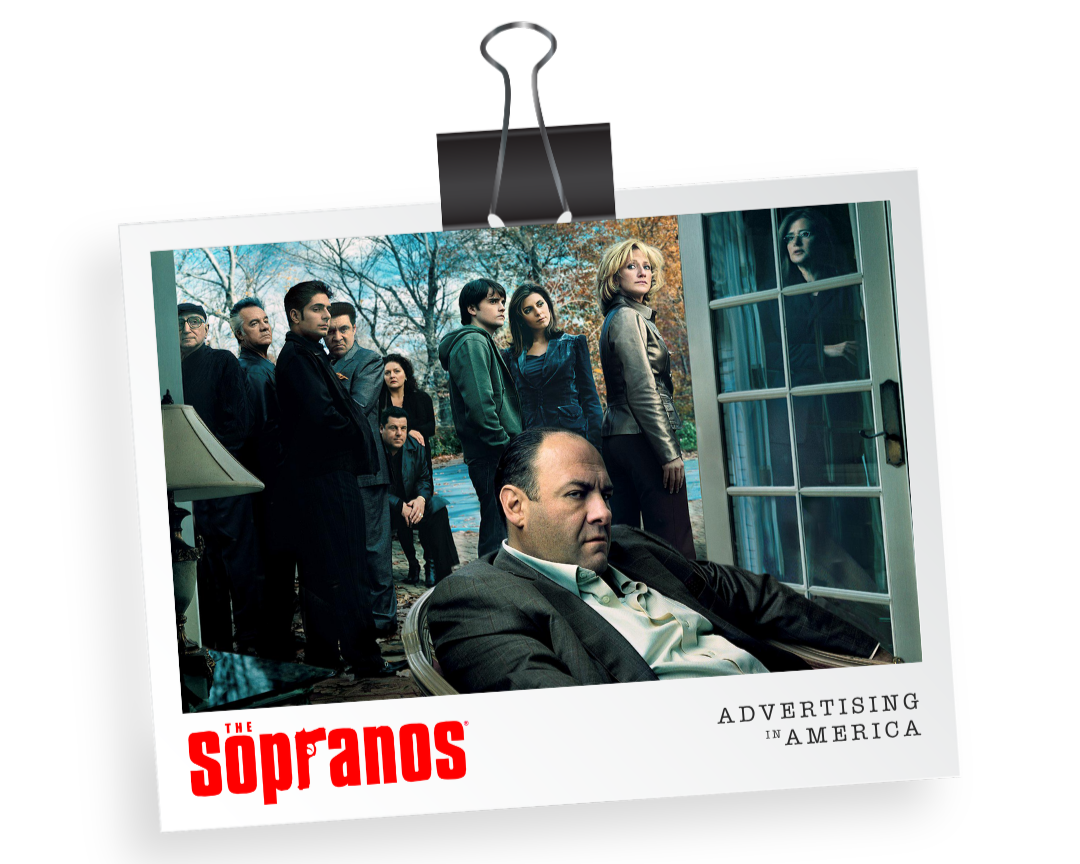
And then it got picked up, and then they shot the entire season, 13 episodes, before they ran the first one. So they had an entire season in the can before it went on television for the first time. And at the end, when they had them all done, they were like, "There's no way we're getting a second season."
"There's no way they're gonna pick this up because it's just too fricking different."
Now, in hindsight, it's very easy to say, "Oh, no, it was brilliant. It was awesome. It did all these things differently. It broke all of these rules." And now these are rules that, that are routinely broken. They are now almost in fact rules.
That's why we have Breaking Bad. That's why we have all these other programs where we have. That's why we have Dexter. It's why we have programs where it's like, "That's a terrible person, and I kinda like him, and I wanna see what he's gonna do next." So, it's easy in hindsight to say, "Bring me something different."
But at the time, everyone involved in that program was like, "There is no possible way this is gonna, this is gonna get picked up." And for us now to look at that, it's "That's impossible." It's like, "No, it's completely possible."
Chris Torbay: And that's partly why both in Hollywood and in advertising, the decision-makers often try to compare it to something they can research. Show me another campaign that did this kind of thing, and how did it perform, and let me compare it to a bunch of benchmarks.
If you're asked for an idea that, that comes at it in a new way, there is not going to be anything else that you could compare it against to say, "If we do this crazy thing, there's a good chance it could actually work," because there isn't one of those and therefore, you're the guy who has to take that painful risk.
Mick Torbay: And what have we learned since that program ended in 2006? Fuck all, that's what. Because what kind of movies are they making now? Another fricking comic book movie. Why? because if we make yet another Deadpool movie, we know that it'll sell. That's not different. That's just another one of those. We're actually afraid to do anything new, even though what you really should be doing is "Let's make the next Sopranos." That is to say, something that's never been fucking done before and be the guy. But that's freaking terrifying.
Ryan Chute: It is. But, fun facts. Fun facts. Bient & Fields…
Mick Torbay: It better be fun by the way, or I’m going to be pissed. I didn't curse in my rant, so I have to curse now.
Ryan Chute: This is it. Binet & Peter Field, The Long and the Short of It (IPA, 2013). Campaigns that hold the line for three-plus years deliver roughly 2 to 3 times the profit growth of campaigns that “refresh” every year. The boredom is the discipline is the point of that of that research.

The whole point of “I’m a Mac, I’m a PC” ran for seven years. 66 spots. Two characters. Mac went from under 2% market share to over 10%. Big boys playing in the big boy fields, going 10%'s a lot of computers.
Mick Torbay: That’s a lot of copies.
Ryan Chute: They didn't get different every quarter. They got familiar. Familiarity is what breeds it. And that leads us to a fun fact. Another fun fact. Horton & Wohl (1956). We’re going back to the heyday, this is the golden era of behavorial science. Psychiatry, vol. 19, they coined the term “parasocial relationship.” It’s the real emotional bond audiences form with consistent characters they’ve never met. It’s why you cried at the Friends finale. It’s also why your customer loyally calls the same HVAC company every time they don’t know you personally, but they feel like they do know you.
%2C%20Psychiatry%2C%20vol.%2019.png)
Mick Torbay: They feel like they do. And that's actually more important.
Ryan Chute: That's much more important. And it comes back to this whole idea of the story as the differentiator. And it's not the wrap, it's not the logo, it's not the five-star service guarantee, despite what people from stage might be beaking off about. Most of that stuff is nonsense. Real talk, your customers cannot tell your truck wrap apart from your competitor's truck. It's invisible. They've all got a smiling mascot holding a wrench on the side. The wraps just start to blur together when they all start to look the same. Your customer thinks every HVAC company is basically the same. Every plumber, every electrician, the same stock 1950s cartoon, same uniform, same speech about quality and service and family-owned heritage. None of it really matters because none of it actually makes people feel.
The only thing that we can actually tell apart is how you made them feel the last time you showed up. That's the brand. That's literally the message, the story. The weird way that it's told is what's actually moving the needle for you. It's not the generic nonsense that keeps coming out of your mouth on a radio ad or a billboard, or what's on the side of a truck. It's what you say that makes people move.
Fun fact. Antonio Damasio, Descartes’ Error (1994), with follow-up peer-reviewed work in Cerebral Cortex (Bechara, Damasio & Damasio, 2000). I actually did do the research with actual real research. The somatic marker hypothesis: Patients with damage to their emotional centers literally cannot make decisions. Not even small ones. Because every decision is emotional first, rational second. This is actually tested in the brain. The “rational” part is the story we tell ourselves about a feeling we already had, which is really just storytelling inside our brain between the left and right hemispheres to get the part. Even when we actually make the decision on the rational side, the emotion has to make the choice.

So you have to be able to release yourself into the wild to feel right about the decision. People don't decide who to call when their AC dies. They ‘feel’ who to call.
Mick Torbay: They feel good about something.
Ryan Chute: They reach for the company they've had feelings about. Maya Angelou? Angelou. Angelou. Angelou said it better than anybody,
"People will forget what you said. People forget what you did, but people will never forget how you made them feel."
One of the most brilliant points ever made in the history of storytelling.
Mick Torbay: I think what business owners really need to do is they need to decide which side of that line they're going to be on. Are you going to be one of many, or are you going to be the one that's gonna stand out? And it's very easy to say, "Oh, I wanna be the one that stands out." And I think what we're here at this table saying out loud, and almost nobody ever says it, is “No, seriously, this is a harder question to answer than you might think.”
Because if you want to be the one who stands out, that does carry with it some risk that you might not have considered. You, there is no easy way to say, "I am going to stand out." You're going to have to risk money. You're going to have to risk reputation. You're going to have to risk, you're going have to make sacrifices that the people who are going to head down the middle of the road won't have to make. And not everybody's cut out for that, and it's okay to say, "Hey that's not the, that's not the place for me."
One of the partners in my airplane, runs a $10 million business, and he has no desire for it to be any bigger. He's perfectly happy. He has lots of time. He's making some money. And he does not want to take over the world. And I respect him for that. He's not under any delusions.
A lot of business owners are under delusions. They think that something magical is gonna happen. It is not. If you want to become a leader, if you want to take over your industry, if you wanna be the one that everybody's paying attention to in your market, you have to do something big and different and scary. And if you want to do it, you can mitigate that by working with people who do big and different and scary for a living, the Wizard of Ads group being one of those outfits. But to some degree, you can do that with any marketing company. You just have to dare to say to them, "We're going to do the crazy shit."
We're not just gonna do the straight-ahead down the middle thing. We're actually going to have some fun.
Chris Torbay: We're not going to focus group it because the focus group's going to be in the same position where they go. They're going to tell you right to the set ... "I don't know about that ad, man. It doesn't look like any ad that I've seen on TV." And so they're going to inject even more uncertainty into the process. That’s if you ask them. At some point, you just have to say, "I'm going to go for this."
Mick Torbay: Part of this is asking yourself who you are. Like, what kind of person are you? And be okay with that.
It's not whether you're a good person or a bad person, it's just let's decide whether you're an empire builder or not.
Because not everybody is. Most people probably aren't.
Ryan Chute: And let's all stack hands, that different is by definition change, and change for most people is terrifying and very difficult to implement into their businesses. While so many of them say, "Say whatever you need to say to get the job done," we're saying, "Tell your true story in a unique way."
And there's a fundamental divide between those two concepts, if you're going to lie your way to success, guess what? You're going to go out of business because good advertising's only going to accelerate you into the thing that was already going to happen.
Mick Torbay: And people can see through that shit so easily.
Ryan Chute: It's superficial, but it's also contrived. As you said, people are gonna see through it. But then there's nobody that's going to back you up in, in your culture. It's "That's not us. That's not what we do. That's not what we say. You say all these funny things. They come here, and then they get a totally different experience." Guess what?
I have always said and will continue to always say that your operation and what you deliver, the experiences you deliver to the buyer, are going to be the number one branding exercise of your business. There is nothing else that does more branding than your own experience, and that's just a fact. No matter what we do.
Mick Torbay: Marketing needs to follow that, not the other way around.
Ryan Chute: That's right. That is marketing in so much as done right, your marketing becomes word of mouth through referral and repeat business, much more than it becomes acquisition of new customers. There's no city in America where there's an endless array of customers. So ultimately, it comes down to there's a certain amount of people who are going to want to do business with you the way you do business. How do you get them coming back and craving more and letting their friends know that you're only, that you're the only guy in town?
Mick Torbay: But you don't solve that problem by having marketing write checks that you can't, that your team can't cover.
Ryan Chute: Absolutely. Absolutely. And there are a lot of ways to tell really interesting stories. I think one of the biggest mistakes that's told in storytelling, for home services in particular, is the hero story where they assume that they're the hero.
They're not the hero, they're the guide.
Mick Torbay: I am terribly important.
Ryan Chute: Yes. And that they're coming to save the day when, in fact, what they are is the old man in the woods helping the hero, our customers get the result that they're looking for to overcome that villain, whatever it might be, the hot water being out, the Mother Nature, the whatever. All of these end up changing how stories are told. Good storytelling is hard. Good storytelling when you don't know what you're doing is-
Mick Torbay: Damn near impossible .
Ryan Chute: Well, it's embarrassing to see some of the stuff that we have seen.
Mick Torbay: Most people frankly don't even try, though. You're actually criticizing the people who are at least trying, and that's not most of them.
Most of them are quality, service, selection, price, convenient location, free parking, and we have professional staff who really care about your needs. My God.
Ryan Chute: So little bonus material here. Distinction's what gets you noticed. Familiarity is what gets you hired. Every campaign we still talk about, Old Spice 1984, Got Milk, Whasssup, Mac versus PC, ran long enough for the audience to fall in love. That's the broad strokes right there.
The brave idea is half the equation. The patience the patience is the other half.
Most folks quit before the patience part starts paying off. So these are the things that we want to start thinking about when we think about, how are we going to advertise our business?
It's going to be I need to tell a bold story. I need to say something that matters. I need to be okay with it being a different story. I don't need to run a different operation that I have to get my employees bought in, because if my culture doesn't deliver on what my brand promises, then the brand is going to be what your culture delivers.
Chris Torbay: Maybe that's an interesting, reassuring point to wrap it up for people, is if you take that approach that you just talked about with consistency and a long-running story, maybe that makes the initial freak-out a little easier to take.
You only have to throw yourself out of the airplane once every time you parachute, and that moment of "Am I going to throw myself out of this airplane or not?" only happens once. Once you do, and you pull the rip cord, and the chute opens, now it's actually a ride that you can stick with, and you're still up there, and there's still things to worry about. And it's fun.
But that moment of plummeting over the edge happens at the beginning when you call your ad guys, and they say, "Okay, here's this thing. We're going to have two penguins, and they're gonna be mud wrestling." And then you go, "Oh, my God, that does not look like anything that I've ever seen before."
You will have... That, that's the moment of throwing yourself out of the airplane. But then the more you stay with it, the more you are dedicated to it, the more other aspects of your business start to pick up on that idea, and it becomes the whole thing that you are known for, then it gets more and more tolerable as you move on.
And maybe that's the reassuring thing, "Don't worry, this is going to freak you out in this meeting, but it's going to get better from here. If you can get past this, if you can write the check this time, it's going to get better, and it's going to get better, and it's going to get better. This is not going to be what it is like to work with me for the next five years."
Mick Torbay: And if you're not good at this naturally, for goodness sake, don't do it yourself. Find somebody who's good at this.
Ryan Chute: It's the who not how concept. If you wanna get there fast, if you're looking to dominate your marketplace, you're not going to do it yourself.
You're going to do it with the help of others, the experts who know what they're talking about. If you try to do it yourself, bring it in-house, but even then, you have the danger of your in-house person getting infected with the curse of knowledge, and this becomes one of the big challenges that you have to consider when you're doing something different. It's so easy to fall into the trap of information. But information has never led to transformation, ever. It's always transformational storytelling that moves others to take action. Not even inspire them, not even get them excited about it, but to literally take the step that needs to be taken to get you to the next level of revenue.
Ryan Chute: So look. If you’re running an essential home service business in America, heating, air, plumbing, or electrical, here are the three things I’d want you to walk out the door with.
- Stop chasing “different.” Create a unique story, not a unique value proposition. The best ad campaigns are like micro-sitcoms. Same characters. New situations. Month after month. Year after year. Pick truths about your business and stay married to it long after you get bored with it.
- It’s never been your truck wrap. Or your logo. And nobody cares that you’ve been “family-owned since whenever.” You could replace your name with literally any competitor. The only thing your customer can actually tell you apart from the herd is the way you made ‘em feel. The feeling is your brand. Make somebody feel somethin’ real good, and anchor it to the pain they feel when something you can sell them breaks. They won’t call anyone else.
- Tell your TRUE story. Not the one you wish you had. Are you funny? Earnest? A bit of a renegade? Are you the hero who shows up at 11 p.m. when the AC dies on the hottest night of the year? Find the authentic story, then figure out how to tell it in an entertaining way. Maybe you get a mad scientist and a British librarian to tell that story?
If you don’t hear anything else, hear this. You do not have to be more clever than your competition. You don’t even have to outspend them. And you certainly don’t have to chase whatever shiny new platform showed up on Tuesday.
You just have to be more like yourself than your competitor could ever hope to be.
Then stick around long enough that folks can only imagine your truck pulling up their home. Go tell your story in a weird way. And do it long enough that you become the company they raise their kids on.
Until next time, this is Advertising in America. Thanks for tuning in.
Thank you for joining us on Advertising in America. We hope you enjoyed the show and captured a nugget of marketing magic. Wanna hear more? Subscribe, leave a review and share this podcast with your friends.
Do you have questions or topics you want us to cover? Join us on our socials @advertisinginamerica.
Wanna spend your marketing budget better? Visit us at wizardofads.services to book your free strategy session with Ryan Chute today.
Until next time, keep your ads enchanting and your audience captivated.
Branding
.webp)
The Thinking Behind the Rebrand -Owning a Headspace
Learn how strategic branding, memorable storytelling, and distinctive design transformed Cornerstone Garage Doors into a scalable, nationally recognizable brand.
For years, Cornerstone Garage Doors was a solid, dependable name in the Tennessee garage door market. So when the team behind Cornerstone decided it was time for a bold new chapter, they didn't just want a new name. They wanted a brand with a soul - one built to scale nationally, told as a story, and impossible to confuse with anyone else in the category. The result is Dad & Daughter Garage Door Service, an incredibly rewarding project for Elastic Studio.
A strategy worth building on
This rebrand started in exactly the right place: strategy. The Ryan Chute Group did the foundational work — the positioning, the market thinking, and the name itself - and it's a genuinely brilliant one. "Dad & Daughter" instantly does three things at once. It signals family-owned and trustworthy. It promises something warmer than the typical trades brand. And it sets up a story - a real, ongoing narrative about a father and daughter building something together - that can carry the company across radio, advertising, vehicles, uniforms, and community touchpoints for years to come.
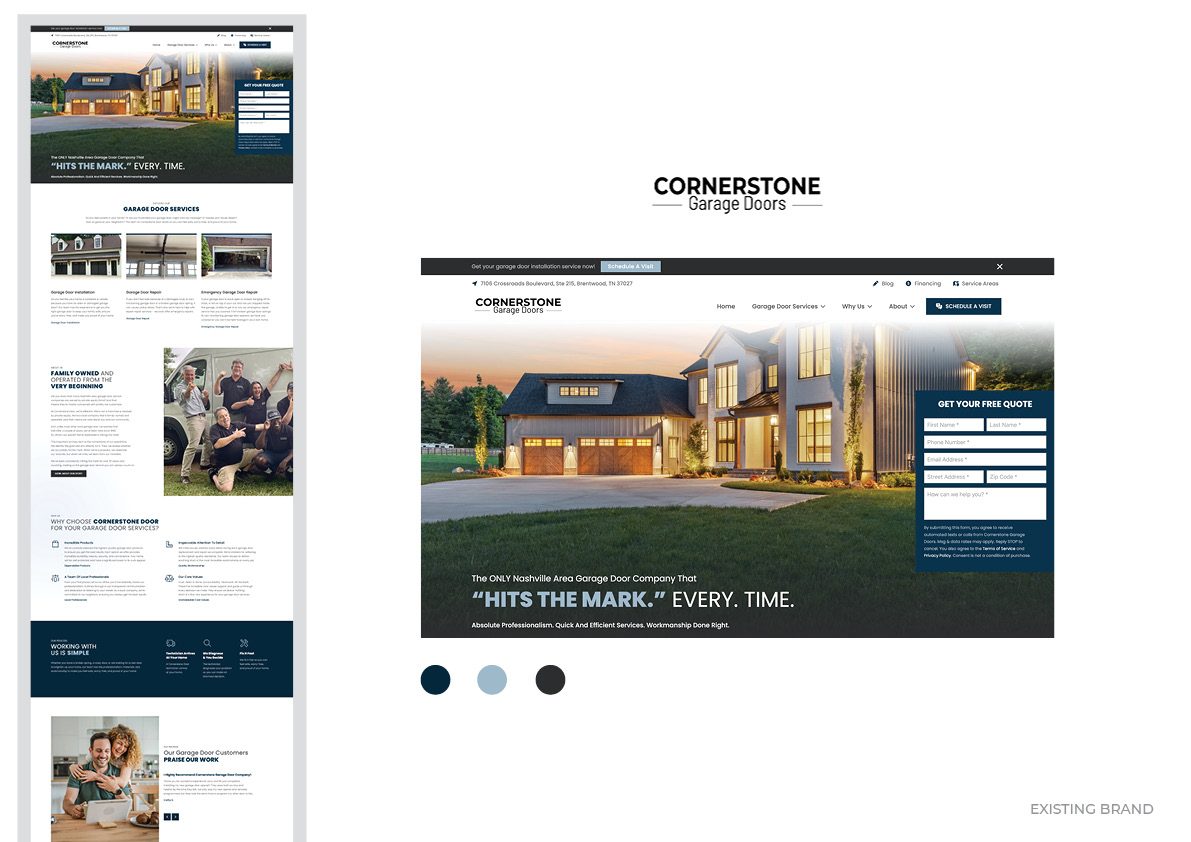
Once that foundation was in place, Ryan Chute at Wizard of Ads for Essential Services brought Elastic Studio on board as their creative partner to bring it to life — to take that strategic platform and give it a face, a voice, and a visual system strong enough to carry the weight of that story. One that would work as well on a van in a driveway as it would on a billboard, a t-shirt, or a business card.
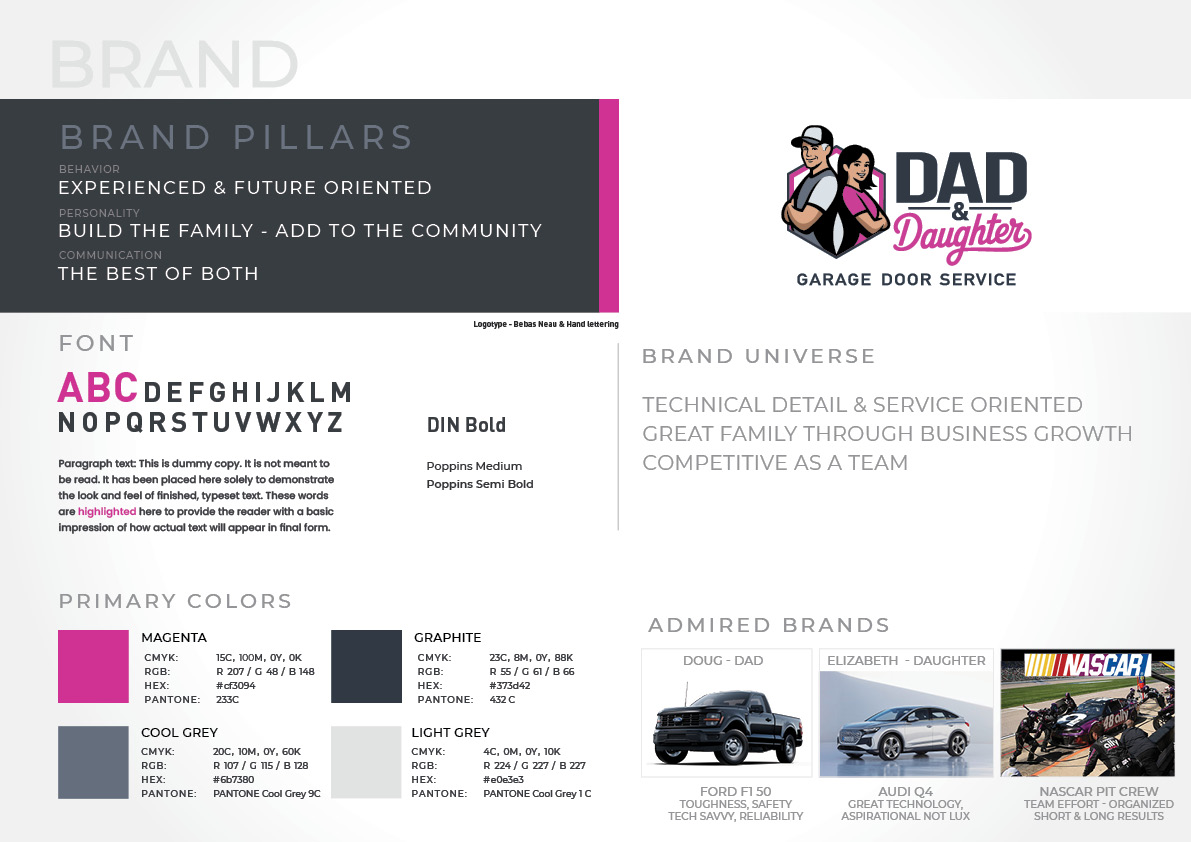
The "best of both" concept
The heart of the brand comes down to a simple but powerful idea: book smarts meets street smarts. Dad brings decades of hands-on, hard-earned installation expertise - the guy who leads a team that can can diagnose a garage door problem and delivers precision work. Daughter brings a university education and sharp business acumen — the person modernising operations, building the customer experience, and thinking about where the company goes next.
Crucially, this is a partnership of equals. One of the clearest creative briefs we worked from was an explicit rejection of the tired "dumb dad" trope so common in family-business branding. Neither character outshines the other. They stand back-to-back, arms crossed, equally confident - a visual handshake that says "we've got this, together."
"Tough and technical, but never flashy for its own sake."
To find the right tone, we looked at brands and cultural references that captured this dual identity: the rugged dependability of a Ford F-150, the understated sophistication of an Audi Q4, and the disciplined teamwork of a NASCAR pit crew — tough, technical, and tightly coordinated. That blend of toughness and intelligence, of blue-collar and white-collar, became the DNA of everything that followed.
Standing out in a crowded, colourful market
Before a single pixel of the new identity was designed, we did our homework. The residential garage door category in the region is dominated by two major players - and both of them lean hard into bold reds, oranges, and deep blues and greens.
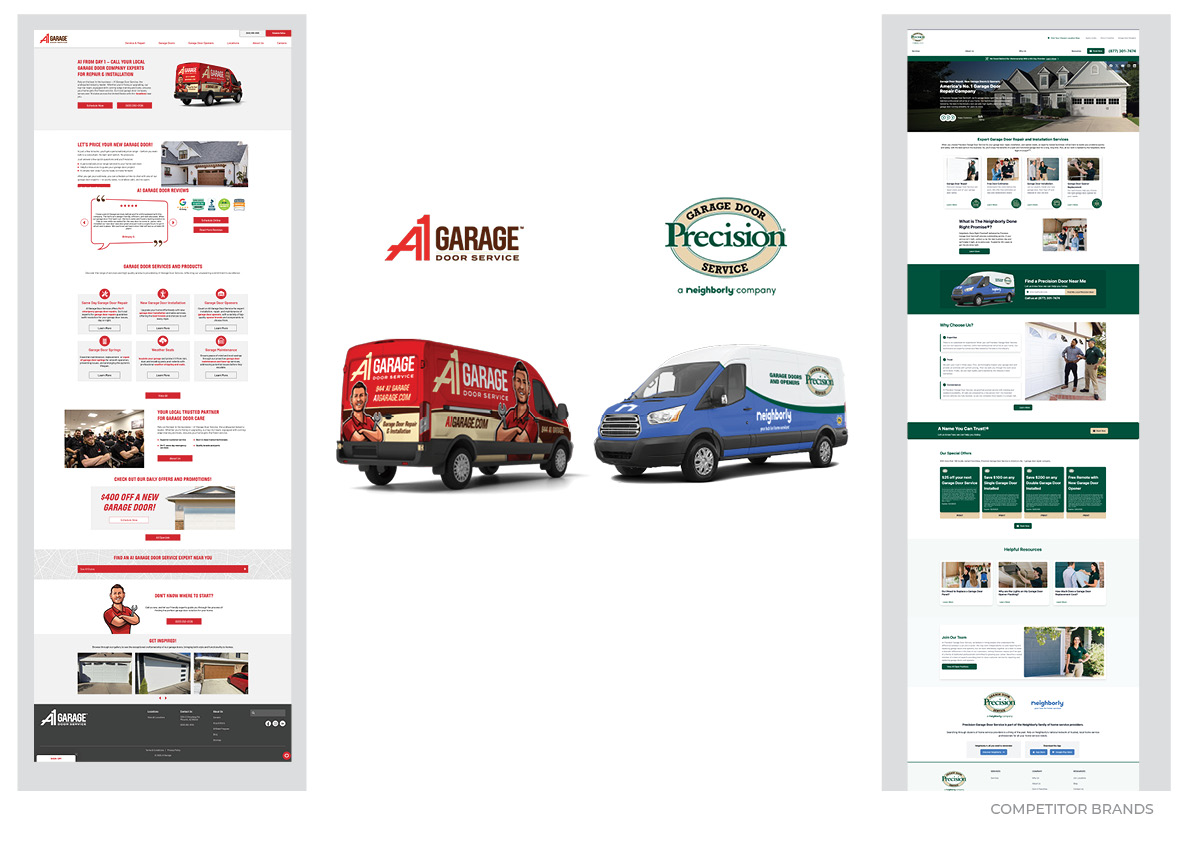
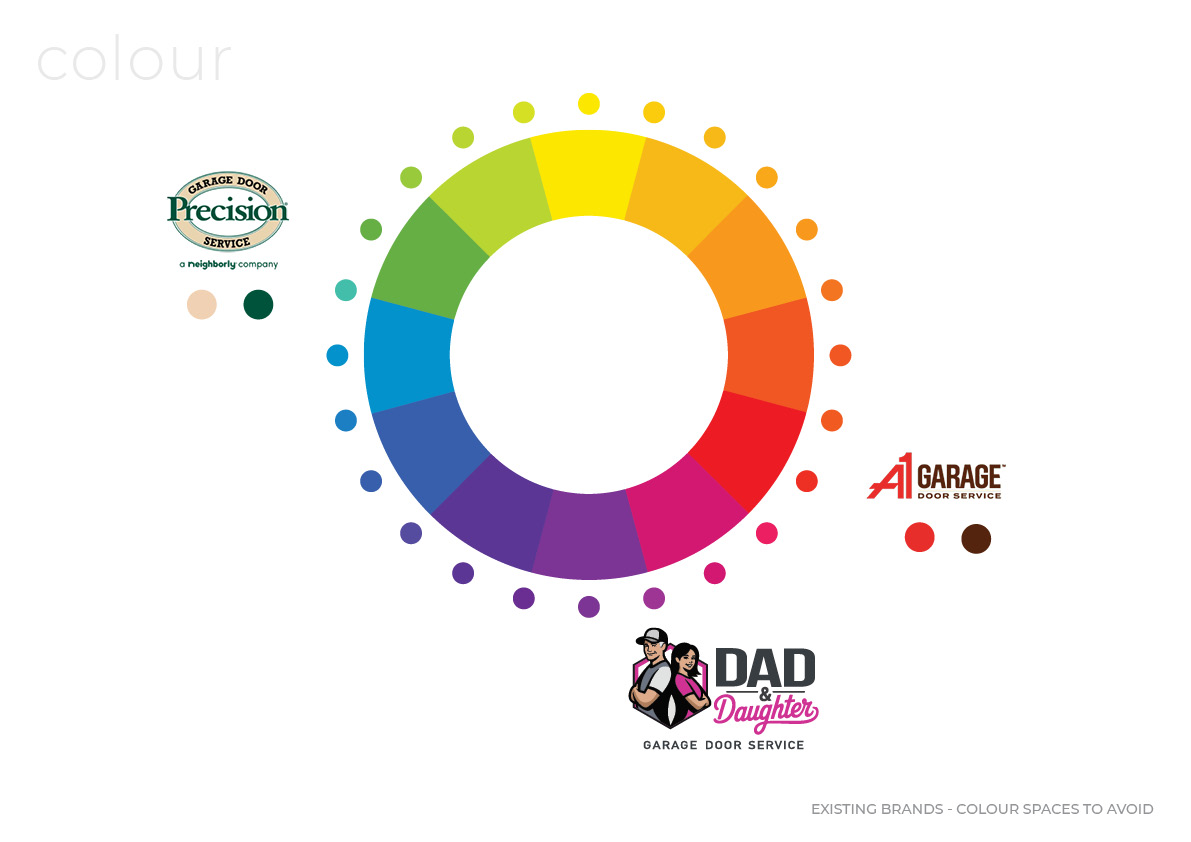
We mapped out the colour territory these competitors already owned and made a deliberate decision to go somewhere else entirely. The result is a palette built around deep graphite and a confident, saturated magenta — a combination that simply doesn't exist anywhere else in this market. It's bold without being garish, premium without losing approachability, and — most importantly — it's instantly recognisable from a distance. In a category where visual space has been very well owned, Dad & Daughter looks like it belongs to a different, better-run business altogether.
Characters worth remembering
At the centre of the new identity are Dad and Elizabeth (Daughter) themselves, illustrated as a mascot pairing that's warm without being cartoonish, and professional without being stiff. We explored dozens of reference points — from classic American mascots to modern tech brand characters — before landing on a style that feels approachable, contemporary, and built to age well as the brand scales.
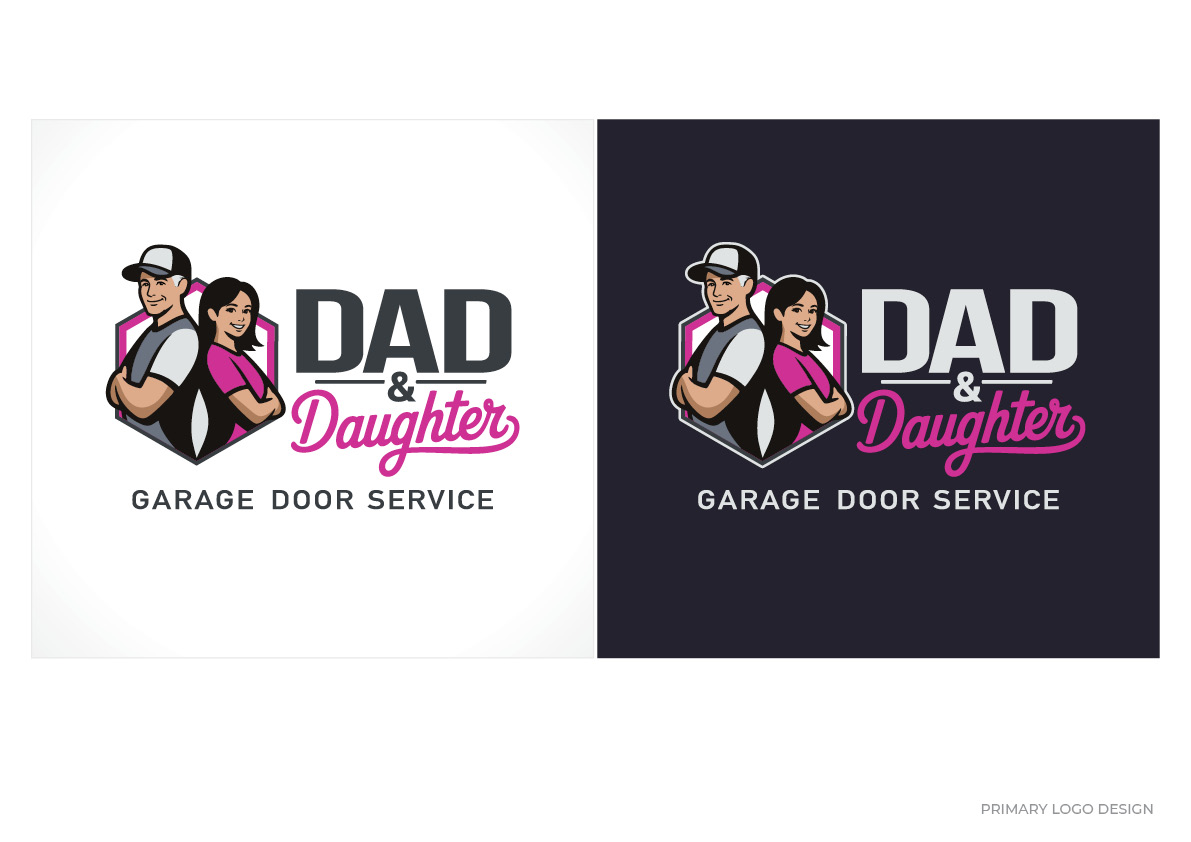
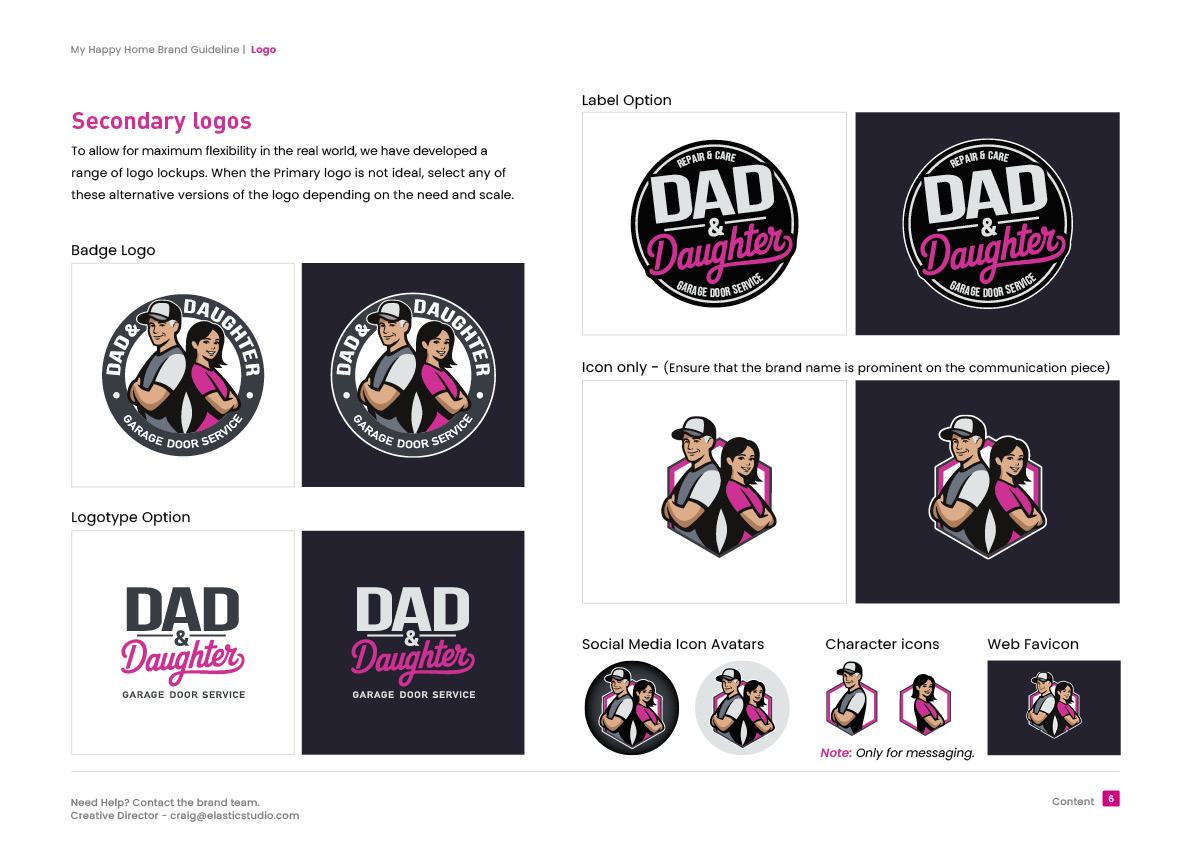
The badge-shaped icon nods to craftsmanship and structure — the kind of mark that feels at home on a uniform patch, a van door, or a hard hat sticker. Bold, uppercase "DAD" typography brings strength and durability, while "Daughter" is rendered in a confident retro script that adds warmth, personality, and a touch of nostalgia. Together, they create a logo that reads instantly, even at a glance from a moving car — which, for a brand whose vans are its biggest billboards, is exactly the point.
A system built to do the heavy lifting
A great logo is only the start. What makes a brand actually work in the real world is the system behind it — and that's where we spent much of our time. We developed a full identity architecture: primary and secondary logo lockups, a badge version, a circular "repair & care" stamp, social media avatars, and standalone character icons for messaging and community communications.
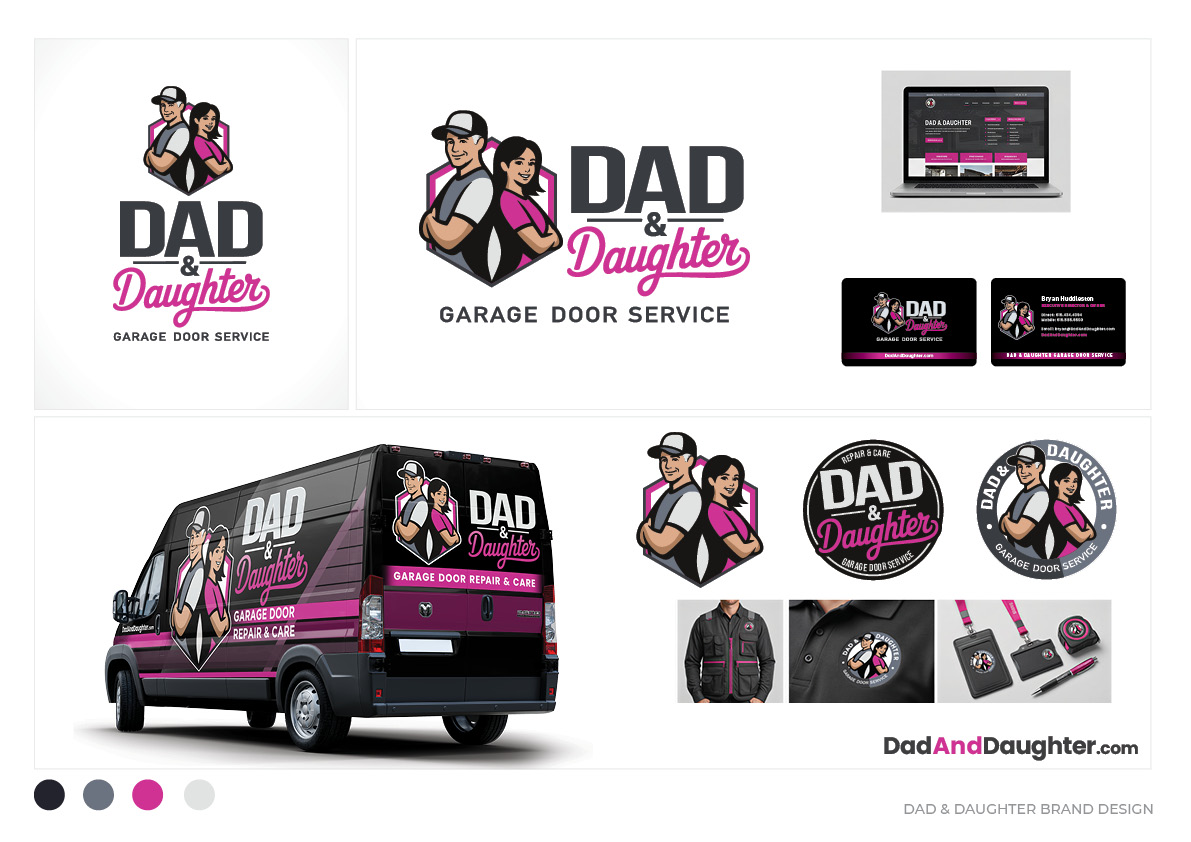
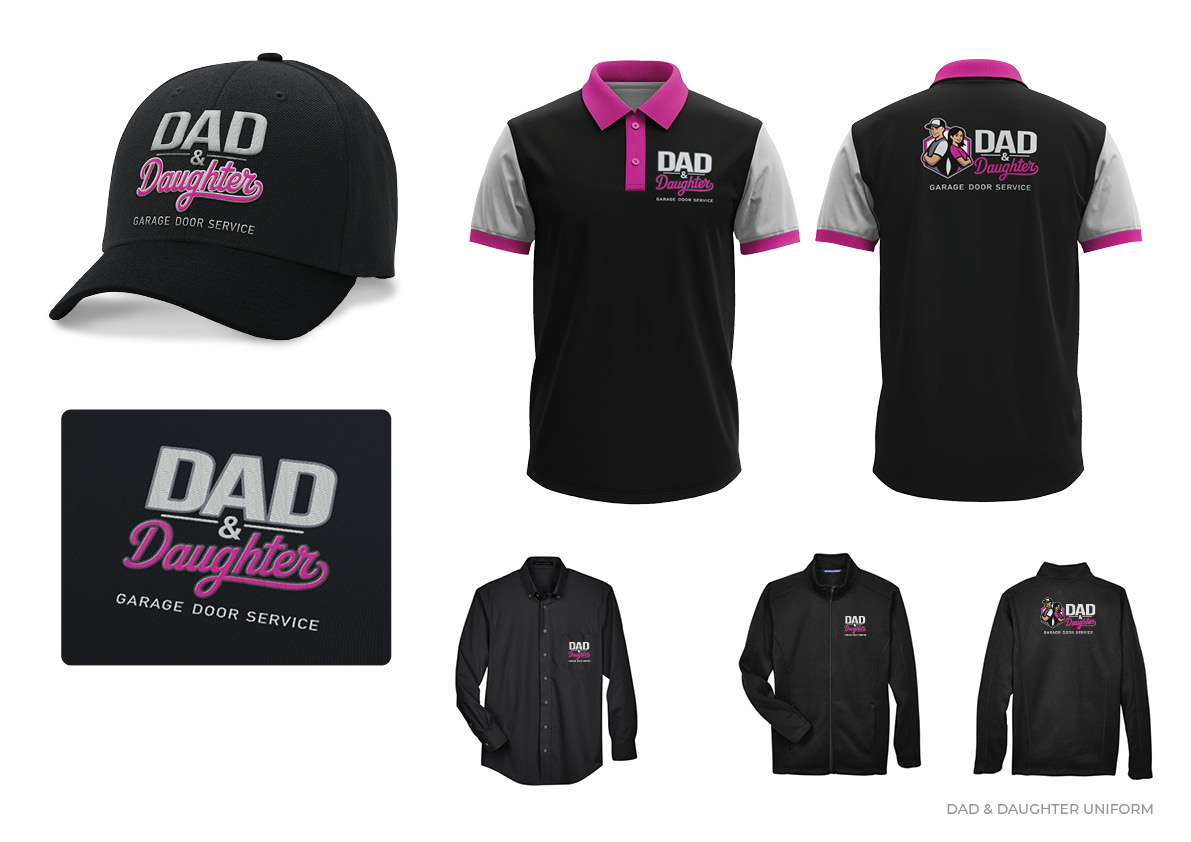
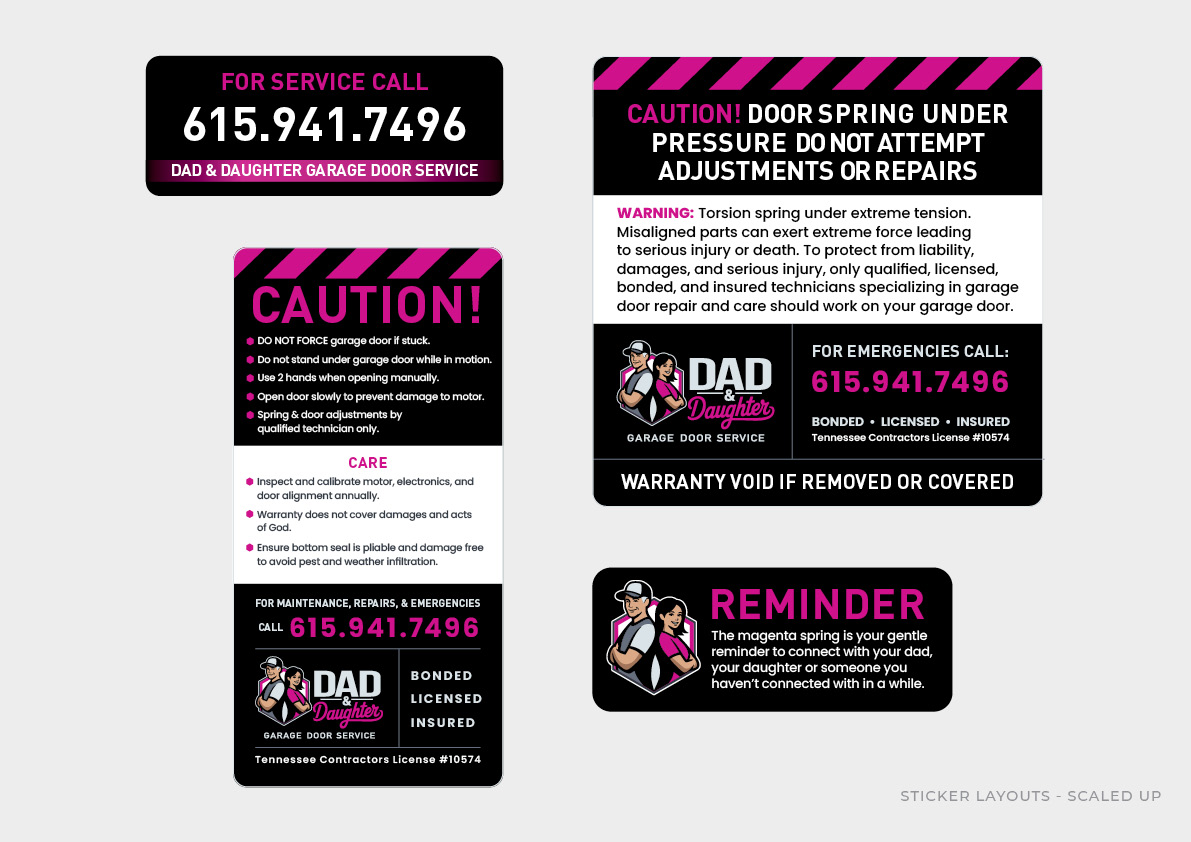
Then we put it to work. Full vehicle livery designs for a Ford Transit van and a RAM 1500 pickup bring the characters and colour palette to life on the road - bold enough to be seen from blocks away, but cohesive enough to feel like one unmistakable brand. Uniform designs carry the magenta-and-graphite palette through polos and caps, with the characters embroidered front and centre. Business cards, letterhead, and a full digital brand guideline round out a toolkit built so that — whether the company adds five vans or fifty - every new touchpoint looks like it was made by the same confident, considered hand.
This is the part of branding that doesn't always make it into the highlight reel, but it's the part that determines whether a rebrand actually sticks: a system robust enough that the brand stays consistent as it grows, scales, and reaches new markets.
A brand built to travel
What started as a local Tennessee garage door company rebrand has turned into something with genuinely national potential - a brand designed from day one to be "elastic" enough to grow, distinctive enough to be remembered, and warm enough to build real community loyalty along the way. That's exactly the kind of project we love: strategy, story, and design system working together, each making the other stronger.
We'd be glad to show you what's possible.
Branding

Brand Recognition Is Much More than Name Recognition
Unlock the secrets to brand recognition with insights from Wizard of Ads for Essential Services. Learn how effective strategies can elevate your brand and captivate audiences today!
We've all heard the typical phrase "get your name out there" when it comes to enhancing your business' brand awareness. But what's in a name? Nothing, really; unless you have an image, a feeling, or a message attached to it. Your brand's name is what customers will use to identify your company, but brand recognition is so much more than that. It's what people think of when they hear or see your brand's name. Creating brand recognition requires strategic marketing and consistent, creative messaging that resonates with your audience. If you want to create impactful brand recognition for your business, stay tuned. In this article, we'll go over some key principles that will make you a master at building powerful brand recognition for your business.
Understanding Brand Recognition
Brand recognition is the most important aspect of branding. It's what allows customers to truly connect with a brand and understand what it represents. Brand recognition goes far beyond the slogan, logo, and color scheme. It's the intricate mental image that is associated with the brand name. This includes not only sight, but sound, smell, taste, touch, opinion, and emotion as well. For example, when you see the golden arches of McDonald's, you might think of happy childhood memories or the taste of a juicy Big Mac. Or when you see the Nike swoosh, you might think of feeling strong and accomplished. These brand recognition examples show how customers can connect with a brand on an emotional level, which is what creates brand loyalty. When your brand's essence is everything that it stands for in the hearts of your customers, that's when you know you've got brand recognition that will stand the test of time. At Wizard of Ads for Essential Services, we believe that your brand's essence is what makes it recognizable, relatable, and ultimately, unforgettable. We've seen first-hand how important brand recognition is to a business's bottom line. If you're looking to create a brand presence that will last, we can help. Our team of branding experts can work with you to build a brand that truly resonates with your target audience. Book a call with us today to learn more!
Brand Recognition vs. Brand Awareness: Key Differences
When it comes to marketing, there is a lot of talk about brand recognition and brand awareness. But what exactly is the difference between these two concepts? Brand recognition is when consumers can identify a brand based on its features or characteristics. This could be something like a logo, slogan, or the way the brand's products are packaged. And, to go even deeper than that, the way the brand makes consumers feel as well as its values and how it resonates with them. Brand awareness, on the other hand, is when consumers are familiar with a brand but may not be able to identify it based on its features. This is more of a top-of-mind awareness, where the brand is one of the first that comes to mind when thinking about a certain product or service. For example, when you think of motorcycles, Harley-Davidson is likely one of the first brands that come to mind. This is because they have such strong brand awareness. Now, if you saw a motorcycle with the same shape and design as a Harley-Davidson, you would still be able to identify it as a Harley, even if there was no logo or name on it. You might also be able to identify a Harley based on the feeling of freedom and rebelliousness that it gives off or the sound of its engine. This is brand recognition. So which is more important for businesses? Ideally, you want to have both brand awareness and brand recognition as strong as possible, but brand recognition is often seen as more important because it leads to brand loyalty. When customers have brand loyalty, they are much less likely to switch to a competitor, even if the competitor’s product is cheaper or better.
Core Elements That Shape Brand Recognition
The most important aspect of brand recognition is the core value that it represents. A brand should be more than just a name or logo — it should be a representation of what the company stands for. Customers should be able to identify the brand's core values and feel confident that they align with their own personal values. When customers feel confident in a brand's overarching message, they are much more likely to become returning customers and brand evangelists. This is because they know that they can trust the brand to deliver on its promises, and they feel good about supporting a company that shares their values. Furthermore, brand knowledge creates a sense of loyalty among customers, which can lead to long-term relationships and higher levels of customer satisfaction. Many other factors contribute to brand recognition, but some of the most important ones include strong brand identity, consistent exposure and positive brand associations.
- A strong brand identity: This includes elements like a recognizable logo, consistent branding across all touchpoints (including online and offline) and a clear brand message.
- Consistent exposure: If people don't see your brand regularly, they're less likely to remember it. Having consistent brand exposure through advertising, PR and other marketing efforts are crucial to drive awareness and brand recognition.
- Positive brand associations: If people associate your brand with positive experiences and attributes, they're more likely to remember it.
Above all else, your brand should resonate in the heart of your customers by delivering an experience that is unique, memorable and brings about positive emotions.
Defining What Your Brand Means to Your Customers
What does your Brand Stand for in the Heart of your Customer? Your brand is what your customers think of when they see or hear your company name. It's the promise you make to them about the quality of your products or services. And it's the emotional connection they feel when they interact with your company. When you're clear about what your brand stands for, it's easier to connect with customers and create a lasting relationship. After all, people buy from companies they know, like and trust. Here are a few questions to help you get started:
- What are your core values?
- What do you want to be known for?
- How do you want customers to feel when they interact with your company?
- What makes you different from your competitors?
Answering these questions will give you a good foundation for understanding what your brand stands for. From there, you can start to build a strategy for connecting with customers and creating meaningful relationships.
Aligning Your Brand with Core Values
Your brand is linked to a set of values that guide everything you do. These values shape how you interact with customers, what kind of products or services you offer and how you want to be perceived in the marketplace. Some common values that brands are linked to include: quality, innovation, customer service, integrity, social responsibility and community involvement. When customers know what your brand stands for, they are more likely to connect with you on a deeper level and become loyal advocates. So it's important to make sure your values are clear and easily communicated to everyone who comes into contact with your business. Here are a few things to keep in mind as you work on articulating your brand's values:
- Keep it simple. You don't need to list out a laundry of values that your brand represents. In fact, too many values can actually be confusing and make it difficult for customers to understand what you stand for. Stick to one to three core values that you feel best represent your brand.
- Be authentic. Your values should be an accurate reflection of what your brand is all about. Don't try to be something you're not just to appeal to a certain customer base or market segment. This will only backfire in the long run and damage your reputation.
- Be consistent. Once you've settled on a few key values, make sure everyone in your organization is aligned with them and knows how to put them into practice. Consistency is key when it comes to values-based branding.
- Be flexible. While it's important to be consistent, you also need to be flexible enough to adapt your values as your brand evolves over time. As your business grows and changes, so too should your values.
- Be patient. Building a strong values-based brand takes time and commitment. It won't happen overnight, so be patient and stay the course.
Building a Brand That Inspires and Lasts
Brand recognition is the lifeblood of what makes a brand powerful in its influence. Name recognition is important, but without the image and feeling that comes with it, your brand will struggle to stand out. That’s where we come in — at Wizard of Ads for Essential Services , we help businesses build disruptive brands that become not only a household name, but a household philosophy. So if you want to increase brand awareness and create or update your brand image, story and presence, book a call with us today. We can’t wait to get started!
Advertising
OTT Advertising: The Secret to Dominating Your Local Market
OTT advertising has exploded and so has the number of people selling it without knowing what they're talking about.
Everybody and their dog is selling OTT right now.
Radio stations. TV stations. Outdoor companies. Your dry cleaner probably has a deck.
But here's what they're not telling you: most of what's being sold under the OTT banner is overpriced, under-measured, and bought from someone who has absolutely no idea what they're doing and even less incentive to admit it.
In this episode, Ryan Chute sits down with media buyer Beth Radtke and Wizard of Ads partner Ray Seggern to cut through the noise around Over the Top advertising; what it actually is, where it actually works, and how to avoid the traps that are quietly bleeding businesses dry.
The conversation pulls no punches. From Comscore's measurement sleight of hand, to the dangerous gap between impressions and actual people in the room, to the Atlanta case study where one buyer got 5,000 households and another got 25,000 for the exact same $5,000 — this episode is a master class in media buying clarity.
Because the medium isn't the problem. Buying blind is the problem.
Episode Highlights
- Media Agnostic or Media Commission? — The single most important question to ask before taking any media advice.
- What OTT Actually Is — And how connected TV, streaming, and broadcast now all occupy the same living room with different rules.
- The Frequency Minimum — Why OTT sellers push frequency caps and why that's exactly backwards from what works.
- Impressions Are Not People — The measurement gap between IP addresses, households, and actual human beings watching your ad.
- Who's Measuring Who? — Why independently verified data matters and what happens when the seller also owns the measurement tool.
- 78 Steps From the Source — Why buying OTT through the wrong vendor means paying a premium for the bottom of the barrel.
- The Atlanta Case Study — Same budget. Same geography. 5× the reach. The difference was who was doing the buying.
- Live TV Is Back — Why appointment viewing is growing inside streaming and why that changes everything for local advertisers.
🎧 If someone is trying to sell you OTT right now, listen to this episode before you sign anything.
👉 Are you buying media or just buying someone else's commission?
📱 Subscribe wherever you get your podcasts
💥 Brought to you by Wizard of Ads for Essential Services
📞 Book your complimentary 45-minute strategy session with Ryan Chute
Today, we have two special guests with us to talk about OTT.
OTT, even though it ends up a little bit more expensive on a per-person basis, for a business that's not prepared to handle a whole DMA, it's a solution.
What's fascinating now about something, if you're not looking at reliable, objective, disinterested, meaning there's no skin in the game, that the owner of the measuring tool is also the owner of the thing being measured, then it's unreliable.
Be very, just deeply cautious of who you're buying your OTT and streaming from. If you're 78 parts removed from the center, you're going to be paying a small fortune for something that you could have bought for considerably less.
When it comes to OTT, how do we know that the ads that you buy on OTT are actually being played?
Ryan Chute: Welcome to Advertising in America, where today we have two special guests with us to talk about OTT. Yeah, you know me. Okay. Are you down with OTT?
Ray Seggern: I'm not entirely down with OTT, but I hope to be more down with OTT as the show goes on.
Ryan Chute: Let's get into it. We have a wonderful guest, Beth Radke, here, who's going to talk to us about OTT and the pros and cons, the good, the bad, the ugly, and senior correspondent from Austin, Texas, Ray Seggern, who's spent many years.
Ray Seggern: From the great nation of Texas.
Ryan Chute: That's right, the great nation of Texas, who is going to talk to us about some of the challenges that he sees, some of the benefits that he's seen and what the landscape has looked like and how it fits into this landscape. Let's jump into it with you, Beth.
Chris Torbay: What is OTT?
Ryan Chute: What is OTT?
Chris Torbay: Explain it to me like I'm about this old.
Beth Radtke: OTT stands for Over The Top. It refers to anything that's delivered, content that's delivered to you over the internet, as opposed to the traditional way that we knew with the bunny ears and a TV, or cable. There's a difference between OTT and connected TV. Connected TV, of course, is just the delivery of that advertising or content through the TV that's connected to the internet. So that's the differentiation between the two. And of course, it's had a huge growth over a period of time now.
.png)
I think if you look back to 2011, which sounds like a long time ago to those of us who are a little older, but in 2011, about 83% of households were connected to cable TV. So they were primarily getting all of their content through the TV was cable-driven. Today, that number is somewhere in the 30% range. So if you look at cable subscribers going from 83 to 33 from 2011 to the current, that's a pretty dramatic shift.
Chris Torbay: So, just so that I understand it fully, what's the difference in terms of what advertising is in that content compared to cable?
So if you're watching cable and it's 2011, when we go to a commercial break, those ads come from where? How do they come from the station, and so, therefore, they go to everybody in the range of that TV station. Those ads are being run at the station, or I guess they're being run at the network, but local ads are being run at the station, and they're going to everybody in my town who's watching that through cable. Now that we are watching some of those same channels, some of that same content, but we're watching it through our computers or through our connected TVs, which is basically through the internet as well, now, where is that advertising coming from, and so then how does that lead to how we think about it?
Beth Radtke: So that distinction, the cable system, that's one platform of advertising, so those people who are watching through cable or broadcast, regular broadcast, are seeing one set of ads. People who are watching on streaming are seeing a different set of ads, and that set of ads is going to vary. I could be getting a different ad than my next-door neighbor, even if we're watching the same exact thing at the same time, which is really hard for people to understand, and it's the big difference. It's a different break than what we're used to with traditional TV, also, where there would traditionally be a series of spots that would run in blocks of five or so, and that's different on streaming. Usually, on streaming, you only see one or two. Sometimes the content is being matched, so they already have five spots laid in for a typical show, so the streaming live version of that will
Chris Torbay: Puts the commercial breaks in the same spot that they put five, if it's a drama, it's going to be the five commercial breaks.
Beth Radtke: Yeah. And because more and more streaming TV is now live, that's like the biggest growth sector of streaming TV right now, and you'll see more of a transition to that. People are watching more live sports and live news, it's really the fastest growing segment, as opposed to on demand, which is, the way we all got introduced to it, like through Netflix and some of those common places. But most households now have an average of four streaming apps that they use.
Chris Torbay: What's the opportunity for the advertiser now, knowing that people are getting their opportunity for streaming? What's the opportunity for them in terms of targeting, I assume?
Beth Radtke: There are a lot of different businesses that this would work well for, and I think when you look at who it makes sense for, it would be anybody who has a specific area they're trying to target, so a geography. We talk a lot about when you have geography that doesn't align exactly with the DMA. So say you're in a big city like Chicago, but you don't service all of Chicago. Then it makes sense to just place your advertising in the zip codes where you really want to be and talk to just those people, and then that allows you to scale up in a more natural way, rather than stretching yourself thin.
Chris Torbay: So, if you put your ads on broadcast on the major networks, you're talking to everybody. You go everywhere. If you go on OTT, I can just buy Evanston, or I can just buy a neighborhood or a couple of neighborhoods or whatever and only pay for those people.
Beth Radtke: And then you can scale up from there. We love broadcast because from an efficiency standpoint, that's the most efficient; you pay the least amount per person per year when you advertise on broadcast.
It's still one of the best vehicles. Even though viewership is changing, it's still one of the best vehicles for reaching many people frequently over a period of time, which is one of our objectives for building great brands. But I think that OTT, even though it ends up a little bit more expensive on a per-person basis, for a business that's not prepared to handle a whole DMA, it's a solution.
Ray Seggern: Hey, Beth, so I know there's a lot of new opportunities with OTT, but one of the things that we've done with my clients through the years has been cable TV, and cable, obviously, you can't target down to the zip code level. It's just whatever their predetermined zones are, they give you the grid map. And so I've got clients that have, like in Seattle, for example, we don't want to service all of Seattle. We essentially have three of the zones on the grid, of the cable grid, with I think it's Comcast there. So, two of them are perfect hand-in-glove fits, the third not so much. And so I’ve been slow to adopt OTT and connected TV, and I'm curious, as somebody who's studied it a lot more, at what point does it make sense to pull off of cable and either switch entirely to OTT or to mix it up a little bit?
Beth Radtke: I think what I'm seeing and hearing a lot of is not abandoning our successful approach wholesale, but I think some sort of measure of blending, maybe to better address the geographic concerns of the advertiser. So even if it's partially OTT, and then using your cable budget as the basis. And for us, that would be another thing we would do is take a base buy and then augment it or layer it so you have that kind of cross-cumulative approach where we're getting frequency in multiple different ways.
Ryan Chute: This goes back to the tenets of ROI and Wizard of Ads, where we want to dominate a particular medium before we start to look at dominating a second one, where we get to diminishing returns before we start seeing value in a second one, particularly one that's going to be more inefficient than the first one. So we always prioritize the highest efficiency to the lowest efficiency for cost, right? We want to keep the cost as low as possible for clients.
The second thing is, what is it that's creating inefficiency in it? One, it's a smaller market. Now, if you're only serving one-tenth of Chicago, then the inefficiency would be trying to serve all of Chicago, right? The drive times for too few trucks, all of those things would be just as detrimental to the business as spending more on the market that you are able to get to. The key is, let's get repetition in here over and over with that powerhouse message, and we'll win the game. Slow, but surely, we’re always going to be better off and we’re all speaking to the choir here, but to say it to the world at hand, it's far more valuable to reach 10% of the market and convince them 100% of the way than it is to reach 100% of the market and only reach them 10% of the way.
Ray Seggern: So frequency, the way that Wizard of Ads does marketing, that we're all on the, yeah preaching to the choir, we're all on the same page, we never sacrifice frequency. And this again, it's not just OTT. This is also with streaming radio. Nobody has ever really answered for me this idea that we want to reach them three times a week, 52 weeks out of the year, and I'm always getting pulled this way to “Just look at my gross impressions," and this and that.
How do you, what are you doing in your research, Beth, to get us to, because I know that you wouldn't be doing this if you weren't making some headway in frequency. So how are we dealing with the main thing, staying the main thing, which is, of course, frequency?
Ryan Chute: Repetition. When we speak of frequency, we're not talking about where we're tuning into, but we're talking about how often they see it a week. How often do you hear that message?
.png)
Ray Seggern: We want to do this ideally, it's at least three times on seven nights' sleep, which is the way that we like to do it.
Beth Radtke: Yeah, and we talk, I’ve talked to so many people about this over the last couple of years. It's interesting, whenever you talk about frequency, they go right away to frequency cap because that's really a standard in that OTT world. It keeps you from seeing that awkward pharmaceutical ad 50 times during one movie. So some advertisers want a cap, so that's a conversation they're comfortable with, and I'm always saying, "No, we have a frequency minimum. So don't serve me the ad if you don't think you can get me three times this week."
And the answer is the currency that all the digital platforms use really is impressions. And we're not. That's not us. That's like a bunch of reach without frequency. So having that conversation is a really important part of what we do because we have to find a way to tool the campaign so we make sure that people are getting that, and the answer is you can't do that immediately from the beginning. We have to optimize for that. So we discover over a period of time how to make sure that we're getting that certain frequency a week, and then we also want to cap at a reasonable limit, too, because we don't want to irritate people that much.
Chris Torbay: I think we've all had that situation where we're streaming something. We missed an episode, and so we go and find it on the app, and you find out that the only sponsor of that program is the same thing, and you just see that same detergent ad literally in every break all the way through the show. And you think, "I can't believe the advertiser wanted this to happen." I'm sure they love to have frequency, but in their desire for frequency, this is not what they wanted. This is definitely not what they wanted. How can you let this happen?
Ryan Chute: That's right, and we have to recognize these things as strategists when we're putting this together. If we know that we're getting an overabundance of repetition, even within a show, let alone a week.
Chris Torbay: Yeah, exactly. I don't want it to happen tomorrow when I'm streaming the next episode. Oh, my God, it’s another five airings of the same commercial.
Ryan Chute: Then what we have to be cognizant of is if that's happening, we have to be ready to swap that ad, which then goes towards the cost of production of those ads. So now we're looking at, not just the cost of getting the thing produced, but the actual purchasing of those products. So, we're not advocates of any particular channel. We're media-agnostic people. We do not care about which media channels we use. We care that the right strategy and the right messaging is used for the channel that's being deployed.
And that's a fundamental break because we're talking about repetition where everyone's capping it. We're saying, "No, we need to have at least three hits a week in a healthy environment." So there are ways that we can cheat with this.
And a few of them come up, like on streaming, you have very little control of that one after the other kind of scenario on OTT, that's mildly mitigated through, for example, the news. Not all OTT is created equal. I think that's one of the things that you and I have spoken about, Beth, is the smart TVs? So you can get your local news on your smart TV directly, almost like it used to be broadcast, right? Like it used to be, the antennas. Now it's just right there, and you can pick the news and watch the six o'clock news live, which is what you're going to do. That's a great option for clients. And then you can cycle those out. So, it's not just that we're only servicing a certain market. It might be, say, I want greater reach, and this is a relatively low-cost, low-efficiency, but still lower-cost access point to just reach people on the news.
Beth and I talk about Nashville and getting a $12,000 spend on TV ads for just running news in Nashville for the week for a month is the cost. So $3,000 or $4,000 a week. Was that worth it? Yes, because we're getting in front of the same consistent group of people. Now, if we run it on two different OTT platforms, one is the smart TV, but then Beth gets it on another OTT set of premium channels, be it specific shows or news, but different broadcasts. Now, all of a sudden, we've got two markets and we, we're not getting maybe a 10%, 20% overlap.
We’re guessing, no one knows. But now we're talking to two distinct markets, but they're consistently seeing the thing. So it, it is about being hyper strategic about it and figuring out, yes, if this is what we're dealing with, and yes, if people are cutting cords, and a way to get additional viewers consistently is to use this channel medium, then great. We go forth and figure that out.
One of the big challenges in California right now is with a client that's not in the LA market, and we have to solve for that problem. So it's what's the problem we're solving, and then how do we solve it in a way that's not going to mess with the game?
Ray Seggern: So, we're at the game has gotten way fiercer than it used to be. It's more ferocious. And as a guy who came up through radio, I knew radio enough to buy my own radio when I went out as a Wizard partner in 2006. And it was easy enough to morph that into a strategy to buy television, right?
So in a town like Sacramento, you've got ABC, CBS, NBC, and here comes Fox. You got the cable company, you got all the radio stations. There is a closed ecosystem of about 17 people I can go to, and I can buy any radio or any TV I want.
What I still don’t understand is how it works, and why we need the Beth Radtkes of the world who are going to devote the time to really stay on top of this. And this would be my cautionary tale for owner-operated businesses that think they're going to go it alone. Buyer beware, because I'm reasonable, I'm sophisticated enough to know that I'm getting out of my depth here at this point, right? Because I look at, okay, so you've got three, I'm not sure what Fox is doing, but obviously got Paramount Plus, and you got Peacock, and you got ABC, through Hulu, and Disney+, so those are the three networks.
.png)
Ryan Chute: You’ve got Prime.
Chris Torbay: You’ve got Netflix
Ray Seggern: We’re going to keep going. You've got Prime, but you've also, before you even get to Prime, you've got access to a lot of those same programs via YouTube TV, via Sling, and all of the cable alternatives, right? So now it's oh, and by the way, iHeart and Cumulus Radio groups, they both want to sell you OTT TV now, too. So it's like all of a sudden my neat, nice, Pleasantville kind of world where I had 12 people to go to, now it feels like it's 37, or is it 137? I honestly don't know if it's 37 or 137.
Ryan Chute: It's both, and I'm going to have to defer to Beth here, but there's, you're talking about two separate things.
It's valuable for the listeners to divide it. One is that everybody and their dog is selling OTT, and not all OTT or streaming is equal, and you may be buying it way downstream of the actual seller, and you may not be. So knowing that and then knowing how you can affect repetition, all deeply crucial to the actual strategy working or not. The second is that yes, there are just an infinite amount of actual real media channels because as the media landscape is shifting and people are either diversifying or trying to bundle, you end up having to deal with so many different players to view the landscape.
And measurement becomes damn near impossible because there is no cross-cumulative measurement of if they watch Prime, they also watch Paramount at its exact levels. In the good old days of radio, and today, even today, we can say without a shadow of a doubt exactly how many human beings in Sacramento will watch it.
So, Sacramento is an interesting city compared to Orange County. Where Sacramento is a city, and we can run strategy in a city way different from how we'd run in Orange County, which basically is getting all of the media coming in from LA. So the layers of where media lands is very complicated. Another complicated one, Jersey, New York markets are the same.
Ray Seggern: Any of those top 20 markets, really, if you think about it, and especially for, we have so many clients that are home service companies, right? So, especially where traffic becomes a thing, too. There is definitely value in geographic targeting. If you can't fish in the bigger pond, you have to create a scalable universe to be able to air your message in.
Beth Radtke: Like, we have somebody in Chicago, they have 10 trucks.
They can't service all of Chicago. They'd be using all their time on windshield time. So, the most efficient use of his media budget, even though he could afford, we could buy some radio for him, but he would be using all of his time, having people all over that city.
Ryan Chute: The flip side is that they'd be saying, "No, we don't service there," which burns you for when you want to service there.
Chris Torbay: When you grow beyond 20 trucks and with a second warehouse, you can suddenly service the South Side. And now people go, “Oh, yeah, I tried them once.”
Ryan Chute: And that’s the kiss of death as much as anything else. So the strategy is specific to the client's exact need. Even in the same city, we could have five different strategies going on with five different clients, all with different needs, at different sizes, and growth, and capacity to service a city.
In LA, if you don't have five distribution points, you don't do LA. You wait until such time as you can handle the city because drive times are disproportionately bad in that city. For sure. Boston's not uncommon to that, as well as New York in the boroughs.
Chris Torbay: There are a number of cities that have a choke point in terms of commuting, and if Boston, if you want to do the south suburbs, there is one bridge, and so to get in or out of there, you have to choose to be on one side or the other, and we have the same thing in Mobile (Alabama). If you want to go east of the city, there is one.
Ryan Chute: It's like you're going into a different universe to do that. It’s like you have to be prepared operationally to do that, and sometimes that's where even our messaging strategy will shift, as it's allowable, when we can actually play the game that's meant to be played, that was always meant to be played, but not until we're at that spot. So all of this is so deeply interconnected and deeply valuable
Ryan Chute: Why do we focus on OTT in this? But because, one, we like to have a single topic per conversation, but it's a fascinating conversation because so many people are being hit with OTT because there's so many sellers of OTT.
Beth Radtke: Everybody's selling OTT now. Pretty much anybody I would talk to about buying media fm, so that's radio, TV, outdoor and then, pretty much anything else in between, everybody's selling OTT and some other digital services. It's at least worth a conversation to look at and just help figure out and make sure that you're getting the best sourcing for whatever you're buying or interested in buying and, just looking at that because when you have people who that's not their main area of expertise, it gets harder to know if you're really getting the right thing.
Ryan Chute: I recall two within the last four months of having them send me over a client who had been presented without our media buyer being on hand, and was presented OTT options. It wasn't 10 seconds that you could see the massively glaring misconceptions that were being portrayed from broad rotators, to timings, to total amount of access, or ad points that were being put out into the marketplace, where they were going to be done. The amount of absolute nonsense that lives out there that we can now reinforce with Comscore, right? Comscore is the biggest scam on the internet in the universe right now. The Comscore is the company that will make up any number in the world that the media channel wants to convince you of the dumb bullshit that they're up to.
Mick Torbay: And we're going to get sued.
Ray Seggern: The opinions expressed by Ryan Chute, may or may not…
Beth Radtke: The views expressed here….
Ryan Chute: These are opinions only. But this opinion is derived off of the absolutely deviously misleading information and terminology being used to convince people that they're getting something that they're not.
Ray Seggern: Here’s the thing. What you've got is you've got companies that are developing their, “We will measure ourselves, and we will share..." And then they start to do this thing where they spread the glitter and the fairy dust on it, and before you know it, you've bought into looking at what…
Chris Torbay: But that's always happened. Radio stations have done that, TV stations have done that. It's a new area, and they’re doing it too.
Ray Seggern: For sure. But Nielsen has always been measuring TV. Arbitron always did a good job with radio, and then Nielsen bought Arbitron. That's a whole other conversation. But still, generally speaking, reliable metrics that we could count on through the decades of the history of broadcasting, there was obviously an evolution in measurement. Radio went away from a diary system, but there's still a lot of diary markets in America. And you have to look at their data differently. But what's fascinating now about something, I'm not going to single out come, but ComScore's not the only flagrant offender in this deal.
Ryna Chute: It's not. No.
Ray Seggern: And the thing that I will say is if you're not looking at reliable, objective, disinterested, meaning there's no skin in the game, that the owner of the measuring tool is not the, also the owner of the thing being measured, then it's unreliable. It's fundamentally, systemically unreliable.
Mick Torbay: In the past, when you were buying a radio campaign or buying a TV campaign, you didn't just have to take the TV station's word for it that this many people saw your ad. There was an independent organization that was actually measuring it, and they could do it to a mathematical certainty, within one or two percentage points, 19 out of 20 times. They actually know how many people are watching this channel, and how many of those same people are watching later that week, so that they could calculate how often they see it. So when it comes to OTT, how do we know that? How can you prove, or how can we independently verify? Explain to our audience, who's independently verifying that the ads that you buy on OTT are actually being played to an audience?
Beth Radtke: There are standards that are held throughout the digital industry that help measure, and there are standards that they hold up.
Mick Torbay: Because, for example, I know when it comes to pay-per-click on Google, the way you know how many people have seen your ads is that Google tells you. How does it work on OTT?
Beth Radtke: It's the same. The platform is measuring it for you. But it is an audited, and they have to. There’s a standardizing industry that measures OTT.
Ryan Chute: And they're measuring the IP. They're not measuring people. They're not measuring a person in the presence like Nielsen, or any people meter subset.
Beth Radtke: Yeah. And that it’s measured individually.
Ryan Chute: And that it's not fluffy.
Beth Radtke: It's by household.
Ryan Chute: That the dog's not being kept company by the TV rather than Mrs. Jones watching your ad. And the definition of people, for example, is within question when you actually say, “Should I even have to ask what the definition of people is?"
Ray Seggern: What are we doing here? Come on.
Ryan Chute: But apparently, that's a definition that you have to ask when you're being served up this information. Which is very true to what you said earlier about impression. An impression is not people, and impression is total potential reach, and they're not telling you, "Oh, here's how long they watched it for," and they have all this information, whether or not there was somebody in the room, whether or not there was somebody paying attention, whether or not all of these things that actually matter in the measurement are true.
We have to find ways of cheating the system based on what we know about human behaviour and the system.
Like the propensity to fast-forward through a thing or skip, or to watch the ads. It's funny. I was sitting in my in-laws' place, and they had the curling on, and they were watching the stuff, and the ads just played. They didn't fast-forward through the ads and stuff. They were just like, "Whatever." Just like, "Let them all play."
Beth Radtke: And that's what we're seeing is the level of engagement and even response to advertisers is different during live TV. People consume it differently than if you're watching your 30th episode of Game of Thrones or whatever it is.
Ryan Chute: The binging.
Beth Radtke: So it's just a different type of viewing. It's more, it takes us almost back to traditional TV viewing where it's appointment TV, like the news comes on at 6:00.
Ryan Chute: In a world where you wouldn't think that was still a thing, it's still a thing.
Ray Seggern: It is. And it makes it interesting, and Beth, by the way, I just want to say, because we're all here going, "But Beth, what about this?"
Mick Torbay: It's because we don't know stuff.
Ray Seggern: And I'm very much picking up from you that this is still very fluid and it's still developing? And I think, I look back on one of the fundamental things that I've, that has been, like, hardest to wrap my head around is if I buy a spot on the 6:00 news on KXAN in Austin, I can go plant myself in front of the TV, get my rabbit ears out, and see if the spot ran.
Chris Torbay: Bring the family around. “Hey, Daddy’s spots are about to run. Come on, everyone."
Ray Seggern: And now it's like I bought 1,000 gross impressions, or did I?
Chris Torbay: And you might not be any of them.
Ray Seggern: Did they play?
And so I know that, and through the years, on some level, radio groups like we used to work at, or TV groups, they deliver an affidavit that's a proof of performance that says, "We ran this spot here," and it's got a little stamp on it, and somebody is saying legally, "No, we guarantee that this is what we did." But you could have a trust but verify when you could go watch the spot. Now you can't do that anymore.
Beth Radtke: And when you buy a campaign, like I could be served the ad, my next door neighbor, even if they're watching the same streaming show at the same time, may not get that same ad. So, for any number of reasons, in that way, I think it's confusing for people because if you knew it only as one way, you're trying to make those two worlds make sense.
Ryan Chute: Let's talk about some of those OTT and streaming buying best practices. One of them being, is to be very deeply cautious of who you're buying your OTT and streaming from, because not all sellers are created equal. If you're 78 parts removed from the center, you're going to be paying a small fortune for something that you could have bought for considerably less. You're going to get showing up in one of the three kind of common areas of OTT:
- the local OTT,
- the premium channel OTT, and
- the garbage channel OTT.
And we know this is true from television statements, as certainly in cable programs, where if you're on the animal channel at 3:00 in the morning, is that as premium a spot as the news at 5:00? No. There's a reason why you're paying premiums for certain things. The other is having a provider who is providing you with some semblance of the ability to drive repetition in the appropriate manner through the strategy or through the actual systemization.
What other best practices should we be paying attention to when we're looking at buying OTT?
Beth Radtke: What you were talking about, making sure that whoever you're dealing with has access to those publishers, at least, some sort of decent connection with them. Some of the larger providers will have that. It shows that they get better inventory. Otherwise, you end up with a campaign that's running in just a bunch of junk places. And even the fast channels like the free ad-supported channels, which a lot of people are familiar with, you don't want all of your campaign showing there. That tends to be a lot of younger people; it's like reruns of whatever. Those just aren't as good at capturing people the way we want to. And some of the things that we do about how to reach people with frequency, so those are the main questions that we focus on are how to make sure that you're getting in the right programming, where you're engaging people, where they're going to be paying attention to our clients and, that they're being seen and remembered, and that has to do with content. That's why you see more of the live content growing currently than any other type of OTT.
Ryan Chute: So there's a part of it that I'm hearing that is emotional environment and surroundings, or putting yourself in a place that's surrounded by other high-value kind of emotional impact trust factor, and everything else.
Live news compared to the 78th rerun of MASH. A different emotional environment. Not to say MASH is bad, MASH is amazing, but at the end of the day you're showing up at a time and a place that's not going to have the same level of impact not necessarily the same type of people watching that are going to be most likely to buy your thing, particularly in home services or higher average tickets, longer purchase cycled items where people have the means to buy your thing.
.png)
Beth Radtke: I think context is important. Seeing advertisers in the environment seems to make sense for them. I expect to see certain national brands on the big, like on Netflix. I expect that. I like the idea of a local advertiser in local content. That makes sense. It's just in the right place with something that's related to their business. The right environment, definitely, I think, makes sense. Finding the places where we think that people are going to be actively consuming. News, for example, is something that more than one person tends to watch. If a household's watching, they're watching. That's News, but otherwise, a lot of TV, OTT has become like a solo sport. People are watching on different screens in different parts of the house.
Ryan Chute: Different rooms, and each TV now has your local news, like if you're showing up on the local news on your smart TV device, that person is less likely to be watching the news on another type of service as well. They've got their favorite when it comes to the News. Be it both the channel and the time of day that they're watching it. But that's a bit of a cheat. If we think about it, that's a way that we can get in front of the same person consistently, which is the most important part here.
Chris Torbay: I go to say, I feel generally encouraged by this whole thing. There are all the caveats that we've all been talking about, whether the numbers are right or how we get the numbers that we actually want not the numbers they're giving us. But in the context of an episode we’ve done before, on whether or not the TV-30 is dead, we talk about this all the time. "Oh, nobody listens to the radio anymore." And we always counter it with Nielsen, which will tell you who is still listening to the radio. So yes, just because you have Spotify doesn't mean that there's nobody listening to the radio. Just because you watch streaming doesn't mean nobody's watching broadcast.
But at the same time, yes, broadcast television is declining and broadcast radio is declining, and so people wonder whether they should still be doing radio ads and TV ads. If this OTT thing is the new way, and if we get those numbers right, we get the data that we need, and we can prove it. What it also shows is creating radio campaigns, if sometimes those ads are going to be on regular radio and sometimes, they're going to be streamed into your podcast and doing TV campaigns, again, some of them are going to be on broadcast and some of them will be on OTT, is still a great way to build the brand for your business in two media that we know are great for building brands.
Ryan Chute: Yes. And can be repurposed too, right?
Chris Torbay: While some of its origins have atrophied, it looks like this is growing in that place. And now we, yes, we've all switched to Netflix, but unless you're paying the premium price, it's got TV ads. Just like TV did.
Ryan Chute: In an early episode of Advertising in America, Mick had alluded to the fact that TV is still TV. That the place where one watches TV may have changed, but TV hasn't gone anywhere. Radio is still radio. A podcast is just another version of long-form radio. It hasn't gone anywhere. Strategically, is there a place for all of these things, depending on what it is that we're trying to achieve? The answer's absolutely yes.
But there are also places where you're just wasting your money. If we're going to take care of your money from a consulting and then in a strategic standpoint and say, "Hey, if we're treating your money like it's grandma's, I'm going to put it in the most efficient stuff first, and then I'm going to drive it down to the least efficient stuff based on what you have for budget as soon as I've optimized at each level."
And that's as simple as that sounds, there are 37 of these different options now, where there used to be 12. And you could talk to six people, or five people or three people. You're talking to 20 now. The job is astoundingly difficult, and then to get it all mixed together.
Ray Seggern: I think also in simpler times, Beth, one of the things where we just keep it simple is let's treat these people as commodities traders. This radio, very few radio stations I wouldn't advertise on, and obviously, it depends on the product or the category that we're in. But for the most part, you can reach good customers just about anywhere. But there was a finite number of radio options. There was a handful of TV options. You figured out how to triangulate cable as being kinda like broadcast but a little less, and now it just feels like the thing that's frustrating for me is I can get access to the six o'clock News six or 16 different ways. Is there an advantage, maybe, to just go into the source and just buy your OTT from you, keep saying get as close as you can to the source? So in Austin, Texas, would I not just go to KVUE, KXAN or KBVO and just get my OTT from them?
Beth Radtke: Yeah, absolutely. I think the other thing, though, that we were talking about earlier is, remember that your salesperson is incentivized to, and so you just have to weigh what all those things are. And that's what we try to do, just look at things. We call ourselves media agnostic. I don't have any dog in that hunt. I don't need to make a commission from a specific growth of a digital product. So it's just making sure that's balanced in the way that makes the most sense and that we think it's going to perform.
Ryan Chute: And having that negotiator on your side, I can think of two recent experiences with Beth in these really weird markets where we're not servicing a full spectrum market in any particular way, and had to use one platform or another to make these buys.
Ray Seggern: So shrink in the universe, so that you don't have the whole metro area of a larger city?
Ryan Chute: So we're creating trade area efficiency over, over reach efficiency. And ultimately, one example comes to mind quite quickly, Atlanta, Georgia, and where the last OTT guy had set up a like, "Let's just get in the house anyway we can," he managed to spend $5,000 a month on 5,000 households with about a one-and-a-half frequency a week. Which is really at the worst edge of bare bones that you could possibly get.
Where Beth comes in that exact same footprint and gets 25,000 homes at the exact same $5,000 at a 3.0 frequency. So when you start to look at when you have someone who knows what they're doing, you can pay them the money, you're going to get five times the result, right?
Yes, you had the same budget. But one, you spent $5,000, and it did nothing and two, you spent $5,000, and it did the thing. The whole point here is if you don't have repetition with a salient, strong, powerful, emotional driven message, and you don't have enough households, you've missed it three times.
We have to shift all of those problems. Buying it and just buying it for the sake of buying it doesn't solve the problem. It can, in fact, just be a burden on your business; you're in a small market, you're already inefficient, and you're already only talking to 25,000 homes. You're making it worse by talking to 5,000 of them so infrequently that they don't even remember you from the next week, one week to the next,
Mick Torbay: See, I'm a little concerned because we keep using a word that we use a certain way, and it's an inside baseball thing, efficiency. We've all said efficiency and/or inefficiency. Beth, can you define an inefficient buy so that we all understand what it is that we're talking about, media buy efficiency? What is an inefficient buy?

Beth Radtke: For our purposes, what we're trying to do is get the lowest cost per person per year. That is one of the ways that we look at it. That’s a way that a business owner can understand it.
Mick Torbay: How does a business owner know that when he goes to a radio station or a TV station, or an OTT salesperson, how does the business owner know that this is an efficient buy versus an inefficient buy?
Beth Radtke: We'll tell him or her.
Mick Torbay: So this is not something that's easily calculated.
Beth Radtke: It’s hard to understand the salesperson, and that's the other thing is I think media sellers haven't been all that good at breaking it down for clients. I feel like we do a pretty decent job of trying to just keep it on one sheet and explain it in a way that people can understand. But our objective is to buy the most cost-effective way, so the least cost per person per year first, and make that your base layer till we get to 50% of the market.
We're trying to reach as many people as we can with that frequency of three or better a week, and then layer on top of that. I'll buy more expensive people later on, but for my base layer, I want to buy it the most cost-effectively that allows us to reach the most people.
When I'm buying something like this, it ends up being more expensive, less effective…
Chris Torbay: Per person. Per year, it's more expensive.
Beth Radtke: Yes. It's more expensive.
Chris Torbay: But also without the wastage. If you have to buy all of Chicago and you can only serve one-fifth of that pie, then the math would be the wrong way, which it would be cheaper per person, except you have to throw out four-fifths of those people.
Ryan Chute: Just look at the Atlanta example. $5,000, at 5,000 people, is effectively 52 bucks to talk to that person for the year. At $5,000, but it's only $2.40 for the other person. So I can talk to you for $2.40 times by, right? All of a sudden, and now I'm talking to 25,000 people, I'm not talking to 5,000 people. Those are the two efficiencies we see. One is almost double, over double, and it's 1/5 of the people.
Mick Torbay: Will the salesperson who's selling me this break it down as clearly as this?
Ray Seggern: Probably not.
Ryan Chute: Maybe just an independent person could. Almost certainly not. They’re going to break it into a gross
Mick Torbay: So, how would I protect myself from that?
Ryan Chute: Hire Beth.
Mick Torbay: She's not the only media buyer at the Wizard of Ads organization, but someone who’s independent of the media providers. Whose business card doesn't say a “media company” on it.
Ryan Chute: 100%. And somebody who has had the opportunity to dig into it and understand it. It's probably taken you quite some time to just sift through this as an experienced media negotiator on both the selling and buying side. What did it take for you to get where you are today? It can only possibly be 10 years of experience, because you're only 30 years old.
Beth Radtke: It's been really surprising because I'm talking with other media professionals and people who I think know what they're doing, and I feel like I am constantly asking 100 questions. I feel like I'm asking the same questions over and over, not really ever understanding what the answer is, because they're, again, living in their world where their currency is impressions.
Our currency is frequency.
I need to find a way to convert that in a way that makes sense with the way that things are changing, and I want to be able to do that and find the most effective way for the clients we work with to do that. But because of the changing industry, I think they're all trying to figure out their sales mojo and sure, some people are happy to buy on impressions. It doesn't matter to them.
Ray Seggern: I think there's another important thing that, and I don't want this to be, "Wizard of Ads is the best media buyers ever. Come buy,” and “If you don’t believe me, ask me again.” Trust me, we are.
Ryan Chute: Sounds like we're the salespeople that are trying to sell it there.
Ray Seggern: So here’s the check, this out, and that's exactly where I'm going. There's a much deeper truth here that I want to make sure we connect to the important thing that Beth just said, which is we really pride the way that we approach things, which is we're never making a commission on any advice we give you.
Ryan Chute: None.
Ray Seggern: We don't benefit ever that you spent this amount of money here, there, or elsewhere, and it profited me or Beth or Ryan or anybody more because a specific channel was recommended. Our only care is what is the highest and best use of the client's money because we're in it for the long haul, and every year, every 52 weeks, we measure the last 12 months of sales.
And if you're up, if you do better, we do better. That's how we make more money, by growing your company. You cannot say that about any direct seller of media that is making a commission off the thing they're advising you to buy.
Ryan Chute: And that's, I think, alludes to Mick's point about efficiency. They're motivated to sell you an inefficient buy because they make more money when they sell more
Ray Seggern: Now you're stoking my trust issues even more now. Beth was getting me closer to wanting to buy more.
Ryan Chute: But navigating that is a challenge. It is a real bear to get your head around, and there are so many people selling something, they don't know what they're selling. And some of them are just so far downstream that they've, everyone's getting their piece along the way. And we have to sift through that. Cutting past a lot of that, like just cutting a lot of the fat off, is a big piece of this. And, being curious, I think the biggest takeaway from today's conversation around OTT is, is this an efficient buy? Are we talking to a heap of people with the right repetition every single week with a message that matters?
If we're not, let's reassess what the message is first, and then figure out the best channel to deliver that on that keeps our budget in line and gets the results we're looking for at meeting or exceeding expectations. And then stack those as we start to get past diminishing returns.
I don't know that there's more to the story than that when it comes down to it, because there are so many little nuances we could just get down the rabbit holes again so easily as a sum up. But that really does, I think, encapsulate what we've explored here today.
Thank you so much for watching Advertising in America. We'll see you next time.
Thank you for joining us on Advertising in America. We hope you enjoyed the show and captured a nugget of marketing magic. Wanna hear more? Subscribe, leave a review and share this podcast with your friends.
Do you have questions or topics you want us to cover? Join us on our socials @advertisinginamerica.
Wanna spend your marketing budget better? Visit us at wizardofads.services to book your free strategy session with Ryan Chute today.
Until next time, keep your ads enchanting and your audience captivated.
No results found!
Frequently asked questions
Questions? We’ve got answers.
Why Wizard of Ads for Services?
Are you ready to transform your business into a distinctive, emotionally resonant brand? Here's why hiring Ryan Chute, Wizard of Ads for Essential Services is the game-changer your business needs:
Distinctiveness Beyond Difference: Your brand must be distinctive, not just different, to stand out. We specialize in creating an emotional bond with your prospects to make your brand unforgettable.
Building Real Estate in the Mind: Branding with us helps your customers remember your brand when they need your service again, creating a lasting impression.
Value Proposition Integration: We ensure that your brand communicates a compelling value proposition that resonates with your audience, creating a powerful brand-forward strategy.
Who Should Work with The Wizard of Ads for Services?
Wizard of Ads for Essential Services start by understanding your marketing challenges.
We specialize in crafting authentic and disruptive brand stories and help build trust and familiarity with your audience. By partnering with Ryan Chute, Wizard of Ads for Essential Services, you can transform your brand into one people remember and prefer. We understand the power of authentic storytelling and the importance of trust.
Let us elevate your marketing strategy with our authentic storytelling and brand-building experts. We can take your brand to the next level.
What Do The Wizard of Ads for Services Actually Do?
Maximize Your Marketing Impact with Strategic Alignment.
Our strategy drives everything we do, dictating the creative direction and channels we use to elevate your brand. Leveraging our national buying power, we ensure you get the best media rates for maximum market leverage. Once your plan is in motion, we refine our strategy to align all channels—from customer service representatives to digital marketing, lead generation, and sales.
Our goal is consistency: we ensure everyone in your organization is on the same page, delivering a unified message that resonates with your audience. Experience the power of strategic alignment and watch your brand thrive.
What can I expect working with The Wizard of Ads?
Transform Your Brand with Our Proven Process.
Once we sign the agreement, we visit on-site to uncover your authentic story, strengths, and limitations. Our goal is to highlight what sets you 600 feet above the competition. We'll help you determine your budgets and plan your mass media strategy, negotiating the best rates on your behalf.
Meanwhile, our creative team crafts a durable, long-lasting campaign designed to move your brand beyond mere name recognition and into the realm of household names. With an approved plan, we dive into implementation, producing high-quality content and aligning your channels to ensure your media is delivered effectively. Watch your brand soar with our comprehensive, strategic approach.
What Does A Brand-Foward Strategy Do?
The Power of Strategic Marketing Investments
Are you hungry for growth? We explain why a robust marketing budget is essential for exponential success. Many clients start with an 8-12% marketing budget, eventually reducing it to 3-5% as we optimize their marketing investments.
While it takes time to build momentum, you'll be celebrating significant milestones within two years. By the three to five-year mark, you'll see dramatic returns on investment, with substantial gains in net profit and revenue. Discover how strategic branding leads to compound growth and lasting value. Join us on this journey to transform your business.
Ready to transform your world?
(do it - you
deserve this)
deserve this)