Gratuitous sorcery and incantations from actual Wizards.
Latest
How Does Emotional Marketing Increase Lead Conversion Rates for Contractors?
The story of a father's commitment to turning a modest HVAC shop into a $38 million company shows how powerful emotional branding and honest storytelling can be. We unpack how emotional marketing and authentic narratives lift contractors above the competition. If you run a home‑service business, you'll learn the mechanics of emotional branding, why family values matter in customer relationships, and which lead‑generation tactics actually connect all through the lens of the Call Dad story. We’ll also explain how Wizard of Ads for Essential Services helps blue-collar heroes shape and amplify their real stories to attract the right customers while building priceless customer loyalty.
Emotional branding is a marketing approach that builds a bond between a brand and its customers by appealing to feelings and lived experience. For contractors, that bond translates directly into trust, higher conversion from lead generation, and more repeat business. When a contractor uses authentic stories to express values and solve real problems, they stand out in a crowded market and earn referrals that money‑can’t‑buy advertising rarely generates.
Emotional marketing drives conversions by making potential customers feel understood and confident. While exact uplift varies by campaign, emotionally driven ads and stories typically outperform plain product pitches. A campaign that showcases heartfelt testimonials, community work, or the people behind the trucks creates familiarity and makes prospects more likely to call.

What Are Key Emotional Branding Strategies Used in HVAC Marketing?
Below are practical emotional branding tactics HVAC companies use to build lasting customer connections:
Applied consistently, these techniques deepen relationships and make your brand the obvious choice when a homeowner needs help.
The Call Dad story is a clear example of authentic storytelling that resonates. It highlights family values and shows the human side of a contractor business, the people who answer the phone when something goes wrong. By sharing the authentic company’s ups, downs, and reasons for showing up, the brand communicates reliability and care in a way that facts alone can’t.
At its core, the storytelling that “when something goes wrong, you Call Dad” captures the emotional role contractors play: trusted helpers who fix urgent problems and put families at ease. That emotional shorthand builds instant trust and positions the brand as dependable in moments that matter.
Family values shaped the company culture and brand strategy, and how it interacts with customers, honesty, responsibility, and community focus. Those values generated loyal customers who felt seen and respected, which in turn drove referrals and repeat business. In short, the company’s values were more than words: they became the reason people recommended and returned to the brand.
When everything goes wrong, and you don’t know who to call… Call Dad.
That simple line became a recognizable marker of authenticity. Strategic media buying and campaign development from Wizard of Ads for Essential Services reinforced those sound bites, so the brand came to mind when someone searched for “HVAC near me” or "emergency plumber near me".

Several practical marketing techniques helped grow the business to $38 million:
Used together with emotional branding, these tactics created a repeatable growth engine and stronger market presence.
Lead generation for contractors is most effective when it combines relationship building with measurable outreach. The goal is to attract customers and then nurture them into long‑term clients.
These approaches create steady, sustainable lead flow when executed consistently.
Storytelling helps contractors attract better leads by making their branding human and trustworthy. When you share real challenges and wins, like helping a family on a tight timeline, prospects see you as someone who understands their needs. That empathy increases trust and makes people more likely to pick up the phone.
A solid brand story also becomes the backbone of sales conversations and marketing collateral, sustaining lead generation over time.
Multiple case studies show how emotional branding and real stories drive results. For example, a local HVAC company that centered a campaign on customer testimonials saw a marked increase in leads within six months. Another contractor leveraged community work in marketing and experienced notable gains in brand awareness and engagement. These examples prove that emotional marketing moves the needle in our industry.
Measuring ROI lets contractors know what’s working and what needs changing. Trackable metrics help you make decisions that grow the business.
These metrics reveal how well emotional branding is working:
Focusing on these gives you actionable insight into brand health and long‑term value.
Analyze successful campaigns to isolate the elements that worked: messaging, timing, creative, and audience. Then replicate and test those elements in new markets. Case studies provide repeatable templates: copy that converts, visuals that resonate, and channels that deliver the best cost per lead.
Family businesses often lead with authenticity and trust, which are powerful differentiators in HVAC. Call Dad embraced family and shows how emphasizing heritage, family, and community ties can attract loyal customers and steady referrals.
Family values translate into perceived reliability and integrity. When a brand communicates that it puts people first, customers respond with trust, and that trust becomes repeat business and positive word‑of‑mouth.
Clear values equal clearer purchasing decisions for homeowners.
Several family‑owned HVAC firms have grown by leaning into their origin stories and community ties. A multigenerational company that highlights its commitment to quality and local service often sees stronger loyalty and more referrals than competitors that rely only on price.
Wizard of Ads for Essential Services builds marketing that honors a contractor’s real story. We help home service businesses turn lived experience into clear messaging and media that reach the right customers at the right time.
Wizard of Ads for Essential Services provides targeted solutions for home‑service businesses, including:
These services give contractors the tools to tell their stories and convert more leads into long‑term customers.
Emotional branding consulting teaches contractors how to translate values into messages that matter. With the right guidance, businesses can strengthen loyalty, increase referrals, and lower acquisition costs by connecting with customers on a human level.
Adding multimedia and structured data makes your marketing both more engaging and more discoverable. Together, they help customers understand your offer quickly and help search engines present your business to the right audience.
Infographics simplify complex service details and show benefits at a glance. Video testimonials put a human face on satisfied customers and build trust faster than text alone. Use both to tell short, memorable stories that motivate action.
Adding Schema.org markup helps search engines understand your services, service areas, and reviews. Properly structured data can improve local visibility, yield richer search results, and drive more qualified traffic to your site.
Marketing is an ongoing process. Regularly review performance, test new ideas, and update creative and messaging to reflect what’s working in the market now.
Useful tools for tracking search performance include:
These tools give you the data needed to optimize campaigns and protect your local visibility.
Keep your content current by adding fresh case studies and industry trends regularly. Highlight recent wins, cite new data, and adapt messaging to changing customer concerns. Updated examples show that your business evolves and remains relevant, a powerful trust signal for prospective clients.
In today’s competitive home service market, humanizing your company is not just a strategy; it’s a necessity. Authentic storytelling and a genuine brand narrative allow your business to connect deeply with customers, building trust and loyalty that transactional advertising cannot achieve. Rather than trying to fit into a generic brand box that doesn’t align with your core values or long-term goals as a business owner, embracing your unique story and values creates a meaningful identity that resonates with your audience.
By letting your real experiences, family values, and commitment to service shape your ad campaigns and marketing efforts, you foster emotional connections that drive sustainable growth. This approach not only differentiates your business but also ensures that your marketing reflects who you truly are, attracting the right customers and supporting your vision for the future. Ultimately, authentic branding is the foundation for lasting success in the HVAC and home service industries.
Explore additional examples of how Wizard of Ads for Essential Services has helped contractors and home service businesses grow through authentic marketing and emotional branding. See real results and learn how these strategies can work for you.

Is Valpak effective marketing or just organized junk mail?
In this episode of Advertising in America, the team takes on one of the most polarizing marketing channels out there—the infamous envelope of coupons. Is it junk mail destined for the trash, or a strategic weapon when used correctly?
Chris Torbay fires the first shot, dismantling Valpak as a brand-killing, bargain-bin tactic that attracts the wrong customer at the worst possible moment. But Mick Torbay pushes back hard, arguing that no media is inherently broken—only the strategy behind it.
Then comes the reality check.
Media buying expert Beth Radtke steps in with data, experience, and a perspective most advertisers never consider: what actually happens after that envelope hits the mailbox.
This episode isn’t about defending or attacking Valpak. It’s about understanding the real game.
Episode Highlights
Because the question isn’t whether Valpak works.
It’s whether you know how to use it.
🎧 Hit play to rethink not just coupons—but how every marketing channel fits into your strategy.
📱 Subscribe wherever you get your podcasts
💬 Do you know how to make any marketing work?
💥 Brought to you by Wizard of Ads for Essential Services
On this episode of Advertising in America, we're talking about Valpak. Is it worth it, or is it just another lame attempt at killing our planet?
If you want to be the brand, people know, like, and trust the brand. People think of first and like the best, and are most predisposed to buy from, Valpak is the wrong thing to do.
Who is Val anyway? And what's so great about her pack? If you're talking about the medium, good or bad, you're missing the point. There isn't one magic media that works, and all the others don't.
There are reports from many advertisers, over a period of time of coupons being redeemed from previous years. They put it in that drawer, they put it in that place, but they know it's there. So when the thing happens. They're going to go back through again. Our job is to make sure that our clients are picked out of there first by the brand that we've helped them establish in the area.
Ryan Chute: Yes, that envelope of shameful discounts in coupons, is it worth it, or is it just another lame attempt at killing our planet one shitty coupon at a time? Joining us today is Media Buying Maven Beth Radtke, who will chime in with her experience and expertise. But first, let's hear out our resident curmudgeon, Chris Torbay.
Chris Torbay: If you're trying to build an industry-leading brand, if you want to be the brand, people know and trust the brand, people think of first and like the best and are most predisposed to buy from in the future, when a need arises in your category, Valpak is the wrong thing to do. The medium is wrong. Their performance claims are suspect, and they're talking to exactly the wrong person for you.
Now, I'll be honest, this first part is anecdotal and not legitimate research, and I'm the first guy to call bullshit on that. When people tell me, “No one advertises on TV or radio anymore, because no one watches TV or radio anymore,” I'm the guy who says, “Here. Look at the numbers.” Nielsen says this many millions still are. So don't tell me that just because your nephew cut the cord, that no one watches TV. But, having said that, everyone knows that people throw Valpak in the garbage, immediately unopened.
The number of homes they deliver to is not the number of consumers you will reach because it goes in the garbage. It is conveniently packaged to look like a bunch of junk mail all bundled together to make it super easy to chuck it without even opening. People try to avoid the ads in Sports Illustrated, but they don't throw Sports Illustrated straight into the garbage because they know there's also some sports stuff in there.
With Valpak, right away, it's just flyers, mostly irrelevant. It is literally a commercial cluster, and when we get to a commercial break on TV, we go take a whiz. We all know being third in an ad cluster of six is death. No one remembers the third commercial. They were watching the football game. They kinda like the Doritos ad that came on before you, so why will they remember you?
This is the same thing in physical form, but if someone does open it, they will find a mishmash of household products and services that are mostly not relevant. Different flyers for different brands and different businesses. If you need a new screen door, that one thing will be relevant, assuming you don't already have a brand in mind.
The driveway sealer, water heater, company, carpet cleaners, diaper service, and everything else that's in there is irrelevant. So your conclusion is mostly junk. Toss it, and no homeowner doesn't eagerly say, “Hey, we might not be in the market for a gazebo this year, but let's just file this away in that kitchen drawer with all the rubber bands and dead batteries, and nine months from now, we'll remember to pull out this guy's ad.”
No in the bin. Six months from now, when their water heater fails, the odds that they also remember seeing a water heater offer in that same bundle of advertising is zero. And even if you do page through, the materials inside are universally lousy and oddly similar, looking even across different offerings, cluttered messaging, too many small pictures, multiple price promotions, table stakes claims, and limited time coupon specials, quality service selection low prices, free parking, and qualified staff who really care about your home.
It's mush. No one remembers anything or anyone. And even if someone does read your ad, which I think I have established is not happening, you are appealing to the wrong target. No favored brand, no criteria to choose a provider. Valpak is literally aimed at the customer who needs new windows, has no idea who to call, but if you offered them a 15% promotional price, they would call you, because I don't know, I guess like, why not?
Valpak appeals to the bargain hunter. The lowest of the low-hanging fruit, it's called fucking Valpak. The bargain hunter target is being dog-whistled right in the name. The person with a need so last minute, they're literally dripping off the bottom of the purchase funnel, and you want to swoop in and catch them at the last second.
They have no preferred brand. No criteria for choosing among contenders. No sense of what they need to spend. No intention of establishing a relationship. They have no favorite, and a coupon would win their custom at the last minute. How many of those people are there? Why is that the shot glass of the market that you want to fish in?
If you want to build a business, create a brand people identify with. A brand people know, like, and trust before they need what you sell. A brand where they will trust your recommendation when you make one, a brand where they appreciate the value they get for the money you charge. Tell your story. Talk about how the thing you do will make my life awesome. Make me feel something. Make me remember you for being you. Don't line up against the wall of the gym with all the ugly kids at the school dance and hope one of the cool kids will come over and ask you to slow dance. That's not how they choose, and you don't want to date the ones who do choose that way.
Ryan Chute: Funny at your age, I figured you'd be up for a bargain on mush Chris, easier on the old digestive track now to complain about his brother hogging all the good stuff. Let's hear out, our friend Mick
Mick Torbay: Once again. My brother is wrong. Val pack, who is Val anyway, and what's so great about her pack, if you're talking about the medium, good or bad, you're missing the point.
There isn't one magic media that works, and all the others don't. Just because a guy who had no success using a particular media doesn't mean it's worthless. What was the message? I'm not a media expert, never claimed to be, but here's what I know about media. If they consistently provide zero results, they don't keep existing.
Business owners are not so stupid that they'll keep throwing their money down the drain over and over again without ever receiving anything in return. So yeah, Chris throws away his Valpak. Good for him. All I care about is how many people don't. How many people open it? How many people read all the stuff inside it?
Just because I don't, doesn't mean everybody doesn't. It always comes down to how much does it cost, how many people does it reach, and how often, in this case, reach doesn't mean the mailbox. Everybody's got a mailbox. Just like everybody has something that can play TV, that's not useful data. How many people are opening it, reading it, and acting on it?
Now, I don't have that data, but I'll bet Beth does because it's her job to know that stuff. You're asking for trouble anytime you say nobody does this or everybody does that. When you use absolutes, you're on thin ice. Nobody watches network TV anymore. No one listens to the radio, except we're building massive brands using those two media, or as many people watching or listening as before. Nope.
Does it matter? Not a fucking bit. Now, how could that be? It's because we never wanted to reach a hundred percent of the market on one medium in the first place. Back in the sixties, you could buy three networks and get 80% of Americans. But here's the secret. You don't want to reach 80%, you only need half of them, 50 tops.
Once you reach half, they'll tell the other half. Costs you way less money, and is totally possible today using radio or TV or maybe even Valpak, for all I know. I don't.
My point is, make sure what you're saying matters, no matter how you decide to say it. And find yourself a smart person to buy your media. Do not do this yourself. Find someone who knows the real hard data on who's reading, who's watching, who's listening, and for how long. And if the person advising you works for a media company, don't be surprised when the perfect buy includes whatever media is on their business card. Ideally, find someone like Beth who doesn't work for the media. She works for you. She's paid on your growth, not on how much you spend. This keeps everyone honest. Stop worrying about who's not watching. All that matters is who is.
Ryan Chute: Have you seen Val's Pak? It's spectacular. I'm just saying, don't diss it till you've tried it. When we return, we'll have adult supervision and ideally intelligent discussion about Valpak costs and how to put it to work for your business.
Ryan Chute: As promised. Joining us now is a mature adult. Beth Radtke is one of the deadliest media negotiators I have ever had the pleasure of working with. Beth, welcome.
Beth Radtke: Thank you. Thanks for having me.
Ryan Chute: Before we let these hooligans into the conversation. Can you give us a quick rundown of the kind of money we're looking at making a Valpak play in and the average city in America?
Beth Radtke: I think when you look at Valpak, it can be really reasonable for any size of advertiser. They start with zones of 10,000 households, which they pre-select because they want to get to actual homeowners. We're talking about hundreds of dollars for one zone, all the way up to, you can reach millions of people across the country. It scales up from there.
Ryan Chute: So when we're talking about how much 10,000 households and a few hundred dollars, we're talking 2 to 3 cents per hit to each one of these households. When you look at that on a yearly basis, we're spending maybe 25 to 26 cents a year to reach a household 12 times.
Beth Radtke: That's what I'm about. That's what I'm seeing now, about 25 cents per year average across the country. And obviously, there, that's a huge efficiency, and when you think about doing direct mail and the way most people do, direct mail gets really expensive. So it's like at least a buck per house, and that adds up really quickly.
Ryan Chute: If you're looking at even the lowest cost I've seen in direct mail, taking EDDM (Every Door Direct Mail) out of the equation for a moment is about 56, 57 cents at the low end. And that's for one time versus. 2.30 cents for one time. It's going to quickly penetrate into a much larger reach and the same repetition, which is arguably too low for any kind of long-term effect, as far as retention and recall go. And the facts that Chris brought up with it being a sales activation piece, it's an offer-based. It's not appealing to the emotion of the brand. It's really just a supporting actor to the whole picture.
Beth Radtke: And that's really how people can differentiate within the envelope itself, is that we have to be working to build the brand outside of that. So if there are five HVAC companies in there, they're going to recognize our HVAC company first because we've been obviously establishing them using branding of some other mass scale in the market.
Mick Torbay: So Chris brought up an interesting point in his 45-minute monologue at the beginning of the program.
Chris Torbay: I like the term comprehensive, but alright.
Mick Torbay: How many people are opening it? That's what I really want to know.
Beth Radtke: Valpak does pretty extensive studies every year, and I have followed this over a period of time. About 92% of people, they say, do open the open envelope. I know your focus group of one says, I know that is true.
Mick Torbay: What we happen to know is that at 99 Hilton Avenue, they're not doing it at all.
Chris Torbay: One hundred percent of them are throwing it away at 99 Hilton Avenue.
Beth Radtke: The other really interesting thing is that over 80% look through every single coupon. When you were talking about the Sports Illustrated thing, I started thinking about this because in this example of Valpak, Valpak is the Sports Illustrated. People are reading it for the offers, and they're retaining it because, I don't know if you've noticed a little bit of sensitivity about the economy for whatever wonkiness is going on out there, people want to save money. They know that the air conditioning unit is going to cost them a lot when it finally goes. Wouldn't it be nice to have an offer on hand? So that's why they hang onto it.
There are reports from many advertisers over a period of time of coupons being redeemed from previous years. They put it in that drawer, they put it in that place, but they know it's there. So when the thing happens, they're going to go back through. Again, our job is to make sure that our clients are picked out of there first by the brand that we've helped them establish in the area.
Chris Torbay: That's one of the things I think that's pretty important, is that the sameness of those, the times I have opened it obviously, and the times you go through it, that they are indistinguishable until you flip to the other side and it's Dave's Windows or Dave's Moving or Dave's Driveway ceiling or whatever it is.
Whereas if it was something that assumed that the brand had entered the public consciousness in other places, and all you had to, all you were trying to do with this piece was say, if you love Dave's, now here's an offer. And it's that sort of final mile approach as opposed to what it what it always appears to me like, is that all of them are trying to scream for attention, give you some offers, tell you a range of things they do. So now it's not even single-minded. because they'll do all the different offerings that they have to try and jam all that onto one thing.
Whereas what you're describing is a tactic I see very rarely done, which is to do that last activation linking to a brand that has already been built. It's what we've talked about this and other things. Like IKEA does one sale a year, and so all of that other brand building, and then they run a sale, now it means something. Whereas if all you ever did was sale advertising, which is what every other furniture company does in the world. Then it wouldn't stand out that conversion wouldn't happen.
Ryan Chute: Every, every day is a sale, and it's a dealer's choice.
Chris Torbay: Whereas it strikes me that when you go through those, they're all people. Yeah-Ta-Da-Da-Da. Trying to get everybody's attention with all of the tactics, a price promotion, tons of pictures of tons of different things, bullet points of all the things that they sell, and bullet points of all the things that are great about them.
It's just, it's all, everything from everyone all the time, as opposed to, you take the brand that's on TV with the penguins, and when you open it up, there's a giant picture of a penguin and a conversation.
Ryan Chute: And it comes down to strategy is always going to beat tactic every single time. It's not the medium, the media, that is going to make the message work. It's the message that's going to make the media work. So what is our sales activation message? Where are they in the buying journey or the product awareness stage?
99% of the people looking at the stuff in Valpak don't need our thing right now.
I categorize Valpak viewers into three general buckets. The people who throw them directly into the garbage, instantly goes in. No one cares because they're not in that mindset right now. Then we have the morbidly curious are going to open it and sift through 80% of them apparently, and just see what they can see to satisfy some sort of shopping urge to, to get a little dopamine hit to see if there's something that they forgot that they should be knowing about, that they should be doing to do the thing with the thing, and then all of a sudden, “Oh yeah, I should probably do it. So the guy who could give me free filters is the one I'll get my air conditioning maintenance from,” or, the guy that I recognize from those TV ads that are radio ads that are crazy and kooky, and I love those guys, and oh, they've got a little thing on it. It's my excuse to give myself permission to spend money in a repressed economy. And the third of course, is the person who's actually actively looking, which is only really 1- 2% of the population at any given time.
When we start to look at those three different groups, knowing that the smallest, most immediate group is going to be the least percentage, but we can pick up a little bit of bandwidth on the other percentage, and even if we only picked up 30% of those to stick our coupon in the drawer against everyone else's, because eventually they're going to need it. Then we just have to think about what is our good messaging is that's going to have them stick ours in the drawer over the others. And it's not necessarily going to be the cheapest price because if everyone bought the cheapest of everything, we'd all be driving Chevy Sparks and having the worst possible shoes and everything else.
Mick Torbay: And we’d all have shirts like that. We'd have shirts like that that are costly.
Ryan Chute: You buy them in bulk, though. So it's good. Its value.
Mick Torbay: He’s only got the one shirt.
Ryan Chute: It's a Canadian classic. So it's your new one you got for Christmas, did you?
Chris Torbay: I did.
Ryan Chute: Boy, I'm proud of you.
Chris Trobay: It looks completely unlike my other one.
Mick Torbay: It seems to me that what Valpak is, it's easy to criticize because I think it would be fair to say you probably can't build a brand on Valpak. So if you've got a limited budget and you want to build your brand. I would not start with Valpak as a brand-building exercise, and that comes down to what you said, Ryan, it's about mindset. But, just because you can't build a brand on a medium does not mean that medium doesn't have any value, right? You can't build a brand on pay-per-click either, because people simply won't see it often enough and regularly enough to have it dig in.
Radio and television, for example, are very good at building brands. They're not that good at sales activation, frankly, because of mindset. You're driving to work, you're not thinking, I wonder what kind of a deal I'll get on a new set of windows, or on a new water heater.
Whereas if you are, for whatever reason, interested in buying something, the mindset that you've got will lead you to say, maybe I should open up this stupid thing and actually flip through it and see if there's something here that I might be interested in. And then, like Beth says, if you look at the thing and go, “Hey, I know those guys. And they're having, there's an offer here.” Now that one gets pulled out, and maybe something's happening.
Ryan Chute: And the thing about that, very often people get wrong about relational buyers is that a relational buyer doesn't mean I'll give you any amount of money that you ask for. I'm not an idiot.
I'm still going to take the discount if you give it to me. There's absolutely an opportunity to do that, and there are ways to protect your brand's integrity along the way. For example, you could run that offer 365 days a year. It could be a standing offer that you're willing to take a loss on to get in the customer's home, and that's okay, but you could also be making just enough to make it worth your while to do the thing that needs to be done.
We all know that building average ticket in home services is where the opportunity lies, not in getting them over the threshold, because there's always somebody who's willing to do it for less on this massive race to zero.
So what is the strategy? And the strategy shows up in our message. It shows up in our brand integrity and what we were willing to do and willing to not do. I'm very comfortable in calling out the fake tune-up. If you're showing up with shiny shoes and a Prius, you're probably going to be on a sales call, right? So do you want that guy in your house, or do you want to spend a reassuringly expensive amount of money in comparison to know that you're not having to face that problem?
Can we call that out? Is that messaging that's viable in this situation? Is that the best message? All of these are the things that we explore and are entertaining when we're looking at what effort we are going to put into this little package of things that are going to put us up against a whole bunch of others at a very specific point.
Beth Radtke: I think the other thing is it allows you to position yourself. So if you're a home services company and you know the best of your business comes from a certain area, maybe you just want to stand out in that area. So let's just focus on mailing to those codes that are in the place where I know I'm getting already 80% of my business.
And make yourself stand out among the others in that area. So there are a lot of different ways. There are also ways that maybe you can give away something free. And so that's the tactic. When your trucks are free, you're running that free call. So you only schedule them when, on days when it looks like you're pretty open. And if it's another way to connect with that homeowner, then you know, that's a good opportunity for doing that. But also thinking about it, it's a billboard in front of those people every month. So if we do something else to elevate the profile of our business, make them remember who we are, remember how much they love us from the other marketing we've done for them, it's just an extension of that. And it's like a brand accelerant.
Ryan Chute: Like aided recall, where they've forgotten about us because their whole job is to forget about us, particularly in home services, where they just really don't want to think about us at all. It all of a sudden pops on them, and they go, “Oh yeah, those guys, I like those guys.”
It's just another little trigger that's the bell being rung to Ivan Pavlov's Dog's Classic conditioning. And we have this exercise of what we know to be true in marketing, we have to have brand awareness, and we need to invest a momentous of our budget, and our messaging and the volume of our messaging in that brand message to have people know, like, and trust us before they need us. And then we have the sales activation.
We can't be so precious about never doing sales activation. And sales activation lives in two worlds. Sales activation is, here's the thing, I have to sell, right? That's sales activation. Just a call to action, I sell air conditioners, okay, now I can know that I can buy an air conditioner or maintenance or a service or 24-hour-a-day emergency phone calls, all the things that allow the person to make an assertion about us.
And the second one is the hard call to action. The “I sell air conditioners for $49 a month. I've got five on stock. Buy one now, or it's never going to be there again. It's the best price in the whole wide world forever. Buy now quickly.”
And that's the hard call, set the urgency, make it a too good to be true offer. Leverage the science of hype, and drive people into making a decision right now for the tiny, little fraction of people who are looking to buy right now. That will get you something most likely if your offer is as good or better than everyone else's, and it's going to get you more if it is both that and you have a brand that they know, like, and trust.
All of this comes back to the message and the strategy. This is a layer in our overarching strategy. If we don't, to Mick's point, only have this, then this isn't enough. Is it an affordable way to get started and to get a little bit of action on the board? Yes. Is it the only thing that we want to do? No. The sooner we can get the message out and have the massive amounts of people that we can afford to know who we are, trust that we're the right choice, and pick us when it comes time to ha to buy our thing, we're going to sell more stuff.
Mick Torbay: So I want to know the people who use this and use it most successfully. What are they doing? What are the circumstances? How are they making it work?
Beth Radtke: It has to do with how the offers are developed, and there are a lot of recommendations on that, which they learn over time. Valpak actually has a system where they put this headgear on people so they can see how people actually read the coupon.
Chris Torbay: The eyeball tracking.
Beth Radtke: So they developed them based on that research. Usually, they find that people like real numbers, so they want to know, "Am I saving? A hundred bucks. Don't tell me 20%. I don't want to do math. tell me I'm saving 500 bucks.”
“Free” people love the “free” tune-up, the “free” whatever. So that's something that they can do or schedule and get you out there before they know the thing's going to break down. So there are different offers that make it more compelling, but for the advertisers, it's the consistency too, showing up in front of these people month after month. So it works, just like we talked about frequency and repetition. So you have to be there consistently. It's not like a one-and-done thing. If you really want to do this program in a way that works for advertisers, you have to do it consistently. So it's showing up, and it's making sure that your brand is being pushed out there, and people see you frequently in the envelope. It's just like a billboard every month for the people who read every single coupon.
Ryan Chute: And it's what measure, what things can we do relationally in a transactional world when all you have is feeling, one of the feelings that we're trying to evoke is familiarity.
People don't get that off of the one-and-done, if you're there and then you're gone, that's how long you've lasted in their brain, maybe seven seconds? You're not going to win that game without having that return visit of them seeing you more than once, and knowing that they can trust that you're going to be around.
Beth Radtke: Also, the messaging is really relevant because think about 10,000 household zones. You can give messaging that says, “Hey, in the Fox Ridge subdivision, we service these subdivisions,” having people register some recognition, seeing availability for something in their area, they love that. Another thing that Valpak is popular for is restaurants. So that's one of the reasons people read it, because they like the coupons from there, but that helps them get through all the other offers as well. But back to one of your points, which was about the people.
Mick Torbay: One of his 17,000 points that he made in his half-hour monologue.
Beth Radtke: People who are discount shoppers, and what is so interesting, like I said, Valpak does a lot of research and one of the things that they found for many years running, and I don't know, I didn't see the most recent one on this, but the highest redemption zip code for Valpak in the United States was 90210.
Ryan Chute: Beverly Hills.
Beth Radtke: Beverly Hills. And it's like that book, The Millionaire Next Door.
Chris Torbay: And this is a common thing that comes out, that rich people are also not stingy, but thrifty. You would think, “Ah, it would cost whatever!”
One of the reasons they became successful, one of the reasons they became wealthy, is finding value all the way in everything in their life. And that includes how much money they throw around.
Mick Torbay: Regardless of your social status, there are things you will spend money on and things you will not spend money on.
Chris Torbay: And you want a bargain now. You want a bargain on a Rolex because you're rich, but you still don't want to waste money.
Beth Radtke: So they might use the $500 off HVAC whole system thing to buy a $35,000 HVAC system. That’s why they hang onto it too, because they know that at some point they might need something in there.
Chris Torbay: Yes. And I'm rich enough that they can afford to replace my air conditioner, so I might as well have this coupon, and I can at least save $500 when I do.
Beth Radtke: Exactly. There's a huge amount of loyalty from the people who use the product, but also from the advertisers who are using it. So the advertisers who use Valpak consistently in the right way are year in, year out, every single month, they're out there doing their thing. And even if they stop, it's one of those things where people think they're still in.
Chris Torbay: If you have been consistent, it's like a TV commercial or a TV campaign that's run for a number of years. Six months after you stop, people still say, “Oh, you're the guys with those ads on TV.”
Beth Radtke: Exactly. And it's why they see redemption of old envelope coupons, well into sometimes years later, people hold onto them for a really long time.
Mick Torbay: I have a suspicion that the most successful advertisers in Valpak are ones that have an established brand because I've always maintained that if I hand out a coupon for Ryan's ketchup, no one's going to give a shit. If I hand out a coupon for Heinz ketchup, people are going to be like, “Oh shit. Yeah, I'll do that” because Heinz ketchup already means something to me. So if you have a brand, and then you get the offer.
Chris Torbay: It's much more likely what Ryan was talking about, it's, that's where it has to fit into the strategy.
One has to come first because you will not brand, you will not make Heinz. The world's most beloved brand of ketchup that ev everybody thinks of first and loves the best.
Mick Torbay: No, that can't be done with coupons.
Chris Torbay: But once it has been created, then if I find that coupon, if you want people, I win twice now, because I already loved the brand and I was going to go buy it, and now I get a bonus.
Ryan Chute: We have to speak to what the customer cares about most, and I think most customers are looking for fair play. They're looking for value, they're looking for savings. We're in a tight economy. We don't want to get carried away with how much a customer is going to spend with us. We want to let the customer know that we're affordable and accessible. People today are far more interested in buying something a little less shitty than what they have now than in getting the best thing that they could possibly get. And that shows up in the Valpak. So it is a piece of that holistic marketing strategy, of us capturing, not just the hearts of the customer, but justifying it with the logic of activating the sale in the ways that we can.
Mick Torbay: And this is why you should be a copywriter, because you could put that right in the offer. This is a little less shitty than the one you've got now.
Ryan Chute: This is it. This is why. The key is to surround yourself with people who know more than you and have them be awesome like we are today.
This has been a really interesting conversation. I think the biggest takeaways that I have for business owners are that we've got to look at marketing the way that marketing works, not try to make a channel, or a media, a tool, do a job that is not meant to do certainly by itself, that we're going to have a lot more success when we are very clear on the message. When we get the message right and we fit it into the strategy, and we have all of the parts and pieces talking together, we're going to have more success in growing the business holistically than in these silos that we've been so dedicated to. And the silos show up from the people who sell you the stuff.
Most marketers are not marketers. Most marketers sell a media channel. They make their money off the thing they sell you. That's our motivation is to sort through that and find the mix that's going to get us the job done, and it's not all just. Radio ads, and it's not all just pay-per-click.
Mick Torbay: And know that when you hire someone like Beth, who's going to be your media buyer, she's going to be choosing the media, the campaign, the schedules and all those things based on what will make you the most money. And that's because that's how she's paid, right? If you make twice the money, she gets a raise. If your business does not go up at all. She doesn't get a raise at all. So there's nothing emotional about her. She does not make her decisions based on anything except her experience, which says, if you buy this and you do it this way, you will make more money. That's how she makes her money. Everyone is kept honest that way.
Ryan Chute: It does keep you honest, and that's super, super important when you're trying to align yourself with somebody and get their advice, right? Because everyone's got the best advice when they're selling you the thing about the thing, right?
So what is the best advice? The best advice is the unbiased third-party advice. And that's what Wizard [of Ads] are designed to do. Not to make this a sales pitch, but to make it a perspective that there are different motivations and to be aware of those motivations as a business owner helps you make a better decision. You pay us well, we get paid well because we're good. But we're good enough that we save you enough money and make you enough money that it all makes sense, because if it didn't make sense, we wouldn't be in business either. It's an interesting mix, but we've had the opportunity to really explore some of these things. Things that I was against for a long time with Valpak are like, “Nah, it's just too salesy. It's too discount, coupon stuff.”
But look, we're in a world where people are more open to that. 90210 doesn't matter how much you make; it matters how much you save. And ultimately, that's a perspective that we can't lose sight of as marketers. So play the game that's being played end-to-end. We'll all win together. So this has been Advertising in America. Thanks for joining us.
Thank you for joining us on Advertising in America. We hope you enjoyed the show and captured a nugget of marketing magic. Wanna hear more? Subscribe, leave a review and share this podcast with your friends.
Do you have questions or topics you want us to cover? Join us on our socials @advertisinginamerica.
Wanna spend your marketing budget better? Visit us at wizardofads.services to book your free strategy session with Ryan Chute today.
Until next time, keep your ads enchanting and your audience captivated.
Discover the 4 biggest marketing threats facing home service businesses—economic shifts, competition, regulation, and consumer perception—and learn how to adapt your strategy to protect growth and revenue.
Every good business prepares a strategic roadmap that outlines its key marketing activities and initiatives, called a marketing plan. If you don’t have one in your residential home service business, I highly encourage you to make one.
But like other endeavours, businesses also face a wide variety of marketing threats that often come from outside the company. These external threats to a business impede the effective and seamless execution of marketing plans. As a result, you fail to maximize the fruits of your marketing endeavours and don’t achieve revenue goals.
With that in mind, marketing strategies must be continually adapted and optimized to respond to these threats.
The question is: what exactly are these threats in marketing?
Sun Tzu states that knowing your enemy is winning half the battle — we’re here to give you full victory. This article reveals the four marketing threats in residential home service businesses and provides tips to overcome them.
Keep reading.
Marketing threats are major challenges that businesses of all industries face. However, a good marketing plan should take these threats into account and include contingency measures for handling them.
Allow me to explain why.
Marketing plans are crafted based on an assessment technique called SWOT analysis. This assessment method outlines four important foundations to guide your marketing direction. SWOT is an abbreviation that stands for:
Marketing threats and SWOT go hand-in-hand.
Why?
Because the threats portion of your SWOT analysis covers all the external marketing threats that may jeopardize your business. While internal threats also exist, they normally get pooled with weaknesses because they are resolvable internally. In other words, you have full autonomy about how and when your company deals with them. Conversely, external threats are those you have no control over, which means there’s nothing you can do to stop them.
Your marketing plans, even if perfect in your eyes, are always vulnerable to these marketing threats. However, you can mitigate the damage and soften the blow that your company receives from them. Marketing threats can take many forms, from competition to changing customer preferences and even weather. It’s important to create countermeasures and workarounds should marketing threats arise to disrupt your business.
Business strategists and marketing experts are the best people you can trust to help develop your defenses against marketing threats. While you may do it yourself, field experts have the battle experience to perceive marketing threats before they happen. Plus, they can help identify your undetected vulnerabilities and devise preventive measures accordingly.
Having worked with residual home service industries for years, I have helped power through challenges and remain competitive amid threats. If you want to stay ahead of the competition and overcome threats as they come, Wizard of Ads for Essential Services can help. Book a call.
The threats in business are not similar across industries, and they even vary from one business model to another. Objectively looking at your external environment and communicating with peers may enlighten you regarding these threats. However, you may only get so much information from personal research. Seasoned business strategists can help you identify your industry’s general and specific marketing threats.
With that said, here are the possible marketing threats that can affect your marketing plan.
Economic change is one of the biggest and most obvious marketing threats affecting any business.
Let’s think about it.
The consumers surrounding your marketing environment control how much money your company makes. Your business takes a hit when people tighten their budgets because of economic downturns or recessions. Moreover, economic turbulence forces demand to plummet, and when it does, you may not achieve your desired revenue. This could force you to lower prices to cope with the market threats.
Economic changes can take many forms. This includes interest rate fluctuations, changes in consumer spending habits or even sudden shifts in market demand.
Staying updated on industry trends and being prepared to adjust your marketing strategy is important to protect your marketing plan. You may also want to explore different marketing channels and tactics. For example, online advertising or digital marketing enables you to reach a wider audience than traditional marketing. Ultimately, being agile and adaptable will help you weather any economic storms that come your way.
Another imminent marketing threat that businesses face is competition or competitive innovation. Given the potentially lucrative nature of the industry, new residential home service startups sprout in the market by the hour. Sadly, new businesses mean new competitors, and competition breeds innovation.
To remain competitive, businesses must constantly strive to develop new products and services. Or, in the case of residential home services, craft better value for the services they render. The only way to do this is by meeting customer demands more effectively than your competitors. Satisfying customer pleasure points and soothing pain points while meeting their underlying felt needs gets the job done.
Addressing this marketing threat, it is critical to continuously monitor your competitors’ marketing activities and stay up-to-date on industry developments. Technology is rapidly changing, and if you stay behind the times, you are bound to get left behind.
Any marketing plan is subject to the constantly changing political and regulatory landscape. Political factors such as new policies, regulations, and taxation can significantly impact marketing activity. Moreover, these changes can sometimes make it difficult for businesses to stay ahead of the curve. This is especially true for heavily regulated industries, such as the HVAC industry.
There’s no way to address these marketing threats, but there is a way to soften their impacts. Businesses should be proactive in staying up-to-date with any changes in legislation that could affect their marketing efforts. Monitoring political developments closely and engaging with policymakers will also allow voices to be heard. Finally, businesses should be prepared to make necessary adjustments to their strategy as required by rules and regulations.
Consumer perception is another important yet overlooked marketing threat for businesses in the residential home service industry. We often forget that consumers are also humans, meaning their preferences are subject to change. Preferences and perceptions are constantly shifting, and this often makes it difficult for businesses to keep up and stay relevant.
One key driver of consumer perception shifts is technological advancements. When a new player comes along with a more refined, advanced and streamlined offer, you will fall into obscurity. So, maintaining the same level of value you offered five years ago is not always a good idea. The key here is understanding that consumer preferences evolve, and you must adapt accordingly.
Here are some ways to improve your business value in the sight of customers:
Doing so keeps your business competitive and enables you to respond to shifting consumer demands.
Knowing marketing threats is one thing, but dealing with them is another. Nipping marketing threats in the bud is the solution to remaining triumphant as a business. Here are two basic steps to do so:
Successful marketing depends on anticipating and responding to changing consumer needs and behaviors. The best way to do this is by thoroughly understanding marketing threats in your industry. Threats impact the execution of your marketing strategies. To effectively respond to marketing threats, it is important to know three things:
These three will guide the development of your countermeasures and help you stay on course to achieving marketing success.
The second step to mitigate marketing threats is to constantly be on the lookout for their tell-tale signs. It’s not enough to have countermeasures, but knowing when they strike is equally as crucial.
Consider this analogy.
Suppose there is a threat of a strong hurricane that will enter your city’s area of responsibility. In response, you prepare first aid kits, emergency food supplies, and evacuation plans. However, if you don’t monitor the storm closely and you leave home before landfall, your preparation might be in vain. Worse, you encounter an accident on your way home because of the heavy rain and strong winds.
The same principle applies in mitigating marketing threats. Your countermeasures are there, but the exact moment that you use them will depend on the threat’s presence. Doing so allows you to time your defenses perfectly. Moreover, it gives you enough headroom to recalibrate your strategy if the threat proves to be worse than anticipated.
The business world is riddled with marketing threats, and complete awareness is necessary to stay ahead of them. Seasoned business strategists and marketing experts like Wizard of Ads for Essential Services can help you stay on top of marketing threats. With a declining economy, we can help your business thrive and survive. Book a free call with us to learn more.

Discover the five essential competencies every great service professional must master, from technical skill to emotional intelligence, and learn how asking the right questions leads to better results, stronger relationships, and lasting success.
Once upon a time, there was a master plumber named Joe. His skill was unmatched, his reputation well-deserved. He was known far and wide, not just as a plumber, but a maestro of pipes and leaks. The secret to his success was a quiver full of arrows, each a different kind of competence. There were five in total, each one as important as the last.
The first arrow was Technical Competence, sharp and straight like a carpenter’s ruler. This arrow was all about precision and knowledge. It was about asking questions regarding the problem itself — like a detective piecing together a mystery. How severe was the leak? What type of bits and pieces were involved? What tools would he need for the task? The answers to these questions ensured that Joe was always technically prepared for the task at hand.
Next in Joe’s quiver was Social Competence, vibrant and energetic like the Town Square. This arrow allowed Joe to understand his customer’s needs. He’d ask about the duration of the problem, the impact on daily life, and the budget for repairs. By doing this, Joe not only understood the problem better but also deepened his bond with the customers.
The third arrow was Emotional Competence, as soothing as a calm Sea Captain amidst a storm. With this arrow, Joe gauged the emotional climate of the situation. The customer was anxious. Their routine disrupted. Just like a Captain reassures his crew in a storm, Joe used his emotional competence to bring comfort and calm to his customers throughout the repair.
Then came Cultural Competence, colorful and respectful like a world traveller. This arrow allowed Joe to assess the environment’s needs where the plumbing solution would exist. He’d ask if the household had specific times of heavy water usage, or if there were cultural norms he needed to respect while performing his work. Just like a good guest respects the customs of the land, Joe adjusted his work to align with each household’s unique way of life.
The last arrow in Joe’s quiver was Intellectual Competence, wise and thoughtful like an old owl. Joe used this to look at the bigger picture. He’d consider safety implications, local laws, and long-term sustainability. He’d ask: What safety issues could arise from this repair? What does the state building code say about such repairs? What solution will be most sustainable in the long run? This allowed Joe to ensure his work was not only effective but also safe, legal, and future-proof.
The tale of Joe teaches us that being a master of your craft is more than just skill. It’s about understanding people, asking the right questions, and respecting the environment you work in. Just like Joe, we too, can fill our quivers with these five arrows, using them to guide us in our work and our lives.
And remember, every situation is an opportunity to draw an arrow from our quiver, aim carefully, and hit the target.
Why most ads fail.not lack of attention but entitlement. Learn how storytelling, clarity, and one message earn attention and drive results.
Most advertisers walk into the market like they’re the main act—expecting people to listen, care, and convert. The reality? You’re the interruption. And if you haven’t earned that attention, you’ve already lost it.
In this episode, the team dismantles the illusion that good products, polished branding, or bigger budgets automatically translate into results. From painfully generic HVAC commercials to bloated national campaigns, they expose the real issue: advertising that says everything and means nothing.
The conversation cuts deep into what actually works—earning attention through entertainment, holding it through storytelling, and delivering a single, memorable idea instead of a laundry list of features. Because the market isn’t ignoring you… you’re just not giving it a reason to care.
If you’re still relying on “quality, service, and low prices” to carry your message, this episode is your wake-up call.
🎧 Hit play to learn why attention isn’t given—it’s earned, fought for, and kept through craft. If your marketing feels invisible, this episode will show you exactly where it’s breaking down and how to fix it.
📱 Subscribe wherever you get your podcasts
💬 Are your ads actually earning attention… or just interrupting people and hoping they tolerate it?
💥 Brought to you by Wizard of Ads for Essential Services
In today's episode of Advertising in America, we desperately want your attention. Like, seriously, do we matter to you? Don't you like our logo and brand colors? Aren't we the coolest three old dudes pontificating about how smart we are on a podcast in 2026?
In advertising, there is no such thing as if you build it, they will come. They won't.
When I watch TV or listen to the radio, I am constantly amazed at the mediocrity of the commercials, and it's not just from the small businesses, large brands, national brands are phoning it in as well.
If you talk about your company's quality, service, selection, low prices, free parking, and qualified staff who really care about your needs, I assure you no one is paying attention.
I think 2026 is a renaissance of shitty advertising. I don't think it's ever been this bad.
Ryan Chute: That's right. Attention. Do we deserve it? How do we get it? How do we earn it? And more importantly, how do we keep it and convert it into American currency that pays our mortgages? First, here's Mick to give us some tough love and a few choice swears. Mick.
Mick Torbay: The topic today is, do we deserve the audience's attention? No. Over to you, Chris. No, wait. I have some more cursing to do. When I watch TV or listen to the radio, I am constantly amazed at the mediocrity of the commercials, and it's not just from the small businesses, large brands, national brands are phoning it in as well, filling their ads with features and benefits based on the assumption that people are hanging on every word.
They're not. The people are there, but did you give them anything worth listening to? Last week I saw a TV ad for a heating and air conditioning company, and I pay attention to that stuff because I have a bunch of clients in that exact space. So I want to know what other people are doing in that category, and wouldn't you know it. It starts with a handsome actor, he is driving up at the truck and has shockingly clean fingernails. He comes to the door, and we see him putting on his cute little booties, close up on the booties. We respect your floors. Then a shot of the technician, pretending to use tools on the air conditioner, and then he polishes the compressor section clean with a nice clean cloth, and then the final handshake with the impossibly attractive homeowner. All the while, a voiceover is telling us about their commitment to quality, service, selection, price, and their professional staff who really care about your needs. Just canned rubbish. Could be for any HVAC company anywhere. And this was a national brand, not some mom-and-pop shop. These people should have known better. This is what I'm competing with. And man, is it ever easy to make something better than that?
Their mistake began before they even started writing. It was all, “Should we tell them this or should we focus on that?” with the assumption that people will be paying attention to whatever it is they decide to say? It's the perfect commercial for a bathroom break.
When you're making your ads, begin with this thought instead: Why should anyone watch this? What will make them want to stick around and watch the whole thing? What will they remember about this commercial? What about it is worth telling their friends at work around the water cooler tomorrow?
If you don't have solid answers to those questions, don't bother shooting it. It's going to be crap. It won't work, and you'll blame the TV station or the radio station for not having enough viewers. The problem isn't a lack of viewers, it's that you gave them nothing worth viewing.
When we make a commercial, there's an idea, and that idea is not interchangeable with any other company in the category. Frankly, any other category, for that matter. There's a story that began long ago, and this is the next chapter. We have characters that are interesting and unpredictable. You never know what he or she's going to say next, and there's some drama or comedy or fucking something to make you feel something. I wonder about the guy who wrote that HVAC ad I told you about? When it comes on the TV, does he say to everybody, “Shh, look, I, I wrote that, the closeup on the booties. That was my idea.” Take some pride in your work. If you wouldn't happily play that commercial for your entire extended family and expect to get a really enthusiastic response, then it's not good enough. Shame on you. You forgot the first rule of advertising. Say something worth listening to. You do not deserve the audience's attention. They are not your audience. They're someone else's audience. You're the opening act for a big stadium show. The seats are filled with an audience in the thousands, but no one came to see you. So your job is to deliver something that moves them, earns their attention, and entertains the living shit out of them. If you can do that, maybe they'll come back for more.
Ryan Chute: The funny thing is, they sell those exact same ads to multiple HVAC companies across America. Imagine thinking generic ads would actually help you sell more. So embarrassing. Turning our attention to mix older, much wiser, much more handsome brother Chris. What say you?
Chris Torbay: In advertising, there is no such thing as if you build it, they will come. They won't. No one cares. The Super Bowl ads aside, there is no advertising that people look forward to. No one owes you their attention. When you decide to write an ad, even better, create a campaign. The first question should be, how do we earn people's attention?
Maybe that should be the first three things we ask ourselves, like the real estate agents and their stupid location-location-location thing. How do we earn people's attention? No one owes you their attention. Hell, that's why Mick and I spend weeks crafting these profanity-laden rants for the top of every show.
No one particularly wants to listen to three guys yak about whatever. So we earn your listenership by researching and planning and crafting a brilliantly profane monologue about the topic of the week to draw you in, disrupt your preconceived notions and make you interested in the ongoing conversation that follows.
Just because three handsome, wise gentlemen have microphones doesn't mean people are going to listen to everything they record with them. The trouble is in marketing, the way we think about these things and work on these things means we always move past the part about earning people's attention and start talking about the content.
“We need to tell people that the all-new J2000 has a new defibrillator attachment with a 1.8 gigawatt flux capacitor that will really save people time and money. Let's put all that in.”
If that is a product your target is already passionate about, they might be eager to hear what you have to say. Tell a Porsche driver about a new gearbox design, and they're all ears. But tell a homeowner about a new breakthrough in air conditioner compressor motors, and they don't really give a shit. They just want the thing to work. And that, by the way, is the best-case scenario when you actually have something new and exciting to say. Most people fill their ads with messages that are not new and not exciting, and importantly, not differentiated, and expect people to take all that boring information in, not a chance.
If you talk about your company's quality, service, selection, low-low prices, free parking, and qualified staff who really care about your needs, just like every one of your competitors does in their ads, I assure you no one is paying attention. That's ad speak, and they tuned out as soon as they started hearing it.
The problem is you looked at all that stuff in the script and thought, “Great. Look at all the things our consumers are gonna learn about us.” They would have if you had earned their attention, but they aren't because you didn't. The weird part is this is a lesson no one ever seems to learn, and that includes the top of the advertising food chain. Big agencies working for big multinational clients. They get it wrong just as much with more money on the table. In the big agency world, people like to use focus groups mostly to cover their ass, but quite often to save themselves from having to actually think for themselves. “Let's ask a focus group if this is a good ad.”
A focus group, if you are unfamiliar, is when an agency and a research company get together and pay 12 people 75 bucks on a Thursday night to sit in a room with the agency and the client behind one-way glass and listen to the ad idea and tell you what they think. A moderator plays the ad and then asks a bunch of questions.
What did you think of the ad? What did it say about the new J2000 defibrillator? Would you recommend this product to your friends and family after what you just saw? These all seem like good questions, except you just paid people to watch the ad, and they paid damn good attention because you told them you were going to ask questions.
Hell, I've heard moderators start with, " Did this ad get your attention?” They're being fucking waterboarded with the ad. Of course, it got their attention. But all the intel you get out of those detainees is now bad data because you don't know if the ad met the most important criteria it was crafted to meet. Is it deserving of someone's attention?
Focus groups and marketing committee meetings, and pouring over the script, checking to see if all the stuff from the brief is in the script, will not answer the biggest question you need to ask when evaluating and approving the ad. Does this ad deserve the attention of our audience? Until it does, everything else in that script might as well be written in invisible ink.
Ryan Chute: It's so nice to see you pay such strict attention to the three-minute rant rule we uphold here so diligently. Reverend Bastards. When we return, we'll turn our attention to the finer points.
Ryan Chute: So the thing I'm most interested in is this thing about the table stakes.
Chris Torbay: Mick, you're a vegetarian. Tell us about steaks.
Mick Torbay: I think 2026 is a renaissance of shitty advertising. I don't think it's ever been this bad, and that is so good for us. Literally on our way, driving down in the car to the podcast today, I heard an ad, and I'll get some of the details wrong, but it basically said this, and this is for a national campaign. This is a coast-to-coast retailer. And they said I'm paraphrasing, but play along.
“We are asking people how they feel about how you can get triple the rewards points when you use your linked card to make purchases at any of these three retailers.” And then the person that they're talking to says, “That's a good idea. I think that's a pretty cool idea. I'm really excited about it.” “There you have it, folks. You can get triple the reward points when you use your linked card to get to use your reward miles to make purchases from these three retailers.”
And I'm like, God, that was like the brief, read, and then “we are asking people about the things on our clipboard that say we have to put these in the ads,” and then they say it again, this is what you guys have come up with.
Chris Torbay: And they sell it to the client by saying, “Here's the idea for the ad. It's like a man on the street thing. Like we're out asking people these things.” It's like you didn't actually get to any fun with a man in the street kind of scenario, which could be fun. And you could put jokes in there, and you could put entertainment in there because you had to do that huge intro with the very convoluted details of what it is that they're asking people about supposedly, and then repeated again at the end, you burned up 25 of your 30 seconds. In fact, the thing that is supposedly this scenario doesn't even get referred to.
Ryan Chute: It's the thing that we are taught when we were first being taught to write by Roy, and you write basically the four minutes of context out before you actually start writing the thing that matters. And then he says, take the lead that you buried and put it to the top. And they didn't, they just kept the context.
Chris Torbay: I think partly what it is that people get the ratio wrong of how much entertainment versus earns you how much content. And it goes back to my lifelong sort of rant, which is that people can remember one thing. They can normally remember one thing about a brand, I guess if you advertise enough, you enough advertising, you can do one thing per ad. But that's where Mick talks about those table stakes, there are seven boilerplate table stakes that people always refer to, right? The quality, service, selection, free parking, low prices, all that kind of stuff that you hear in every ad. That's too much content for how much entertainment you have. You need to flip it. You need to mostly just earn my attention. I was listening to the radio, I was listening to Taylor Swift, I was watching the football game, whatever I was doing. You have to earn my attention from that thing. And spend most of your effort doing that, and then give me one nugget that I can remember. That's the ratio.
Really make your advertising memorable and interesting, and something I can talk to the people at the water cooler about the next day. Spend most of your time making sure that happens. And then give me one nugget, which you can attach to that, and the problem is, I think most people flip that, and they go, “let's fill it full of stuff and put a joke at the end. Or let's do a gag opening and then dive into the strategy document.”
Ryan Chute: Open big and big. I liken it to sneaking it into the sauce. When you have a little kid, you don't want them to know that they're eating the broccoli. You chop it up real fine, you sneak it in the spaghetti sauce and all of a sudden they're eating their veggies. And they don't know it, but you snuck it in. And they're getting their veggies. It's not unlike that with entertainment. The whole thing is entertainment, and you snuck a little bit in the sauce, and they're going to accidentally learn something about you through humor and or something else. Something that made them feel.
Mick Torbay: And we're in a lucky position if, in our category, it's well understood what we are. If you're in the trades, if you're a plumber or HVAC technician or a roofer or a garage door guy or an electrician, any of the things where people basically understand what it is, then really you don't have to do any heavy lifting. I don't have to explain what a water heater is. All I have to do is let people know my company does water heaters. Then, what I have left is to entertain them for 60 seconds, and maybe like that company and make them like those people. And it's amazing when you get a client who gets that, and I have a client who gets this. My client in southwest Texas, whose marketing person was trying to suggest some particular angles that were very specific to them, very specific to the company. And he said, “Just have the characters be interesting and don't worry about it. That's the good part.”
And it's that's actually the good part. It's hot in southwest Texas. They fix air conditioners. I don't have to go into any detail. All I have to do is make people like them. Liking the brand is so much more important than ticking the boxes of all the things we wanted to talk about today. So I know that the brand manager probably said, “It's really important that people understand that they can get triple the reward miles, but they have to use a card that's linked. It's not just using the card. It has to be a linked card to do, and it's only these three retailers because there's own all owned by the same parent company,” and it's so fricking specific. And what do I care about that?
Chris Torbay: And you've ended up, to your point of burying the lead, you've buried the lead, which was probably triple the miles because you've included a bunch of specificity that I'm not going to remember. What are the three retailers? Is the card linked, actually, or is it like those sorts of things? I'm gonna forget all that stuff. But it did, all it served to do was muddy the waters, and so now I probably missed, “Hey, I can get triple the points!” because if I actually have that rewards card, and you're suddenly there's a triple the points offer out there. Man, if you'd have just somehow been clearer or more entertaining about making, about one thing that you wanna say about it, the triple points opportunity, maybe I'd have remembered that and been excited about it because I collect those points.
Ryan Chute: It's worth the effort. We have three currencies, right? Three tangible currencies as human beings, whether we're the consumer, whether we're the employee, it doesn't matter. Money, energy, and time. That energy is expended. We're paying people attention. We are given the gift of their money or their time. And they will pay us only so much as it's not too much of a burden. When it becomes stressful, and anxious, and frustrating, they tap out, they're going on to the next thing.
Chris Torbay: And I'm not going to use my energy just because your ads are on the air. I'm not going to use my energy to try to decipher something from it. You need to use your energy.
Ryan Chute: To pull me in
Chris Torbay: To get that time out of me, I guess in right, in your equation.
Ryan Chute: Why pay anybody anything that's without some sort of return on investment? My investment in time, my investment in energy, my investment in money.
So it's it is an equation. This goes back to the same notion that Eugene Schwartz talks about back in 1956, where he's dealing with the state of awareness and the state of sophistication in hot water tanks. It's a very sophisticated market. Everyone knows what a hot water tank is, right? New innovative technologies. Different story. Right now, we're teaching people about it. It's a different message. That message that we talk about in hot water tanks won't work in the latest computer, specialized camera, or whatever the case might be. So we have to pay attention to who our biggest audience is, who is most likely to be moved. If we think about home services, people aren't going to be moved by maintenance. That is a proactive thing. The majority of people are only gonna be moved when they are forced to move in an externally triggered grudge purchase.
So speak to that pain and make it painless in that way. How are we getting their attention? Is based on the words we choose to use. Words are absolutely the most powerful elements of what your brand has to offer. It's not your logos, your colors, it's not any of these things. It's the things that represent relief for the customer in the home services space, for pleasure or identity in the other.
Chris Torbay: And very seldom is the specificity of something. You talk about there could be new technology and water heaters sometimes, that's interesting, but rarely, and that's why I make that example about Porsche. If you're talking to a Porsche driver, they are interested in gearboxes, and cubic centimetres of displacement and all that kind of stuff, and suspensions and whatever, new technologies. But largely, most drivers are just concerned about the driving experience, and so in most things, the details of the product are not what's interesting.
You just want to buy a brand because you like that brand. Rolex will tell you why Rolexes are great and why they are expensive to make, and things like that. But most people buy a Rolex because they want to have a Rolex, because of an emotional thing. And Mac are the same. Apple will tell you about their processors and their engineering and all the kinds of things. But it's like Mac people are Mac people, and you want to be that if you want to be in that group. It's an emotional reason. There's some justification, but you don't put it in the advertising. The advertising isn't about the new process, or the advertising isn't about those sorts of things. It's about something memorable and interesting.
Ryan Chute: So one of the things that I'm hearing is that we need to recognize that attention comes from identity. That even the person who wants to get their air conditioner repaired has the identity of, I don't want to be duped, I don't want to be taken advantage of. I want somebody who I can know is going to play fair.
Chris Torbay: Yeah. And in southwest Florida, it's hey, that guy from the, the mixed client, it's like that guy from the ads, he seems like the kind of guy,
Ryan Chute: he's an all right guy.
Chris Torbay: And I'll ask him what is good with air conditioners, and he can tell me about the new J2000 compressor or whatever. If there is such a thing, but it doesn't go in the ad. It, it doesn't need to. It's that character that was created in the advertising, and in this ongoing story that makes me go, “If there's a guy I'm going to call, it'll be that guy. He seems cool.”
Ryan Chute: It's the two on the nose type of messaging that we need to avoid. If you have to say, trust us, then you've done it wrong. If you have to say we're honest and have integrity, then we've done it wrong already. It's how do we make a person feel trust for us? We show up empathetically. We show up in good humour. We show up in competence. We don't say we're competent. We show up in that, in the message that we do, and we paint the interesting picture. The novelty comes from. The interesting picture, and this goes back to [David] Ogilvy, back in the fifties, when he's talking about the headline has only one job, to get you to the first sentence. And the first sentence has only one job: to get you to the second sentence. And that's the same thing as we hear from all of the social media gurus talking about hooks and this and that and the other thing. Nothing has changed. The psychology, the biology of this whole thing, stays the same.
Where I want to shift next is to shift into the difference between getting attention and holding interest, because there is a fundamental difference between getting attention and earning attention.
Great. We can get attention. I believe any idiot can get attention. You do something audacious enough, and you've got attention. How do you hold it? How do you keep them in your corner until such time as they buy the thing that you sell? Because in a lot of our categories, they're long purchase cycles. We need to hold that intention until such time as they're ready to buy. We need to have them make that decision. Days, months years.
Mick Torbay: There's really two questions there, which are, holding their interest through the length of the ad or holding their attention for three years. And those are two legitimate problems. Holding the interest through the ad, that's hard enough. In the example that I used at the beginning, I instantly started another conversation because it's not relevant to me this is clearly an ad that was not written for the delight of the consumer. It was written for a committee somewhere that had a bunch of boxes that needed to be ticked. And we know they're going to evaluate the ad, not by how persuasive or how powerful or sticky it is. It's did they mention all seven things that we had that we said had to be in the ad twice?
You are writing for the wrong fucking person. That person has to buy this product. The challenge we've got is that the people don't care about our client, don't care about the category, don't care about any of this stuff, and in fact, are not even listening to this radio station or watching this TV program because they particularly want to hear anything from us. That's why I use the example of the opening act, like, they're not here for you. Get that through your head.
When you're at a marketing meeting, and you're just poring over a script and discussing it and bouncing the ideas off of it, you've got this broken sense that everyone is going to care about these minute changes that you're all talking about. It's like they don't even give a fuck about any of it, let alone did you use this word rather than that word. You don't deserve their attention. They're not here for you. You have to hijack it. You have to hijack their attention. They want this, and they're getting you. And you have to make them happy about that. That's really hard. And you don't do it by simply telling them the things that you would like to get off your chest.
Chris Torbay: And the point where they, where you lose their attention within the ad is soon as you go from being entertaining to, and now clearly this is the advertising stuff that you wanted to piggyback on, that you start with a joke and then you launch into talking about the product and it's I know I can tune out now because you've stopped being entertaining and you've started being advertising, which is going to wash over my head. What you have to resist is saying I think I've earned their attention, and now I can just bombard them with all this stuff.
No, that is the turning point, which we, and there are lots of people who will tune out, that they will tell you they heard the joke, and they go, “I forget who it was for because then they went on and they talked about the product.”
Mick Torbay: Chris calls this the 50/50 ad, and you hear it all the time. And not for small advertisers. Big, big advertiser will use the 50/50 ad where it starts off with a really funny line, and then is just details and back to the boilerplate, and it's just “oh, great, so I don't have to listen to this part. You've given me the entertainment, and now you think you've earned me that.” No, you have to weave it. It has to all be part of the same idea so that they will pay attention.
Chris Torbay: People will tune out halfway through. They will pay attention to the part that's interesting and then ignore the part that's not interesting. It's not that if you get their attention in the first 10 seconds, the next 20 seconds of attention are a given. They can change their mind halfway through your commercial. It doesn't necessarily extend to the end just because you got them in the first third.
Ryan Chute: And we see that on social media with view rates. We see if you can get a person to watch you for six seconds, you're better than 99% of the internet.
Mick Torbay: Wow.
Ryan Chute: Six seconds. The average gets less than two. Yes.
Chris Torbay: We're really good at swiping
Ryan Chute: Because it's not fitting into our dopaministic urge. It's not hitting our relevant center. It's not on point to anything that matters to my existence right now. And that again, it comes back to the state of awareness, state of sophistication. Where are we with that? We're not gonna get everyone. That's okay. But if we can get more people to stay because we've done something that not just gets their attention but holds their interest, now we've got momentum and that builds over time, which is why it takes time to build a brand.
Mick Torbay: And that, that's leading to the second part of your question, which is how do we hold someone's attention for weeks and months and years. And the answer to that is a campaign. A campaign that has that consistency, has that familiarity that makes people want to listen, make them, that makes them want to turn the volume up when they hear the commercial, because they know that these commercials are always entertaining, always interesting. What the heck is he going to say next because they just don't know. And so they're paying attention. That's how you get that. And since I made this point slightly differently in our last podcast, but if you do that even not perfectly, it still counts.
It's still better than not doing it at all. And the proof of that is there's, if you talk to somebody from whatever small town you came from or whatever, small neighbor, whatever neighborhood you used to talk to or you used to live at, and you talk to somebody who used to live there, they will inevitably say, “Oh, you remember that, that coffee shop on the such and such, oh, they had just the best ham and cheese sandwiches,” and it's no, they didn't. They didn't have the best ham and cheese sandwiches. It's just that you used to have a ham and cheese sandwich every day, and all your buddies were there, and that was growing up and familiar. That was life, and familiar, and nostalgic. It was nostalgic. That's nostalgia. That's not good.
“Oh, remember that pizza place? Oh, they had the best pizza.” If they had the best Pizza… No Napoli is. That was not the best pizza in the world. It was your local pizza joint.
Chris Torbay: And you miss it and you came to love it.
Mick Torbay: But it wasn't great. It's exactly the same in advertising. If it's familiar and warm and you feel something because you're in it, the ad has made you feel it. Then being consistent and always there, is actually half the battle. You could also make the commercials excellent.
Chris Torbay: Yeah, it's interesting when you say that, turn the radio up, turn the radio down thing, it works both ways, which is if you say, “Oh, I like these guys. They're always have funny things to say.” You turn the radio up, and you listen all the way through. Equally, if you say,” Oh, these are the guys where they always start with a knock, knock joke, and then they go on about the product and a bunch of details and sales and promotions and shit,” the audience will learn that. They will learn that after hearing the joke, they can tune out just as much as they will learn. “I always like these guys, they always do 60-seconds of interesting conversation, and I like them.”
Mick Torbay: I wonder sometimes if almost by design, they don't give per people permission to tune out. Because sometimes they'll be having these two characters and they'll be, the one's a kangaroo and he's talking to the penguin and they do something interesting, and it's, oh, that's hillarious. And then an announcer comes in and says, “0.8% financing on the such and such.”
Chris Torbay: Even that is the permission point.
Mick Torbay: That's the point where you're giving the listener permission to tune out because of nothing entertaining is going to happen.
Chris Torbay: Now you might as well say, and now a word from our sponsor person so that I know that can, I can stop paying attention.
Ryan Chute: And a lot of these same lessons that we're seeing in social media about how do you get the person to last past six seconds, how do you get them to hang onto the end of the video, are the same rules that we've always followed, that we've always had out there. You give a partial reveal, you do a random entry, you do something that's novel in its entry point. You have characters that you can invest in emotionally in some case, and want to see what the outcomes are. When you start with something outrageous and tease the exciting ending, the customer's more inclined. The audience is more inclined to listen through to the end. And that's really quite important. It also is equally important what environment you're in on social media it's easy to swipe. On the radio, the most you're going do is turn it down, turn it up, turn the channel. But, if you've got proper repetition, like our good friend Beth has helped us with frequency on the radio, you're going to be haunted no matter what channel you turn it to, so it's inevitable that you'll hear our ads.
Mick Torbay: It just goes to show there is actually nothing new here. Like what you just said about social media is exactly what Ogilvy said about the ad, about the newspaper ad. The picture gets you to read the headline. The headline gets you to read the body copy. It only works in that way, and if your picture's shitty, it doesn't matter. They won't read the headline. It does work in order, and that's grabbing attention, keeping attention, and then managing to deliver something important, whilst keeping the person motivated and engaged. That's the thing. It's been the same since the fifties. It's exactly the same on any digital source. It's the same stuff. The digital people understand it more. It's almost like the TV and the radio people have just said, “nah, fuck it. We're just gonna tell people what it is.”
Ryan Chute: Let's just get to the cut to the chase, and we do, we have this natural urge as business people to cut to the chase, to forget the romance.
Mick Torbay: The chase is the best part. There should be the chase in a movie is the part the consumer wants to see. When a client says, cut to the chase, they mean. Cut away from the interesting thing,
Chris Torbay: Cut to the end of the case where we've caught the guy.
Mick Torbay: And cut to the part that I want to talk about, which is what shit that matters to me. We have these sorts of difficult con conversations with our clients all the time where we have to look them in the eye and say, “Nobody cares about you. Nobody cares about your products, nobody cares about your services, and how do you like that?”
Now that doesn't make for a good meeting, but it's honest, and it's true. And we have to remind them that our job is to be that opening act that will distract that consumer who did not come here for advertising and yet stick through it. And you're not going to get through that by telling them who you are and what you sell.
Ryan Chute: A hundred percent. This has been fantastic. Thank you, gentlemen.
Ryan Chute: So what does this mean for our listeners? Say something that matters. People are looking for leaders who stand for something and stand against the things they stand against. Craft a story that can continue in an entertaining way. Any idiot can get attention. It takes a skilled storyteller to hold a prospect's interest until such time as they need what you have to sell. Make people feel. The stickiness of your brand comes from the feelings you stir up in your audience's soul. In a transactional world where you sell all the same things as everyone else, the only differentiator you have is how you make people feel. People are desperate for connection, confidence, and certainty. They're going give their money to the people who deliver that, with the goods and services that they sell. Until next time, this is Advertising in America. Go start a subreddit and tell the planet how gay we seem to be.
Thank you for joining us on Advertising in America. We hope you enjoyed the show and captured a nugget of marketing magic. Wanna hear more? Subscribe, leave a review and share this podcast with your friends.
Do you have questions or topics you want us to cover? Join us on our socials @advertisinginamerica.
Wanna spend your marketing budget better? Visit us at wizardofads.services to book your free strategy session with Ryan Chute today.
Until next time, keep your ads enchanting and your audience captivated.

Discover how Call Dad transformed HVAC services into a human-centered brand built on trust, storytelling, and emotional connection with Wizard of Ads for Essential Services.
Some brands are built to be seen.
The great ones are built to be felt.
What changed wasn’t just a logo or a truck wrap.
It was a strategic decision to build a human-centered home-services brand. One rooted in trust, familiarity, and emotional connection.
Founder Matt Pozda didn’t set out to disrupt HVAC marketing. He set out to solve a trust problem.
After nearly a decade in investment banking, Matt experienced two very different HVAC companies as a homeowner: one efficient but pushy, the other genuine but unreliable. Neither delivered the experience people actually want from a home services provider.
The real insight came when Matt realized something deeper: this was the one situation where he couldn’t call his dad for help.
That realization became the foundation for a brand positioned around care, reliability, and peace of mind, the very things most essential services companies struggle to communicate.
When Matt and his leadership team partnered with Wizard of Ads for Essential Services, they expected a marketing strategy session.
Instead, they experienced a full uncovering.
Rather than focusing on trucks, tools, or service menus, the conversation went deeper—into values, family stories, leadership beliefs, and personal motivations. What emerged was undeniable: this company wasn’t built by technicians first.
It was built by dads.
The existing brand name had no emotional relevance. No memory trigger. No meaning.
And that’s when the idea surfaced:
Not as a clever hook, but as a brand promise.
The rebrand was bold, unconventional, and intentionally different from anything in the home services category.
Growth dipped. Exactly as predicted.
Significant capital was invested. The leadership team had to sit in the discomfort of short-term uncertainty to achieve long-term brand equity.
Then something shifted.
Customers didn’t just recognize the brand, they connected with it.
At that moment, it became clear:
Call Dad wasn’t a marketing campaign. It was a relationship.
Instead of scripted corporate messaging, Call Dad leaned into story-driven advertising, the kind rooted in shared memories and universal experiences.
Dad jokes.
Holiday stories.
Familiar phrases like “I’m on my way.”
Radio became the foundation, embedding the brand into long-term memory through repetition and emotional resonance. Social media expanded that connection. Television added a visual layer to a brand that customers already trusted.
The result was a home services brand that felt familiar before the first service call ever happened.
Today, Call Dad is experiencing sustained, measurable growth:
These results weren’t driven by discounts or lead gimmicks.
They were driven by brand clarity, emotional connection, and consistent storytelling.
“I’ve gotten handwritten letters about how our service filled the expectations people had for their father.” — Matt Pozda, Chief Executive Officer, Call Dad
Customers don’t want another HVAC company.
They want reassurance.
They want to know someone’s on the way.
They want to feel taken care of.
They want to trust without feeling sold to.
Call Dad works because it didn’t try to sound professional.
It tried to sound personal.
That’s the power of a brand built on values instead of vanity, where the business doesn’t just tell a story, but becomes one people remember.
Sometimes, the fastest way to grow is to feel familiar.
And sometimes, the smartest marketing strategy is simply being human.
All you gotta do?
Call Dad.
"Stories make up the fabric of human communication, the things that make people feel, live in stories. There's never been information that has delivered transformation." — Ryan Chute, Wizard of Ads for Essential Services
🎙️ Intrusive Auditory Brand Building: Radio storytelling was engineered for long-term memory, embedding Call Dad into listeners’ minds through repetition, familiarity, and emotional resonance, and not short-term promotions.
🤝 Emotional Positioning Over Features: The brand wasn’t built around HVAC services, pricing, or systems. It was built around reassurance, care, and the promise of being taken care of when something goes wrong.
🧔 Founder-Led Brand Persona: Matt Pozda became the voice of the brand, allowing customers to connect with a real human instead of a corporate identity, accelerating trust, connection, and credibility.
📻 Message-First, Visual-Second Strategy: The brand was intentionally built in the imagination first through the message, creating deep familiarity before expanding into social and television, amplifying effectiveness across every channel.
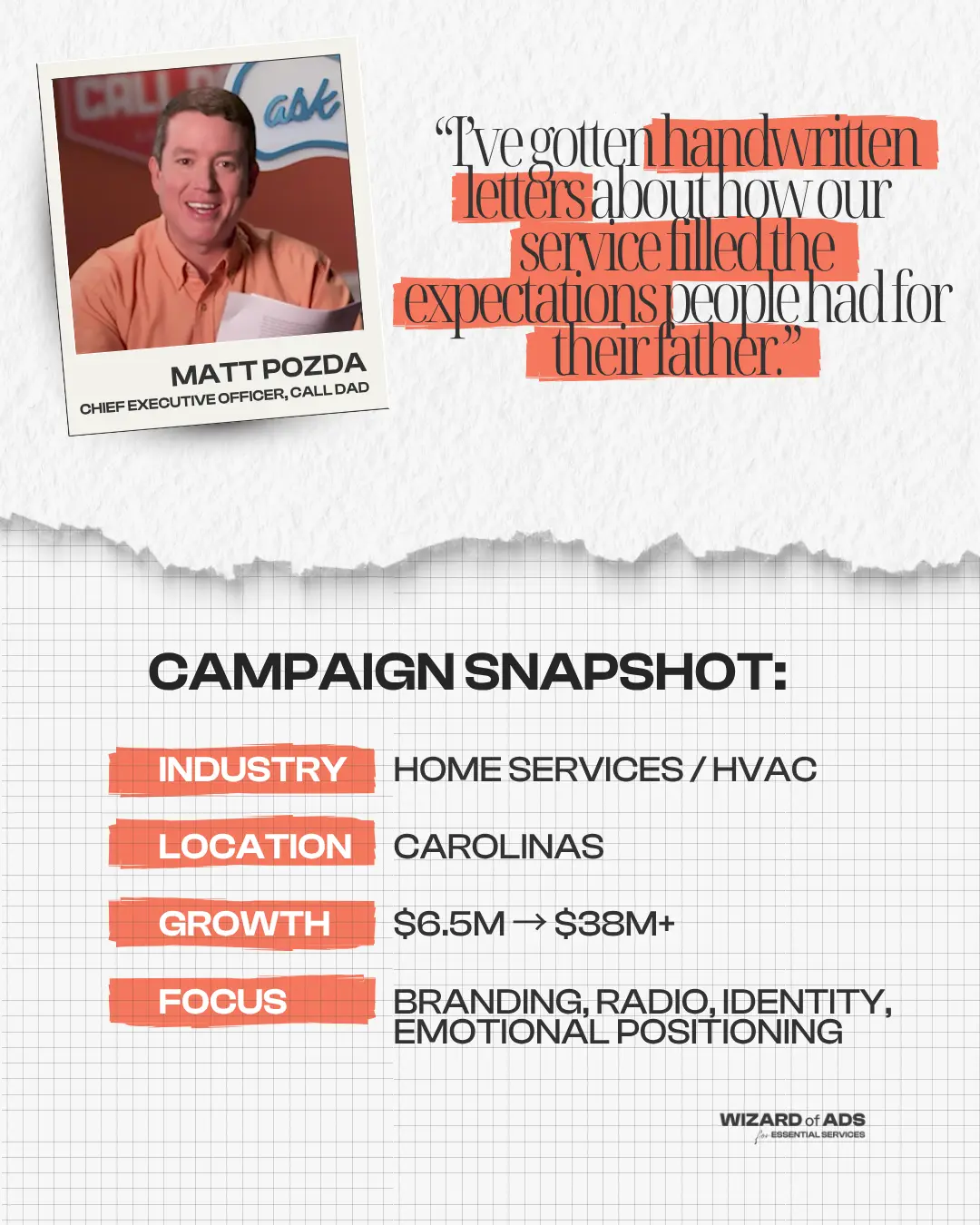
Are you ready to transform your business into a distinctive, emotionally resonant brand? Here's why hiring Ryan Chute, Wizard of Ads for Essential Services is the game-changer your business needs:
Distinctiveness Beyond Difference: Your brand must be distinctive, not just different, to stand out. We specialize in creating an emotional bond with your prospects to make your brand unforgettable.
Building Real Estate in the Mind: Branding with us helps your customers remember your brand when they need your service again, creating a lasting impression.
Value Proposition Integration: We ensure that your brand communicates a compelling value proposition that resonates with your audience, creating a powerful brand-forward strategy.
Wizard of Ads for Essential Services start by understanding your marketing challenges.
We specialize in crafting authentic and disruptive brand stories and help build trust and familiarity with your audience. By partnering with Ryan Chute, Wizard of Ads for Essential Services, you can transform your brand into one people remember and prefer. We understand the power of authentic storytelling and the importance of trust.
Let us elevate your marketing strategy with our authentic storytelling and brand-building experts. We can take your brand to the next level.
Maximize Your Marketing Impact with Strategic Alignment.
Our strategy drives everything we do, dictating the creative direction and channels we use to elevate your brand. Leveraging our national buying power, we ensure you get the best media rates for maximum market leverage. Once your plan is in motion, we refine our strategy to align all channels—from customer service representatives to digital marketing, lead generation, and sales.
Our goal is consistency: we ensure everyone in your organization is on the same page, delivering a unified message that resonates with your audience. Experience the power of strategic alignment and watch your brand thrive.
Transform Your Brand with Our Proven Process.
Once we sign the agreement, we visit on-site to uncover your authentic story, strengths, and limitations. Our goal is to highlight what sets you 600 feet above the competition. We'll help you determine your budgets and plan your mass media strategy, negotiating the best rates on your behalf.
Meanwhile, our creative team crafts a durable, long-lasting campaign designed to move your brand beyond mere name recognition and into the realm of household names. With an approved plan, we dive into implementation, producing high-quality content and aligning your channels to ensure your media is delivered effectively. Watch your brand soar with our comprehensive, strategic approach.
The Power of Strategic Marketing Investments
Are you hungry for growth? We explain why a robust marketing budget is essential for exponential success. Many clients start with an 8-12% marketing budget, eventually reducing it to 3-5% as we optimize their marketing investments.
While it takes time to build momentum, you'll be celebrating significant milestones within two years. By the three to five-year mark, you'll see dramatic returns on investment, with substantial gains in net profit and revenue. Discover how strategic branding leads to compound growth and lasting value. Join us on this journey to transform your business.